#BookReview A Long Petal of the Sea by Isabelle Allende

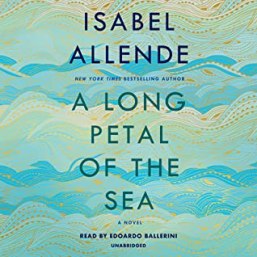
A Long Petal of the SeaAbout the Book

Victor Dalmau is a young doctor when he is caught up in the Spanish Civil War, a tragedy that leaves his life – and the fate of his country – forever changed. Together with his sister-in-law, he is forced out of his beloved Barcelona and into exile in Chile. There, they find themselves enmeshed in a rich web of characters who come together in love and tragedy over the course of four generations, destined to witness the battle between freedom and repression as it plays out across the world.

Format: Audiobook (9h 46m)             Publisher: Bloomsbury
Publication date: 21st January 2020  Genre: Historical Fiction, Literary Fiction

Find A Long Petal of the Sea on Goodreads

Purchase links
Bookshop.org
Disclosure: If you buy a book via the above link, I may earn a commission from Bookshop.org, whose fees support independent bookshops

Hive | Amazon UK
Links provided for convenience only, not as part of an affiliate programme


My Review

I’m almost ashamed to admit that this is the first book I’ve read by Isabel Allende mainly because she’s known for her works of magic realism which is a genre I’ve been unable to get along with. However, when I saw the description of this book, especially that it was partly set during the Spanish Civil War and its aftermath, I thought this might be my opportunity to experience her writing. I listened to the audiobook version, skilfully narrated by Edoardo Ballerini.

The book, translated by Amanda Hopkinson and Nick Caistor, vividly recreates the chaos and confusion of the Spanish Civil War and its terrible toll on Spanish citizens, tearing apart families and communities, plunging others into homelessness, poverty and hunger, and forcing many into exile. Mixing historical events with both real and fictional characters, each chapter of the book opens with an excerpt from the works of renowned Chilean poet Pablo Neruda.

The book tells the story of Victor Dalmau, a young doctor who is caught up on the Republican side in the Spanish Civil War and is forced to flee to France with Roser, the wife of his brother who was killed fighting against the forces of Franco. Although I had heard of Pablo Neruda, I had no idea of his role in helping refugees from the conflict to emigrate to Chile, the country whose description as the ‘long petal of the sea’ inspires the book’s title.

There are vivid scenes aboard the SS Winnipeg, as Victor and Roser make the dangerous and uncomfortable voyage across the Atlantic, through the Panama canal, into the Pacific and their eventual arrival in Chile. There Victor pursues his ambition to become a doctor, alongside running a tavern (named Winnipeg in honour of the ship that carried them to safety), and Roser builds a career as a musician. Having entered into a ‘marriage of convenience’ in order to secure their entry into Chile, Victor and Roser pursue separate relationships whilst at the same time finding there remains a strong connection between them. Their past life in Spain is not completely left behind either despite the thousands of miles that divide them from their homeland and from people they believed lost forever.

Alongside the fIctional story of Victor and Roser’s new life in Chile, the book describes the political changes in that country from the end of the Second World War onwards, including the rise to power of Salvador Allende (a distant relative of the author), his subsequent overthrow and assassination, and the coming of the brutal Pinochet regime. I’ll admit that, at times, my attention wandered during this part of the book as it felt more like a history lesson – albeit one influenced by the author’s own heritage – than a story inspired by the characters she had created. However, the book was redeemed for me by the final section which charts, in the most powerful and emotional way possible, the final years of the lives of Victor and Roser.

Spanning decades and a number of generations, A Long Petal of the Sea is an epic family saga that vividly demonstrates the emotional turmoil and suffering caused by war but also serves as an insight into turbulent periods in the history of both Spain and Chile.

In three words: Powerful, eventful, epic

Try something similar: Those I Have Lost by Sharon Maas

Follow this blog via Bloglovin


Isabel AllendeAbout the Author

Born in Peru and raised in Chile, Isabel Allende is the author of The House of the Spirits, Daughter of Fortune, PaulaMy Invented Country and The Japanese Lover. Her books have been translated into more than 35 languages and have sold over 65 million copies worldwide. The Japanese Lover was an international and New York Times bestseller. She lives in California. (Photo credit: Publisher author page)

Connect with Isabel
Website

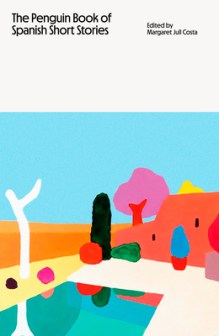
#BookReview The Penguin Book of Spanish Short Stories edited by Margaret Jull Costa @PenguinUKBooks

The Penguin Book of Spanish Short StoriesAbout the Book

This exciting new collection celebrates the Spanish short story, from its modern origins in the nineteenth century to the remarkable work being written today. Featuring over fifty stories selected by revered translator Margaret Jull Costa, it blends hidden gems and old favourites, surprising new voices and giants of Spain’s literary culture, from Emilia Pardo Bazán and Leopoldo Alas, through Mercè Rodoreda and Manuel Rivas, to Javier Marías. Brimming with romance, horror, history and farce, and showcasing alluring hairdressers, war defectors, vampiric mothers, and talismanic mandrake roots, the daring and entertaining assortment of tales in The Penguin Book of Spanish Short Stories will be a treasure trove for readers.

Format: Hardcover (416 pages)    Publisher: Penguin Classics
Publication date: 24th June 2021 Genre: Short Stories, Literature in Translation

Find The Penguin Book of Spanish Short Stories on Goodreads

Purchase links
Bookshop.org
Disclosure: If you buy a book via the above link, I may earn a commission from Bookshop.org, whose fees support independent bookshops

Hive | Amazon UK
Links provided for convenience only, not as part of an affiliate programme


My Review

I cannot recall having read much literature by Spanish writers and, to be completely honest,  all the authors whose stories are included in this collection were previously unknown to me. I also learned it’s too simplistic to say the stories are translated from Spanish because, as the book’s editor Margaret Jull Costa explains in her introduction, they were originally written in one of Spain’s four languages – Basque (euskara), Castilian Spanish (castellano), Catalan (català) and Galician (gallego). Each story is accompanied by a brief biographical note about the author.

The stories are arranged in chronological order of the author’s birth, the earliest being 1843. I was struck by how much of an impact the Spanish Civil War had, either on the lives of the authors themselves – many of whom were forced into exile – or on the subject matter of the stories, especially in the case of the authors featured in the first half of the book.

In her introduction, Costa offers the advice not to read one story after the other but to treat the collection like a box of Belgian chocolates, savouring and pondering the stories ‘one or, at most, two at a time’. I did my best to follow this advice even if it meant showing considerably more restraint than I would if presented with an actual box of Belgian chocolates!

Margaret Jull Costa argues that a short story is not a truncated novel but is more akin to poetry and that ‘the best short stories create a world in just a few pages’. Indeed, many of the stories in the book are very short, just a few pages in length. As is often the case with short story collections, I enjoyed some more than others. Quite a few in the collection had a fantasy or supernatural element which is not really to my reading taste, although I can see them appealing to other readers. I’ve picked out some below that I particularly enjoyed.

The Novel on the Tram by Benito Pérez Galdós – one for anyone who’s ever eavesdropped on others’ conversations while travelling by train or bus, or wondered about the lives of their fellow passengers

The Talisman by Emilia Pardo Bazán – reminiscent of M. R. James’ story ‘Casting The Runes’

Duet for Two Coughs by Leopoldo Alas/Clarín– the imaginings of two strangers sharing the same malady

The Reverse Side of the Tapestry by Azorín– in which a poet weaves a story whilst at the same Fate is weaving his

The Boy by Ramón J. Sender– the brutality and senseless nature of war captured in just a few pages

Come Twelve o’ Clock by Ignacio Aldecoa – a mother’s warning to her son turned on its head

Summer Orchestra by Esther Tusquets – a poignant story of a young girl’s growing awareness of the complexities of the adult world

The Fullness of Summer by Quim Monzó – I read this after returning from a family lunch out but we couldn’t compete on the kissing and photographs front, although the author’s characters did have the advantage of being pre-pandemic

The Butterfly’s Tongue by Manuel Rivas – the story of an inspirational teacher that has a sting in its tail

And Shortly After That, There Was Now by Eider Rodríguez – the tale of a journey into the past that has an elegiac quality

My thanks to Matt Hutchinson at Penguin Books for my advance reading copy.

In three words: Imaginative, varied, insightful

Follow this blog via Bloglovin


About the Editor

Margaret Jull Costa has translated the works of many Spanish and Portuguese writers, among them novelists: Javier Marías, José Saramago and Eça de Queiroz, and poets: Sophia de Mello Breyner Andresen, Mário de Sá-Carneiro and Ana Luísa Amaral. Her work has brought her numerous prizes, most recently, the 2018 Premio Valle-Inclán for On the Edge by Rafael Chirbes. In 2014, she was awarded an OBE for services to literature.