About the Book
A man revisits the university campus where he lost his first love, aware now of what he couldn’t understand then. A daughter returns home to Lagos after the death of her father, where she must face her past – and future -relationship with his longtime partner. A young musician rises to fame at the risk of losing himself and the man who loves him.
Generations collide, families break and are remade, languages and cultures intertwine, and lovers find their ways to futures; from childhood through adulthood; on university campuses, city centres, and neighbourhoods where church bells mingle with the morning call to prayer.
Format: Hardback (224 pages) Publisher: Weidenfeld & Nicolson
Publication date: 28th July 2022 Genre: Contemporary Fiction, Short Stories
Find God’s Children are Little Broken Things on Goodreads
Purchase links
Bookshop.org
Disclosure: If you buy a book via the above link, I may earn a commission from Bookshop.org, whose fees support independent bookshops
Hive | Amazon UK
Links provided for convenience only, not as part of an affiliate programme
My Review
I was fortunate enough to be offered a copy of this short story collection by Emily at Midas PR when it appeared on the longlist for the Swansea University Dylan Thomas Prize 2023. Unfortunately, I couldn’t fit it into my reading schedule at that point but I’m rectifying that now that it has made the shortlist.
The author’s debut collection, it’s described by the publishers as ‘nine exhilarating stories of queer love in contemporary Nigeria’ and has been praised by Sarah Waters as ‘A hugely impressive collection, full of subtlety, wisdom and heart’.
As a straight white British woman I wondered if I would be able to feel a connection with the experiences of characters so different from me. However, at their heart, these are stories about relationships that involve passion, longing, betrayal, tenderness, disappointment and loss, experiences and emotions to which all of us can probably relate to some degree. However, in an environment in which homosexuality not only brings abuse and discrimination but is also illegal, as it is in Nigeria, there is an added element: the need for secrecy and hiding your true self. ‘He was not new to pretense. Wasn’t his entire life a play, and hadn’t he put on, so far, a stellar performance? He had picked this life and sworn to be very good at it because there was no reward in loving boys… It made you the most hated person in the world.’
In some cases, this hatred takes the form of physical violence, even perpetrated within familes. And, for many of the characters, the need to hide their sexuality leaves them open to abuse and violence that they cannot report. Intimacy may be confined to snatched moments in anonymous hotel rooms, in clandestine clubs, teenage bedrooms or even abandoned buildings. Disclosure can damage careers, destroy reputations and wreck lives.
A story I found particularly moving was ‘Where The Heart Sleeps’ in which the relationship between Nonye and Tochukwu, the partner of Dubem, Nonye’s recently deceased father, changes gradually from hostility to a degree of understanding, united by their shared loss. ‘They were silent, but it was not the silence of before. It was not exactly comfortable, but it was nice.’ It caused me to think about aspects of discrimination that wouldn’t otherwise have occurred to me, such as Tochukwu having no official status, even to have Dubem’s body released to him or to have the right to continue living in the house they shared. ‘It hit him like a sudden shard of light at a precarious bend on a dark road, the extent of his powerlessness.’ And the notion that Tochukwu, as a gay man, must by nature be predatory is reflected in Nonye’s mother’s remark that he ‘will be an old story soon, a memory, something that happened’ and that he will ‘move on to the next man’.
There is some beautiful writing, such as in the first story, ‘A Dreamer’s Litany’ in which a young man gazes at a cityscape from a hotel room. ‘The city was like a drunken man, it wobbled, garrulous and loud, and then a moment came when it tempered into a fitful somberness, slipping finally into a long, exhausted sleep.’
The stories in God’s Children Are Little Broken Things are often dark, and occasionally distressing, but there are flashes of light in that darkness, such as in the final story, ‘Mother’s Love’. For those sensitive to such things, some of the stories contain scenes of a sexually explicit nature. And there are occasional fragments of dialogue in the native languages of Nigeria which, whilst giving authenticity, did require me to search out translations.
You can find details about the other books on the shortlist here. The winner will be announced on Thursday 11th May 2023.
In three words: Intense, thought-provoking, intimate
About the Author
Arinze Ifeakandu was born in Kano, Nigeria. An AKO Caine Prize for African Writing finalist and A Public Space Writing Fellow, he is a graduate of the Iowa Writers’ Workshop and is pursuing his PhD at Florida State University. His work has appeared in A Public Space, One Story, and Guernica. God’s Children Are Little Broken Things is his first book.
Connect with Arinze
Website | Instagram

Photo credit: Bec Stupak Diop for Black Rock Senegal

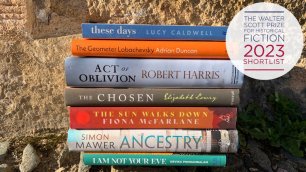
 The announcement of the winner of the Walter Scott Prize for Historical Fiction 2023 on 15th June 2023 at the Borders Book Festival – These Days by Lucy Caldwell – was the final stage in a process that began in August last year when submissions opened.