

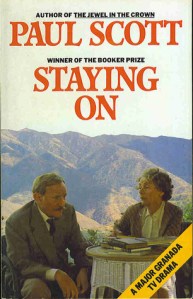
 About the Book
In this sequel to The Raj Quartet, Colonel Tusker and Lucy Smalley cling to their bungalow in the hills of Pankot after Indian independence deprives them of their colonial status. Lucy, fed up with accommodating her husband, tries to assert her own independence.
In scenes both poignant and hilarious, she and Tusker act out class tensions among the British of the Raj and eloquently give voice to the loneliness, rage, and stubborn affection in their marriage.
Format: Paperback (pp.) Publisher: Granada
Published: 1978 [1977] Genre: Literary Fiction
Purchase Links*
Amazon.co.uk ǀ Amazon.com ǀ Hive.co.uk (supporting UK bookshops)
*links provided for convenience, not as part of any affiliate programme
Find Staying On on Goodreads
My Review
Staying On is my book for the #1977Club organised by those great book bloggers, Stuck in a Book and Kaggsy’s Bookish Ramblings. This was a re-read for me of a book I read quite a few years ago now because it is a sequel to Paul Scott’s The Raj Quartet series of novels that I really loved when I read them. The Raj Quartet was televised as The Jewel in the Crown in 1984, introducing a number of actors who subsequently went on to great things, such as Tim Piggott-Smith, Geraldine James and Art Malik. Staying On was also adapted for television in 1980, starring the wonderful Trevor Howard and Celia Johnson.
Goodreads tells me I gave Staying On three stars when I read it for the first time and I have to say my feeling towards it this time is pretty similar. This is despite the fact that it was awarded the Booker Prize (as it was known at the time) in 1978 by a panel of judges chaired by Philip Larkin, no less.
The most successful character for me was Lucy Smalley who felt the most fully-rounded creation and engaged my sympathy more than the other characters. It helps, no doubt, that the reader is party to more of Lucy’s thoughts and feelings than of the other characters. In contrast, Tusker remains rather a remote, tragic figure.
Tusker’s declining health and concerns about her financial position should the worst happen prompt Lucy to reminisce about her girlhood, her first meetings with Tusker, their courtship, eventual marriage and move to India. She recalls movingly her struggles to adjust to the strict social hierarchy of the British in India, and the petty rules and humiliations meted out to her by other wives.
Lucy is an engaging character because it’s clear she thinks of others whereas Tusker seems only to think of himself. As Lucy observes, ‘He hears. He listens. But doesn’t let on. And he rejects and obfuscates. He rejects anything he hears which it doesn’t suit him to hear.’ I found it sad that Lucy and Tusker seemed to have stopped being able to communicate, to understand each other and appreciate their respective needs. It’s not until very late in the book that we get an insight into Tusker’s feelings for Lucy, feelings he is sadly unable to express directly to her. Her reaction to what she learns is very moving.
I felt that many of the secondary characters – like the awful Mrs. Bhoolabhoy – bordered on caricature. However, most problematic for me was the handling of racial difference. For instance, in the following quotation – and I apologise in advance if any of the terms cause offence – Lucy recalls that, ‘one of the earliest lessons she had learned in India was of the need to steer clear, socially, of people of mixed blood and she had quickly been taught how to detect the taint, the touch of the tar-brush in those white enough to be emboldened to pass themselves off as pukka-born.’ I appreciate that what is being depicted were different times (although the book is only set in 1972) but that word ‘taint’ brought me up short when I read it.
I also felt uncomfortable about what seemed like stereotyping of the different races, especially as I didn’t get a clear sense that I was being encouraged by the author to challenge such generalisations. Lucy recalls, ‘She’d been told that the Eurasians (Anglo-Indians as they were then called) were very loyal to the British; that without them there would have been no reliable middle-class of clerks and subordinate officials. [….] they formed an effective and in-depth defence against the strange native tendency to bribery and corruption which, coupled with that other native tendency to indolence, could have made the Indian empire even more difficult to run than it already was.’
What Staying On does well is evoke the end of an era. Tusker and Lucy represent the last remnants of a different kind of society, social order and way of life. As Lucy confides in a letter to a friend, they are now literally the last of the British permanent residents ‘on station’ in Pankot. Their situation has become precarious both financially and practically as plans for development of Smith’s Hotel threaten The Lodge which is their home. As Tusker observes, “I still think we were right to stay on, though I don’t think of it any longer as staying on, but just as hanging on”.
In three words: Moving, tender, elegiac
Try something similar…The Jewel in the Crown by Paul Scott
 About the Author
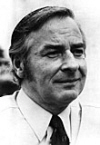
Paul Scott was born in London in 1920. He served in the army from 1940 to 1946, mainly in India and Malaya. He is the author of thirteen distinguished novels including his famous The Raj Quartet. In 1977, Staying On won the Booker Prize. Paul Scott died in 1978.


 Manhattan Beach by Jennifer Egan
 Sugar Money by Jane Harris
 Grace by Paul Lynch
 The Wardrobe Mistress by Patrick McGrath
  Miss Boston and Miss Hargreaves by Rachel Malik
 The Gallows Pole by Benjamin Myers
 What Cathy Read Next...