
Blog Tour: 13 Reasons Why I Loved Home Is Nearby by Magdalena McGuire

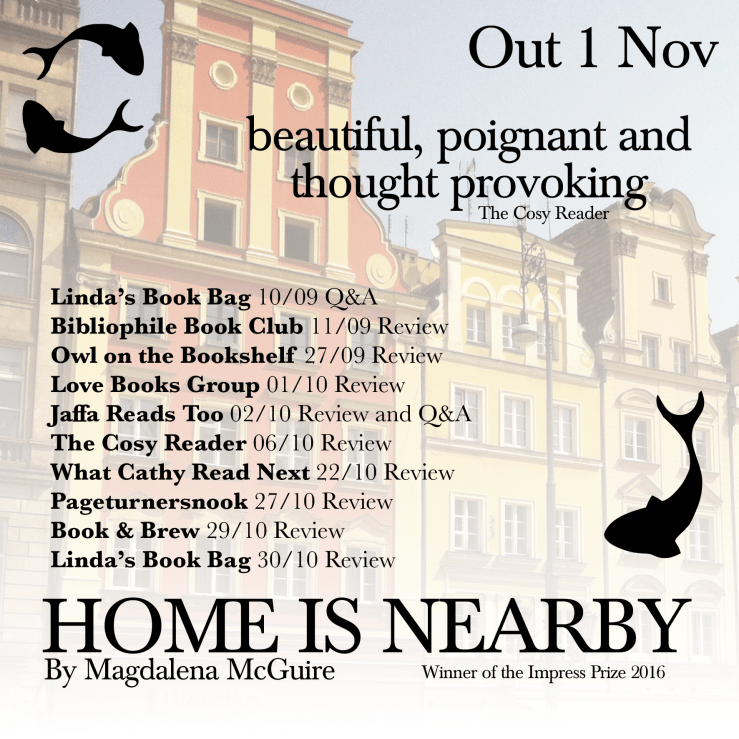
Home Is Nearby blog tour banner

I’m thrilled to host today’s stop on the blog tour for Home Is Nearby, the debut novel by Magdalena McGuire, which is published on 1st November 2017.   Rather than write a standard review, I thought I’d channel just a little bit of the creativity at the heart of Home Is Nearby and give you thirteen reasons to read this thought-provoking and fascinating book.

My thanks to Natalie at Impress Books for the advance proof copy and the invitation to join the blog tour.
Follow my blog with Bloglovin


HomeisNearby1About the Book

1980: The beginning of the polish crisis. Brought up in a small village, country-girl Ania arrives in the university city of Wroclaw to pursue her career as a sculptor. Here she falls in love with Dominik, an enigmatic write at the centre of a group of bohemians and avant-garde artists who throw wild parties. When martial law is declared, their lives change overnight: military tanks appear on the street, curfews are introduced and the artists are driven underground. Together, Ania and Dominik fight back, pushing against the boundaries imposed by the authoritarian communist government. But at what cost?

Format: Paperback , eBook (320 pp.)    Publisher: Impress Books
Published: 1st November 2017                Genre: Literary Fiction

Pre-order/Purchase Links*
Amazon.co.uk
*links provided for convenience, not as part of any affiliate programme

Find Home is Nearby on Goodreads


13 Reasons Why I Loved Home is Nearby

1) Our narrator, Ania: her relationship with her father, her courage, her determination to be true to herself, her commitment to her art and the gradual awakening of her creativity as she is exposed to the contemporary art scene

‘The tin can sculpture, the cubes, Malgorzata’s photos – these were far from traditional. And yet here they were displayed in a gallery. I was beginning to see that being an artist didn’t mean I had to copy the masters. What I did have to do was create something that belonged to me – something that no one else could make.’

2) Ania’s father: his tender, unselfish support of Ania’s desire to be an artist, his sacrifices and his unconditional love

3) Learning about the economic situation in Poland in the 1980s – food shortages (using teabags multiple times, drinking water before eating to feel fuller), waiting lists for a telephone line or an apartment (unless you could afford a bribe or to call in a favour)

4) Learning about the political background and the Polish state’s attempts to stifle the rise of the Solidarity movement: censorship, internment, surveillance, informers and control of the press. Was this really happening as recently as the 1980s?

5) The defiance of the Polish people both explicit (student protests, graffiti) and implicit (carrying on with traditional Christmas preparations)

Every time the militiamen painted over the graffiti, it appeared again the next day. With new slogans, bigger writing. It was an ongoing battle between us and them: slogan, silence, slogan.’

6) The way the author brings to life the process of creating art from initial inspiration, through manufacture to completion.

‘The professor was right. Metal was a masculine material, the stuff of guns and tanks. If I was going to work with it I had to find a way to use it slyly, with a wink in the other direction. Take the notion of hardness and turn it on its head.’

7) Examining the question that Ania wrestles with – is art enough? ‘What good was a picture when people were suffering?’ ‘What good was sculpture at a time like this? Unlike Dominik’s writing, it couldn’t change the world.’ Ania’s gradual realisation that art can be an act of defiance as well.

8) The evocative picture of rural Poland and the constrast between life there and in the city. As Dominik says: ‘I’d forgotten what the rural parts of Poland were like.’

9) The moral dilemmas facing Ania and others protesting against the system and the anguish and consequences that follow from their decisions

10) The insight into Polish customs, culture, food and drink (carp, cabbage parcels, cherry compote)

11) How contemporary events and culture in the rest of the world are woven in – the rise of punk rock, Ronald Reagan, Hollywood films.

12) That Ania’s final piece neatly alludes to the author’s own act of creativity.

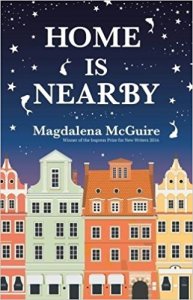
13) The gorgeous cover


MagdalenaMcGuireAbout the Author

Magdalena is an award-winning writer who was born in Poland, grew up in Darwin and now lives in Melbourne with her husband and son. Her short stories have been published by The Big Issue, Mslexia, Margaret River Press and The Bristol Prize. She won the 2017Mslexia Women’s Short Story Competition with ‘Salt Madonna’. She has published widely on human rights topics, including women’s rights and the rights of people with disabilities. She is an avid reader and particularly enjoys reading books about girls who like reading books. Home is Nearby is her debut novel.

Connect with Magdelena

Website ǀ   Twitter ǀ Goodreads


Book Review: New Boy by Tracy Chevalier

NewBoyAbout the Book

‘O felt her presence behind him like a fire at his back.’

Arriving at his fourth school in six years, diplomat’s son Osei Kokote knows he needs an ally if he is to survive his first day – so he’s lucky to hit it off with Dee, the most popular girl in school. But one student can’t stand to witness this budding relationship: Ian decides to destroy the friendship between the black boy and the golden girl. By the end of the day, the school and its key players – teachers and pupils alike – will never be the same again. The tragedy of Othello is transposed to a 1970s’ suburban Washington schoolyard, where kids fall in and out of love with each other before lunchtime, and practise a casual racism picked up from their parents and teachers. Watching over the shoulders of four 11-year-olds – Osei, Dee, Ian and his reluctant girlfriend Mimi – Tracy Chevalier’s powerful drama of friends torn apart by jealousy, bullying and betrayal will leave you reeling.

Format: eBook, paperback (183 pp.) Publisher: Random House UK/Vintage
Published: 11th May 2017                    Genre: Literary Fiction

Purchase Links*
Amazon.co.uk ǀ Amazon.com
*links provided for convenience, not as part of any affiliate programme

Find New Boy: Othello Retold on Goodreads


My Review

New Boy: Othello Retold is the fifth in a series of retellings of Shakespeare plays by bestselling novelists as part of the Hogarth Shakespeare project. Other writers who have contributed so far are Jeanette Winterson, Howard Jacobson, Anne Tyler and Margaret Atwood. You can find out more about the project here.

I always approach a retelling of a classic in something of a quandary.   To be successful, I feel a reinterpretation needs to shed new light on the original work.   A good example that always comes to mind is Jean Rhys’s Wide Sargasso Sea which presented a very different picture of the character of Bertha Mason from Charlotte Bronte’s Jane Eyre.  On the other hand, a retelling needs to be recognisably linked to its source material. But if you’re not familiar with the source material, do you get the same value from the retelling? Conversely, if you are familiar with the source material, do you lose focus on the new interpretation because you’re constantly looking for the connections with the original? Although well-written, in the end I was left ambivalent about New Boy.

The action takes place over a single school day giving a sense of a timescale similar to watching the play. The book is divided into five parts – Before School, Morning Recess, Lunch, Afternoon Recess and After School – mirroring the five act structure of Shakespeare’s play. There are also references to acting and performance scattered throughout the book.

Then Dee gave the boy the precious class jump ropes, and they began to laugh, throwing their heads back as if there were no audience but the two of them, performing for each other.’

‘And himself, the new boy, standing still in the midst of these well-worn grooves, playing his part too.’

‘They were like characters in a play who needed an extra scene, a thread to pull them tight.’

In spite of the variation in names, it’s a simple matter to match the children and staff in the book with their equivalent characters in the play. I did find the ‘casting’ of Brabantio (Desdemona’s father in the play) as Mr Brabant, the teacher, slightly puzzling. But perhaps the author had in mind the role of teacher as ‘in loco parentis’.

The setting of the school playground with its petty rivalries and short-lived alliances was interesting. In the main, the characters were believable as eleven year-old children. The exception to this was Ian (who doubles for Iago). He seemed unrealistically wise beyond his years and his ability to manipulate, read others’ intentions and strategize just didn’t ring true for someone of his age.

What the book does very well is convey Osei’s feelings of being an outsider, of being different, of being regarded as something of a novelty and the casual, ‘everyday’ racism he experiences.

‘The kids who were friendly at school but didn’t ask him to their birthday parties even when they had invited the rest of the class….The assumption that he was better at sports because black people just – you know – are, or at dancing, or at committing crimes. The way people talked about Africa as if it were just one country.’

Unfortunately, I feel the children’s – and to some extent, the staff’s – sketchy knowledge of Osei’s cultural background and the fact he’s forced to simplify his name would be recognisable today. I’ve experienced situations in the workplace where people from India or Nigeria have found it easier to ‘anglicise’ their name or adopt a nickname rather than try to get colleagues to pronounce their given name correctly.

Although the book held my interest, in a way I felt it would have worked equally well as a story about difference and racial prejudice without the constraints of following the story of Othello.

I received a review copy courtesy of NetGalley and publishers, Random House UK, in return for an honest review.

Follow my blog with Bloglovin

In three words: Thought-provoking, imaginative, intertextual

Try something similar…Hag-Seed by Margaret Atwood


TracyChevalierAbout the Author

TRACY CHEVALIER is the New York Times bestselling author of eight previous novels, including Girl with a Pearl Earring, which has been translated into 39 languages and made into an Oscar-nominated film. Born and raised in Washington, D.C., she lives in London with her husband and son.

Connect with Tracy

Website ǀ Facebook ǀ Twitter ǀ Instagram ǀ Goodreads