
When an author contacts you about reviewing their book and the description sounds enticing it’s frustrating to know that it’s going to be several months before you’ll be able to get around to reading and reviewing their book. Such is the case when Sandy Day contacted me about her book, Fred’s Funeral. However, although it’s going to be a while until I get to read it, that doesn’t mean I should hide it away from followers of my blog who may not have such a large review pile as I do…
You can find an extract from the book below. Also, click here to read an interview with Sandy in which she talks about the inspiration for Fred’s Funeral and her approach to writing.
 About the Book
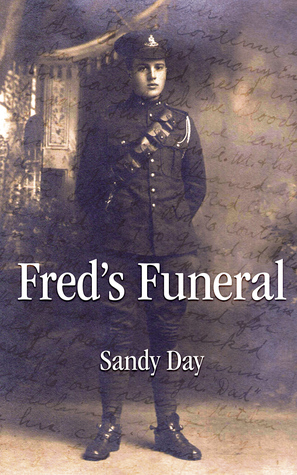
Fred’s Funeral is a short novel set in 1986. Fred Sadler, a WWI veteran, has just died of old age and his dismayed ghost now discovers that the arrangement of his funeral has fallen to his prudish sister-in-law, Viola. As Viola dominates the remembrance of Fred, he agonizes over his inability to set the record straight. Was Fred Sadler really suffering from shell shock? Why was he locked up most of his life in the Whitby Hospital for the Insane? Could his family not have done more for him? Fred’s memories of his life as a child, his family’s hotel, the War, and the mental hospital, clash with Viola’s version of events as Fred’s family gathers one rainy October night to pay their respects. Readers of literary historical fiction will enjoy Fred’s Funeral.
Format: eBook, paperback (129 pp.) Publisher:
Published: 28th November 2017 Genre: Literary Fiction
Purchase Links*
Amazon.co.uk ǀ Amazon.com ǀ Kobo ǀ iBook
*links provided for convenience, not as part of any affiliate programme
Find Fred’s Funeral on Goodreads
Extract from Fred’s Funeral by Sandy Day
1928, Ontario.
At his father’s repeated insistence, Fred finds work away from Lakeview House with a highway construction crew. It’s hot. Hotter than Arabia and dustier than a coal shed. He’d much rather be puzzling over a 36-degree gradient with a slide rule and graph paper, but jobs like that are for men with experience, and that, he has to admit he is a little short on. He detests physical labour – it gives his brain too much time to think. And it baffles him that the men around him don’t seem to mind the tedious digging and heaving and plodding in the heat he finds so torturous. They just toil away, humming, and talking, smoking their cigarettes.
Fred’s mind whirs like a radiometer as he works. He recalls the ass he made of himself when he last saw his cousins Pauline and Gertrude. He can never seem to catch Pauline alone. He is tongue-tied around her, and irritated by that nosy old Gertrude, whom he suspects laughs and makes fun of him behind his back. What is the point of it anyway? Pauline is his cousin for Chrissake. Why can’t he just leave her alone? Find another girl he likes?
And he replays the argument he had with Thomas on the weekend about the Chinese family their father hired to work in the hotel laundry. That one old Chinese lady scolded him for parking on the lawn where he always parks the car! And he told her to go fuck herself. Oh, that had been a mistake. Why did Thomas never lose his temper? Why was it always Fred getting into trouble?
His mind frets over the money he owes his father and how it keeps racking up and he never seems able to pay it back. He kicks himself for spending all his pay from the service – it had seemed like such a large sum at the time – he didn’t realize how quickly he’d fritter it away.
There must be something wrong with his nerves. This can’t be normal. He’s afraid he’s done permanent damage and reminds himself again to go pick up a bottle of vitamins at the drug store. That must be why his hands are so tremulous. He wonders if anyone notices. It can’t be something he’s doing to himself, can it? He needs an outlet for his pent up energy, but he could scarcely talk to a woman, which brings him back to Pauline, and the whole circus starts up again.
By the time the foreman blows the whistle, Fred has sweated off more pounds, which is no good whatever because his stomach is in such a knot these days he barely eats anymore. His belt is well past the last notch and hangs down the leg of his work pants. He should just cut it off. But what if he gains the weight back? He doesn’t want to go ruining a perfectly good belt.
Fred’s back is to him so he doesn’t know how or why the damn fool plunges his hand into a pail of boiling tar but Fred hears the man howl and the whole world goes black. The rat-a-tat-tat of guns shatters the air and missiles whistle past Fred’s head. He ducks and instinctively curls into a ball, pulling for his tin hat. The foreman shakes Fred by the shoulder. “Sadler! Sadler! What the hell’s the matter with you?” A sergeant is shouting. Fred can still hear the poor sod wailing. Slowly, and with growing mortification, Fred realizes the bawling is coming from his own throat and that he’s crouching on a dry dusty roadbed somewhere in Southern Ontario.
Fred’s pants are wet. He’s pissed himself.
He watches helplessly as the tar-scalded man is whisked away to the hospital. “You better go home, Sadler.” The foreman shakes his head.
Fred’s parents will be angry. He’s gone and messed up another perfectly good job, disgraced himself. What is wrong with his damn head?
 About the Author
Sandy Day is the author of the soon to be released, Chatterbox, Poems. She graduated from Glendon College, York University, with a degree in English Literature sometime in the last century. Sandy spends her summers in Jackson’s Point, Ontario on the shore of Lake Simcoe. She winters nearby in Sutton by the Black River. Sandy is a trained facilitator for the Toronto Writers Collective’s creative writing workshops. She is a developmental editor and book coach.
Connect with Sandy
Website ǀ Facebook ǀ Twitter ǀ Goodreads

 bout the Book
 About the Author

 What Cathy Read Next...