

I’m delighted to be hosting today’s stop on the blog tour for From a Low and Quiet Sea by Donal Ryan and to bring you my review of this powerful novel. From a Low and Quiet Sea is described as Donal Ryan’s most expansive book to date, set partially in Syria and partially in the familiar territory of rural Ireland.
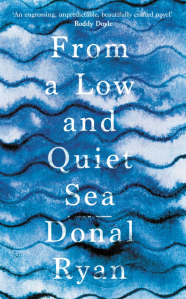 About the Book
‘Can you imagine how that would be? If a tree is starving, its neighbours will send it food. No one really knows how this can be, but it is. Nutrients will travel in the tunnel made of fungus from the roots of a healthy tree to its starving neighbour, even one of a different species. Trees live, like you and me, long lives, and they know things. They know the rule, the only one that’s real and must be kept. What’s the rule? You know. I’ve told you lots of times before. Be kind.’
Farouk’s country has been torn apart by war.
Lampy’s heart has been laid waste by Chloe.
John’s past torments him as he nears his end.
The refugee. The dreamer. The penitent. From war-torn Syria to small-town Ireland, three men, scarred by all they have loved and lost, are searching for some version of home. Each is drawn towards a powerful reckoning, one that will bring them together in the most unexpected of ways.
Praise for From a Low and Quiet Sea
‘A magus of a writer’ Sebastian Barry
‘The product of a life-enhancing talent’ Guardian
‘Among the great contemporary chroniclers’ Independent
‘It’s furious, it’s moving, it’s darkly funny, it punches you right in the gut’ New York Times ‘Dazzling’ Mariella Frostrup, BBC Radio 4
Format: ebook, hardcover (192 pp.) Publisher: Transworld Digital/Doubleday Published: 22nd March 2018 Genre: Literary Fiction
Purchase Links*
Amazon.co.uk ǀ Amazon.com ǀ Hive.co.uk (supporting UK local bookshops)
*links provided for convenience, not as part of any affiliate programme
Find From a Low and Quiet Sea on Goodreads
My Review
Convergence and interconnectedness seem to have been a theme of several books I’ve read recently. For example, Entanglement by Katy Mahood (my ‘try something similar’ recommendation below) and Oliver Loving by Stefan Merrill Block (click here to read my review). Of course, knowing that disparate storylines will converge at some point in a book can mean the reader spends the whole time anticipating that convergence or looking out for subtle clues as to how it will come about. Can I just say, don’t bother with this book, because the author achieves the bringing together of the different strands in an unexpected and quite unsettling way. In addition, to think about it too much would, to my mind, mar the enjoyment of the journey and the wonderful writing.
The prose with its long, flowing sentences gives the reader the sense they are inside the heads of the characters, experiencing their thought processes, impressions and feelings as they occur. The author creates some imaginative metaphors, often incorporating the sea, water or tidal forces.
‘He knew the rhythms of the house and the two people below him, the syncopated beats of them, the tides that flowed and ebbed with no regularity but with a strange and comforting predictability’.
‘…he’d imagine the panic that rose inside him to be rising water against a lock gate, and he’d picture the wheel of the lock gate being turned, and he’d imagine the flow through the lock, the downward easing, the levelling.’
The foolishness that swept through him, more every day, it was like a rogue current below a flat, still surface, a deadly undertow that could drag you down to perdition.’
I also loved this description of how a rumour with no truth to it can spread if set in motion by skilled but unscrupulous hands.
‘My story, my something out of nothing, replicated itself like a monster virus, mutating to strengthen itself, rearranging the component parts and properties to better survive each retelling and gain in size and virulence; it leaped the border into Kerry; it travelled back the road into Limerick City; it forded the estuary to Clare.’
The sections told from the point of view of Lampy and John, with their use of vernacular and colloquialisms, perfectly capture the rhythm and lilt of an Irish accent. Can I mention at this point the wonderful character that is Lampy’s grandfather? His telling of tall stories and slightly embarrassing jokes (that are meant to seem spontaneous but have actually been well rehearsed), don’t help Lampy’s low self-esteem. However, they actually disguise his grandfather’s inability to express the affection he really feels for his grandson.
Although their life paths initially appear to have no prospect of overlapping, each of the three men – Farouk, Lampy and John – share the experience of loss and betrayal. However, their psychological and emotional reactions to what they have experienced will be very different. In two, their response will probably earn the reader’s sympathy and understanding. In the third, the response may be, like my own, rather different.
At the end of the book there is retribution but brought about unwittingly in a way that one suspects will cause further psychological scars. However, there is one small spark of hope for the future. I am so grateful to have been introduced to the assured, beautiful writing of Donal Ryan.
I received an advance reader copy courtesy of publishers, Transworld/Doubleday, and Anne Cater at Random Things Through My Letterbox, in return for an honest and unbiased review.
In three words: Compelling, powerful, lyrical
Try something similar…Entanglement by Katy Mahood (click here to read my review)
 About the Author
Donal Ryan is from Nenagh in County Tipperary. His first three novels, The Spinning Heart, The Thing About December and All We Shall Know, and his short story collection A Slanting of the Sun, have all been published to major acclaim. The Spinning Heart won the Guardian First Book Award, the EU Prize for Literature (Ireland), and Book of the Year at the Irish Book Awards; it was shortlisted for the International IMPAC Dublin Literary Award, longlisted for the Man Booker Prize and the Desmond Elliott Prize, and was recently voted ‘Irish Book of the Decade’. His fourth novel, From a Low and Quiet Sea, will be published in March 2018. A former civil servant, Donal lectures in Creative Writing at the University of Limerick. He lives with his wife Anne Marie and their two children just outside Limerick City.
Connect with Donal
Amazon Author Page ǀ Goodreads


 About the Book
 About the Author
 What Cathy Read Next...