Throwback Thursday: The Sixteen Trees of the Somme by Lars Mytting

ThrowbackThursday

Throwback Thursday is a weekly meme originally created by Renee at It’s Book Talk.  It’s designed as an opportunity to share old favourites as well as books that we’ve finally got around to reading that were published over a year ago.

Today I’m revisiting a fabulous book I reviewed when it was first published in August 2017, The Sixteen Trees of the Somme by Lars Mytting (translated by Paul Russell Garrett).  The book was published in paperback earlier this week, with a new cover design.  You can find purchase links below.   The Sixteen Trees of the Somme is also the Waterstones Fiction Book of the Month for October 2018.


The Sixteen Trees of the Somme PBAbout the Book

Edvard grows up on a remote mountain farmstead in Norway with his taciturn grandfather, Sverre. The death of his parents, when he was three years old, has always been shrouded in mystery – he has never been told how or where it took place and has only a distant memory of his mother.

But he knows that the fate of his grandfather’s brother, Einar, is somehow bound up with this mystery. One day a coffin is delivered for his grandfather long before his death – a meticulous, beautiful piece of craftsmanship. Perhaps Einar is not dead after all.

Edvard’s desperate quest to unlock the family’s tragic secrets takes him on a long journey – from Norway to the Shetlands, and to the battlefields of France – to the discovery of a very unusual inheritance. The Sixteen Trees of the Somme is about the love of wood and finding your own self, a beautifully intricate and moving tale that spans an entire century.

Format: Paperback  (416 pp.)                                     Publisher: MacLehose Press
Published
: 1st October 2018 [10th August 2017]  Genre: Historical Fiction

Purchase Links*
Amazon.co.uk  ǀ  Amazon.com  | WaterstonesHive.co.uk (supporting UK bookshops)
*links provided for convenience, not as part of any affiliate programme

Find The Sixteen Trees of the Somme  on Goodreads


My Review

The death of Edvard’s grandfather, Bestefar, and the facts that come to light as a result, change everything for Edvard. They see him embark on a journey that will take him away from the isolated Nowegian farm where he has grown up to the Shetlands and France as he searches for the truth about the cause of his parents’ death and the four days afterwards when he was missing. It also stirs up vague fragments of memories – a scent, the sound of a voice, the texture of a fabric, a discarded toy – that don’t make any sense but convince Edvard that he needs to find out more about his parents’ death.

‘Because there was something about Mamma and Pappa’s story that was stirring, quietly, like a viper in the grass.’

As is often the case when unearthing secrets from the past, Edvard is forced to confront unwelcome possibilities and make agonising choices. Edvard’s search reaches back in time to WW1 and WW2, bringing to light painful facts from the past – death, injury, separation and betrayal – but also revealing stories of courage, determination and devotion. It provokes questions such as whether it is better sometimes not to know the truth, to be careful what you wish for, that actions have consequences even if unintended, and the fulfilment you seek may be closer to home than you think.

I found the story absolutely enthralling and I loved the fantastic sense of place created in each location. From the author’s beautiful, heartfelt descriptions, I felt as if I could look out my own window and see the farm in Norway laid out before me.

‘Redcurrant bushes dense with berries, the flag-stoned path leading to the swimming hole at the river, the creek which cut through the potato fields and disappeared from sight behind the barn. The fruit trees, the pea pods that dangled like half moons when we got close to them, so plentiful that we could fill up on them without taking a step. The dark-blue fruit of the plum trees, the sagging raspberry bushes just waiting for us to quickly fill two small plates and fetch some caster sugar and cream.’

In particular, I loved the way the author captured the remote beauty of the Shetlands and the sense of a community where everyone knows what goes on, who’s arrived on the ferry, whose car has just passed them on the road. The author roots the various parts of the story each in their distinct time, in particular, using popular music as the background to Edvard’s journey. (I get the impression the author is a bit of a music fan, perhaps attracted at some point in his life to a girl by the way she browses in a record shop.)

At times, Edvard feels as if he has come to a dead-end in his search but still he continues searching for clues, motivated by curiosity but also by a sense of obligation to the dead – those known to him and those victims of two world wars unknown to him: ‘I wanted to be someone the dead could rely on.’

As the author of the left-field hit, Norwegian Wood: Chopping, Stacking and Drying Wood the Scandinavian Way (now also an activity book), it’s no surprise that wood is at the heart of the story. It is part of the plot in a number of ways – in fact, more and more ways as the story progresses – but it is also celebrated in the book for its form, history and beauty. Similarly, there is real regard for the craftsmanship that can fashion a piece of wood into an object of beauty, utility or religious symbolism.

The Sixteen Trees of the Somme has a compelling, enthralling story line with wonderfully atmospheric settings and well-developed characters. I was completely immersed in Edvard’s search for the truth about his parents’ death; like him, all the time fearing the dark secrets he might uncover but compelled to find out nonetheless. A fantastic book, highly recommended.

I received an advance reader copy courtesy of NetGalley and publishers Quercus Books/MacLehose Press.


LarsMyttingAbout the Author

Lars Mytting, a novelist and journalist, was born in Fåvang, Norway, in 1968. His novel The Sixteen Trees of the Somme was awarded the Norwegian National Booksellers’ Award and has been bought for film. Norwegian Wood: Chopping, Stacking and Drying Wood the Scandinavian Way has become an international bestseller and was the Bookseller Industry Awards Non-Fiction Book of the Year 2016.

(Photo credit: Goodreads Author Page)

Connect with Lars

Website | Goodreads

Book Review: Money Power Love by Joss Sheldon

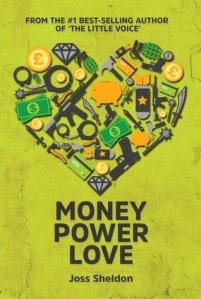
MoneyPowerLoveAbout the Book

Born on three adjacent beds, a mere three seconds apart, our three heroes are united by nature but divided by nurture. As a result of their different upbringings, they spend their lives chasing three very different things: Money, power and love.

This is a human story: A tale about people like ourselves, cajoled by the whimsy of circumstance, who find themselves performing the most beautiful acts as well as the most vulgar.

This is a historical story: A tale set in the early 1800s, which shines a light on how bankers, with the power to create money out of nothing, were able to shape the world we live in today.

And this is a love story: A tale about three men, who fall in love with the same woman, at the very same time…

Format: ebook, paperback (298 pp.)             Publisher:
Published: 7th October 2017                           Genre: Historical/Literary Fiction

Purchase Links*
Amazon.co.uk  ǀ  Amazon.com  ǀ Hive.co.uk (supporting UK bookshops)
*links provided for convenience, not as part of any affiliate programme

Find Money Power Love on Goodreads


My Review

Nominally set in the 1800s,  the author vividly depicts the sights and sounds of the London streets of the time, such as this description of traders taking advantage of the crowd gathered to witness a hanging.  ‘Surrounding this scrimmage, costermongers were selling just about anything which could be eaten, to just about anyone who could eat.  Their rickety barrows were overflowing with ice-cold oysters and burning hot eels; pies and puddings , crumpets and cough-drops, ginger-beer and gingerbread; pea soup, battered fish, sheep’s trotters, pickled whelks, baked potatoes, ice lollies, cocoa, and peppermint water.’ Characters such as Wilkins (surely the literary doppelganger of the Artful Dodger in Oliver Twist) could have come straight out of Dickens, as could many of the character names: Timothy Tyrrell, Bumble Blumstein. There’s even a sneaky reference to a famous opening line from Dickens: ‘They were the best of times.  They were the worst of times.’

Throughout the book, the author’s love of language – at one point a set of steps is described as ‘bodacious’ – and fondness for alliterative pairings is evident (as in the excerpt above).   At the same time, some of the language is deliberately anachronistic – fantabulous, mansplaining.   Readers will either find this amusing or irritating; I was in the former category most of the time.

All three main characters  – Hugo, Archibald and Mayer – have flaws and, despite being friends, their actions don’t always reflect this – especially when it comes to their rivalry for the affections of the same woman. None of the three are especially likeable but then they are really archetypes designed to illustrate the nature versus nurture debate and to demonstrate the consequences of being motivated by love (Hugo), power (Archibald) or money (Mayer).

Arguably, money plays the biggest part in the book as the author explores different forms of exchange that have been used over the centuries: barter, tally sticks, promissory notes.   At one point, Mayer muses: “Why, I’ve already heard of a new invention called ‘Cheques’.  Those could take off.  Maybe one day we’ll create token money, electronic money, or money spent on plastic cards.”   When his partner, Mr Bronze, protests that “money doesn’t grow on a magic money tree”, Mayer responds, “It does, Mr Bronze, and we bankers are its gardeners”.

Each chapter features an epigram from figures ranging from Mark Twain, to Confucius, to Banksy.  The story moves from Georgian London to Manchester, India, Van Diemen’s Land, China and Africa.   Along the way, through the stories of its three main protagonists, the book seeks to shed light on the worst excesses of colonialism and capitalism and to reveal the fragile foundations on which our financial systems are fabricated (note the alliteration please).

The motives of financial institutions and governments are ruthlessly exposed by the author. Here’s Mayer again: “We need charity; it compensates for the worst excesses of capitalism, without challenging the system itself.  It’s an investment which pays dividends; protecting capital from civil unreset.”  And again: “Wars are only ever fought to open up new markets, control resources and amass wealth.  All wars are bankers’ wars.”

Money Power Love is a surreal, satirical romp written with real verve and wit.  By turns funny, challenging, inventive, didactic and thought-provoking, it’s quite unlike any other book I’ve read, which did pose some problems when it came to my ‘Try something similar’ recommendation below*.

Now I’ve finished Money Power Love, I don’t know whether to go and eat some trifle, invest in bitcoins, invade a small country, go mudlarking or buy a backscratcher.  If that sentence intrigues you, why not pick up a copy of the book using one of the purchase links above.

I received a review copy courtesy of the author in return for an honest and unbiased review.

*For some reason I can’t quite put my finger on, while I was reading the book I kept thinking of the film Kind Hearts and Coronets (1949) starring Dennis Price and Alec Guinness.

Follow my blog with Bloglovin

In three words: Imaginative, witty, satirical

Try something (possibly not at all) similar…The History of Tom Jones, a Foundling by Henry Fielding or Orlando by Virginia Woolf


Joss SheldonAbout the Author

Joss Sheldon is a scruffy nomad, unchained free-thinker, and post-modernist radical. Born in 1982, he was brought up in one of the anonymous suburbs which wrap themselves around London’s beating heart. Then he escaped!  With a degree from the London School of Economics to his name, Sheldon had spells selling falafel at music festivals, being a ski-bum, and failing to turn the English Midlands into a haven of rugby league.

Then, in 2013, he ran off to McLeod Ganj; an Indian village which plays home to thousands of angry monkeys, hundreds of Tibetan refugees, and the Dalai Lama himself. It was there that Sheldon wrote his debut novel, Involution & Evolution.  With several positive reviews to his name, Sheldon had caught the writing bug. He travelled to Palestine and Kurdistan, where he researched his second novel, Occupied, a dystopian masterpiece unlike any other story you’ve ever read.

It was with his third novel, The Little Voice, that Sheldon really hit the big time, topping the charts on both sides of the Atlantic, and gaining widespread critical acclaim.  Now Sheldon has returned with his fourth and most ambitious novel yet. Money Power Love is a literary mélange of historical, political and economic fiction; a love story that charts the rise of the British Empire, and the way in which bankers, with the power to create money out of nothing, were able to shape the world we live in today.

Joss’s latest novel, Individutopia, was published in August 2018.

Connect with Joss

Wikipedia | Website  ǀ  Facebook  ǀ  Twitter  ǀ  Blog  ǀ Goodreads