Book Review – SPIT by David Brennan

About the Book

Welcome to the village of Spit, where Danny Mulcahy is losing the run of himself, and where, as he and his friends dream of escaping, an unexpected death sets the rumour mill into motion.

Suffering an unexplained, perpetual banishment the Spook of Spit is watching everyone and everything – nothing goes unnoticed. Bearing witness to the village’s half-truths and suppressed secrets, fragments of its own dark and obscured history are unveiled.

As events spiral out of control, the past, present and future are set to collide. Can there be redemption for past deeds? How do you escape when you are fated to remain? What does it take to break free from the confines of Spit?

Format: ebook (279 pages) Publisher: époque press
Publication date: 17th June 2025 Genre: Literary Fiction

Find SPIT on Goodreads

Purchase SPIT from époque press

My Review

‘I once inhabitated the body of a dead dog for two weeks.’

From its opening line you know you’re about to enter a strange world of the author’s imagination. SPIT is a story that marries the struggles of everyday life in an Irish village with the challenging nature of the unending afterlife.

Much of the book is narrated by the ghost of Spit. If it isn’t a contradiction in terms, he’s having an existential crisis. Apart from occasional fragments of past events that come to the surface, he cannot recall who he was in life – although he thinks he might have been a bard – or why he is tied to the village of Spit. ‘It’s only in my dreams I can leave Spit.’ But then by his reckoning he’s been dead over six hundred years so perhaps the memory lapse is to be forgiven.

The ghost is the unseen witness to everything that goes on in Spit, able to remain invisible or take other forms such as a goat (one of his favourites) or, memorably, a wasp in a marmalade jar. He is often the unseen, sole companion of the dead or dying, and is drawn by some invisible force to significant events. However, much like the spirits in Dickens’ A Christmas Carol, he is powerless to intervene to change the course of events. ‘I can see them, feel them, taste them, be them even, but I can never alter the nature of their fates. This is my curse.’ His whispered advice goes unheeded and his conversations are by definition one-sided. It’s a lonely life, an eternally lonely life. I have to admit, the ghost was my favourite thing about the book.

Danny Mulcahy is on a metaphorical road to nowhere, drinking himself into oblivion. To be fair, he’s not alone because much of the life of the village is centred on its pubs. ‘Mondays, Tuesday, long days, in the half darkness, the men of Spit know how to drink, day to day, generation to generation.’ Danny’s got to the point where after a night’s drinking he experiences blackouts leaving him with no memory of what he might have done or how he got to the place he wakes up. Inconvenient when one of your best friends dies in mysterious circumstances.

Danny has a troubled relationship with his father, the local police sergeant, who considers him a failure. It’s an assessment Danny shares, to be fair. Family meal times are a silent affair imbued with a constant sense things could kick off at any minute thanks to his father’s short temper. Danny’s life is not a neverending downward spiral though. There are times when his future looks brighter: a period of sobriety and a relationship with a much admired young woman from the village. Only the ghost is witness to the rather gruesome activities she gets up to when alone (or so she thinks). Spit is like a whirlpool that is constantly trying to drag you down and only the strongest, most determined will survive.

SPIT is an unusual book – in a good way. I enjoyed its acutely observed portrait of human failings and its dark humour. But do remember the words of the ghost of Spit: ‘If you wake up screaming in the middle of the night haunted by some nightmare then I’m likely to be sitting on your chest looking into your eyes.’

My thanks to Sean at époque press for my digital review copy.

In three words: Imaginative, intense, witty
Try something similar: Villager by Tom Cox

About the Author

David Brennan won the Frank O’Connor Mentorship Bursary Award in 2016 and in 2017 he was longlisted for the Colm Tobin Award. He was one of the winners of the Irish Novel Fair in 2018 with his debut novel, Upperdown, which was published by époque press in June 2019.

David lives and writes in China and SPIT is David’s second novel.

Book Review – Woman in Blue by Douglas Bruton @FairlightBooks

About the Book

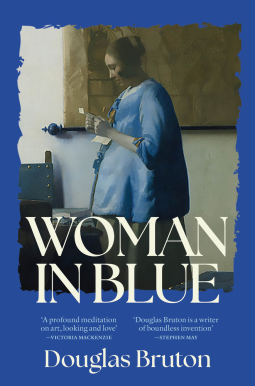
Front cover of Woman in Blue by Douglas Bruton featuring image of Vermeer's painting of the same name

‘You will live beyond one lifetime and beyond even two in the painting he makes of you.’

In the Rijksmuseum of Amsterdam, there is a painting called Woman in Blue Reading a Letter. Each day a man visits to gaze at it. He is irresistibly drawn to it. Obsessed by it. He studies the painting, in search of resolutions to his past and present loves, and the Woman in Blue studies him back. For there is more to the Woman in Blue than any of the men who gaze upon her realise. She has a story of her own to tell.

Format: Paperback (144 pages) Publisher: Fairlight Books
Publication date: 20th February 2025 Genre: Fiction

Find Woman In Blue on Goodreads

Purchase Woman in Blue from Bookshop.org [Disclosure: If you buy books linked to our site, we may earn a commission from Bookshop.org, whose fees support independent bookshops]

My Review

I recently read the author’s book Blue Postcards, which was longlisted for the Walter Scott Prize for Historical Fiction in 2021, and enjoyed its ingenious and unconventional structure: 500 numbered paragraphs each including the word ‘blue’. The author continues his fascination (I hesitate to call it obsession) with the colour blue in this his latest book which is inspired by a painting by Vermeer that hangs in the Rijksmuseum in Amsterdam.

Each day a man visits the Rijksmuseum to gaze at the painting Woman in Blue Reading a Letter by Vermeer. Only that painting, and for hours on end. Initially we don’t know quite why, and we’re not alone because the museum attendants wonder too. So does his wife. Does the model remind him of someone? Is it just a distraction from other aspects of his life? Is he seeking inspiration for a book? It did our author, after all.

The man’s fascination with the picture and the long hours he spends looking at it, observing it, wondering about small details in it – the significance of the map on the wall behind her or the box of pearls on the table – has an intensity to it, a meditative quality that draws you in. How often nowadays do we sit and look at anything for longer than a few minutes?

Gradually it becomes clear that it is the Woman in Blue who possesses most control over events and that this is not entirely coincidental. She is not the passive artist’s model we might have first thought. In the author’s imagination, her influence extends beyond the picture. She can sense the thoughts of the man viewing the picture, is amused by how often his ideas are wrong and luxuriates in her ability to captivate him as she has Vermeer. She even becomes a little impatient at his attempts to make sense of things in the painting, to discover the artist’s intentions. ‘Just look, like you did at the start,’ she says.’

The book explores the boundaries between reality and illusion in art. The man notes the Woman in Blue casts no shadow on the wall behind her as she would in real life. He recalls reading that in another of Vermeer’s paintings, View of Delft, he shifted buildings a little to suit his composition. The blue bedjacket the Woman in Blue is wearing gives the impression of a gently swollen belly but she is not pregnant. It is Vermeer who, at that moment, is in the process of bringing things into the world: a painting and a child by his wife.

We also see how a painting can live on in other forms, some quite crude or mundane. For example, the man notes that it’s possible to purchase a tea towel with the Woman in Blue on it in the museum gift shop although he’s perturbed that the blue is not exactly the same as that in the painting and fears it will fade after multiple washes.

For a short book, Woman in Blue contains a remarkable number of ideas and I suspect more will come to you, as they did to me, once you’ve finished reading it. Predictably, the book brought to mind Tracy Chevalier’s novel The Girl with the Pearl Earring, also inspired by a Vermeer painting. Playfully, the author has the man complain Vermeer has painted the Woman in Blue’s hair in such a way that it conceals her ear and that ‘had it not he might have painted a wonderful pearl earring there’.

In addition to its inclusion in the title, the author manages to sneak in a few more references to the colour blue. (I like to think this was for the amusement of those who’ve read Blue Postcards.) For example, the man writes a letter to the Woman in Blue on blue lined paper and is particular in using a blue pen. He buys his wife a blue Delft tile with a blue tulip on it.

Woman In Blue is a delightfully clever novel that will make you think about the relationship between artist, subject and viewer next time you visit a gallery or look at a painting.

‘That is what great art does: it allows the viewer in and the viewer brings something new to the painting, something of their own story and life and love.’

I received a digital review copy courtesy of Fairlight Books via NetGalley.

In three words: Thought-provoking, playful, contemplative

About the Author

Author Douglas Bruton

Douglas Bruton is the author of five previous novels: The Chess Piece Magician (2009), Mrs Winchester’s Gun Club (2019), Blue Postcards (2021), With or Without Angels (2022) and Hope Never Knew Horizon (2024). Blue Postcards was longlisted for the Walter Scott Prize for Historical Fiction 2021. His short fiction has appeared in various publications including Northwords NowNew Writing ScotlandAesthetica, The Fiction Desk and the Irish Literary Review, and has won competitions including Fish and the Neil Gunn Prize. He lives in the Scottish Borders. (Photo: Publisher author page)

Connect with Douglas
Goodreads