
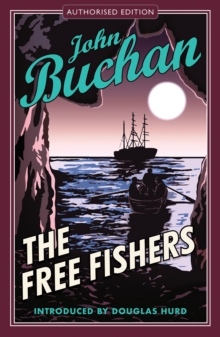
 The Free Fishers was published in the UK by Hodder & Stoughton in June 1934 and in the US by The Riverside Press on 31st July 1934. It had first appeared in serial form in Chamber’s Journal between January and July 1934. My own copy is from January 1936. Buchan’s historical fiction was never as commercially successful as his “shockers” although the combined sales of the Hodder & Stoughton and Nelson editions of The Free Fishers totalled 100,000 up to 1960 and the Penguin paperback edition added another 21,000.
The last historical novel Buchan wrote, The Free Fishers is set in the Regency era at the time of the Napoleonic Wars. The story takes its hero Antony Lammas, a young Professor of Divinity, from the coast of Fife, to the moors of Northumberland and the fens of East Anglia. John Buchan’s first biographer, Janet Adam Smith summarises the plot as “the rescue of a young man from a black-hearted fanatic”. She notes that the appearance of Prime Minister Spencer Percival “adds colour” but although describing the book as lively enough she finds it rather short on suspense.
Buchan scholar David Daniell takes a somewhat different view. He admires the book’s “speed and zest” and the fact the exuberance of the action does not overwhelm the plot. One particular scene in which the heroine is first glimpsed, he sees as evidence of Buchan’s “fine, assured touch”. Ursula Buchan, John Buchan’s granddaughter, concurs describing The Free Fishers as ‘a rollicking, exuberant story”. In her biography of her grandfather, Beyond The Thirty-Nine Steps: A Life of John Buchan, she writes, “It is meant as a high compliment to say that this is a Georgette Heyer novel, but written by a man.”
Andrew Lownie sees in the book many of the ingredients of the contemporary shocker, especially its villain, Julian Cranmer, described variously as “the most dangerous man alive on earth” and “an immense perverted genius”. Sounds good to me so look out for my review of The Free Fishers later this month.
Sources:
Janet Adam Smith, John Buchan: A Biography (OUP, 1985 [1965])
Ursula Buchan, Beyond The Thirty-Nine Steps: A Life of John Buchan (Bloomsbury, 2019)
David Daniell, The Interpreter’s House: A Critical Assessment of John Buchan (Nelson, 1975)
Kenneth Hillier and Michael Ross, The First Editions of John Buchan: A Collector’s Illustrated Biography (Avonworld, 2008)
Andrew Lownie, John Buchan: The Presbyterian Cavalier (Constable, 1995)



 What Cathy Read Next...