
 About the Book
Twelve years on from the last novel in which he featured, Richard Hannay, now in his fifties, is called by an old oath to protect the son of a man he once knew, who is also heir to the secret of a great treasure. Helped by old friends, Sandy Arbuthnot, now Lord Clanroyden, and Lombard, the action takes place in England, Scotland and on the Island of Sheep.
Format: Hardcover (343 pages) Publisher: Nelson
Publication date: 1962 [1936] Genre: Adventure
Find The Island of Sheep on Goodreads
My Review
The Island of Sheep by John Buchan, first published in 1936 by Nelson, is dedicated to Buchan’s son, Johnnie. The dedication reads “To J.N.S.B. who knows the Norlands and the ways of the wild geese”. In the book, Peter John, son of Mary and Richard Hannay, shares Johnnie’s interest in birds, nature and wild places.
The book opens with Hannay feeling a little too settled and comfortable in his life at Fosse Manor in the Oxfordshire countryside. Fosse Manor resembles Buchan’s own family home, Elsfield, and perhaps Hannay’s restlessness reflects Buchan’s own feelings as he contemplated his forthcoming role as Governor General of Canada.
The oft-quoted line from the classic film Casablanca – “Of all the gin joints, in all the towns, in all the world, she walks into mine” – comes to mind as Hannay has chance encounters with Lombard, an old friend from his days in Rhodesia, and shortly afterwards with Haraldsen, the son of the man to whom Hannay, Lombard and Hannay’s former comrade, Peter Pienaar swore an oath that they would come to his aid should this ever be required.
Other characters from previous novels turn up including a villain from South America and Hannay’s old friend, Sandy Arbuthnot, who once again demonstrates the mastery of disguise for which he is renowned, although some suspension of disbelief on the part of the reader may be required in one particular case.
The story builds to a dramatic climax on the isolated Island of Sheep as there is a final reckoning between Haraldsen’s son and his allies, and the gang of baddies pursuing him. Peter John and Anna (Haraldsen’s daughter) play an important role in events and knowledge of the habits of wildlife also proves crucial.
The Island of Sheep is an engaging adventure set in some interesting locations.
In three words: Entertaining, action, adventure
Try something similar: The Dancing Floor by John Buchan (read my review here)
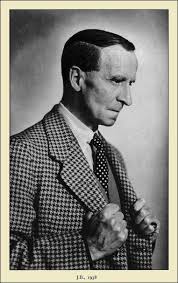 About the Author
John Buchan (1875 – 1940) was an author, poet, lawyer, publisher, journalist, war correspondent, Member of Parliament, University Chancellor, keen angler and family man. He was ennobled and, as Lord Tweedsmuir, became Governor-General of Canada. In this role, he signed Canada’s entry into the Second World War. Nowadays he is probably best known – maybe only known – as the author of The Thirty-Nine Steps. However, in his lifetime he published over 100 books: fiction, poetry, short stories, biographies, memoirs and history.
You can find out more about John Buchan, his life and literary output by visiting The John Buchan Society website.
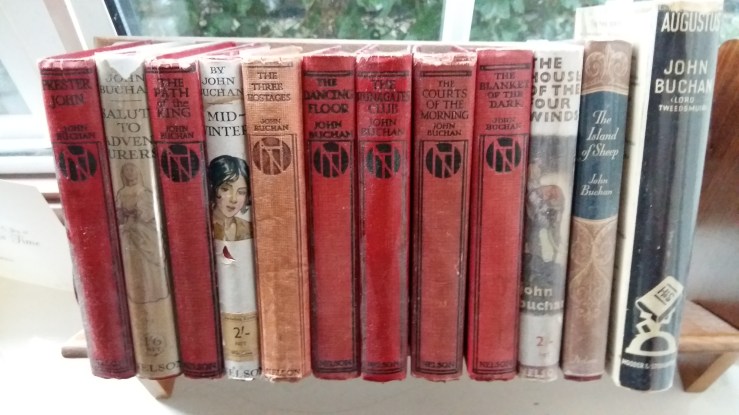


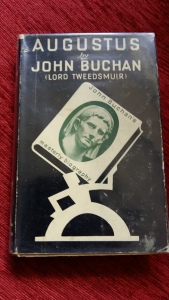 Augustus was published by Hodder & Stoughton in the UK and by Houghton Mifflin in the US in October 1937.
 What Cathy Read Next...