About the Book
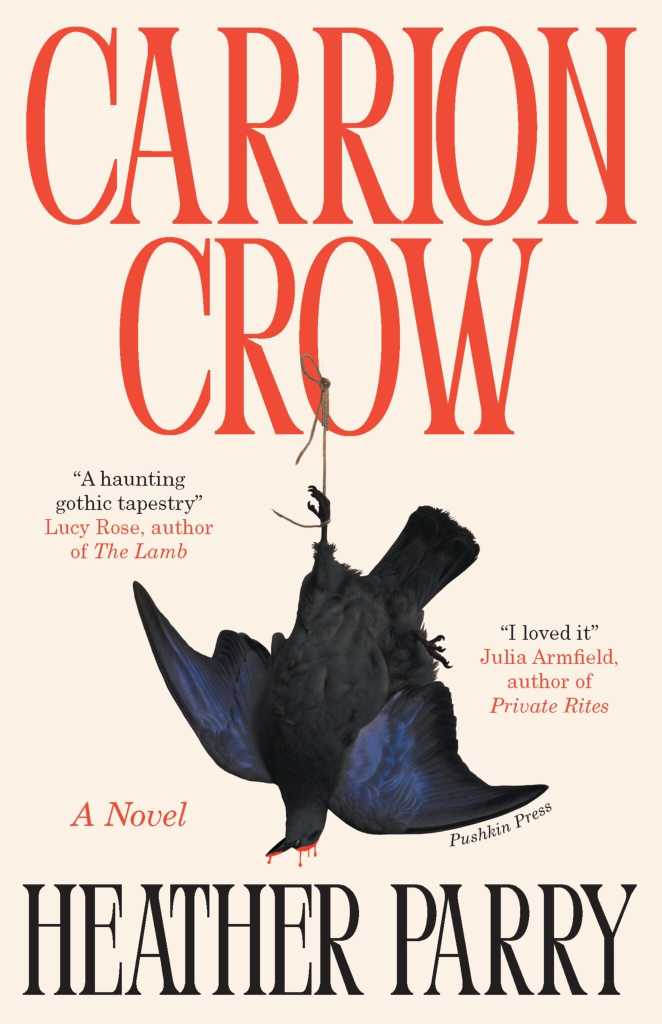
Marguerite Périgord is locked in the attic of her family home, a towering Chelsea house overlooking the stinking Thames.
For company she has a sewing machine, Mrs. Beeton’s Book of Household Management, and a carrion crow who has come to nest in the rafters. Restless, she spends her waning energies on the fascinations of her own body, memorising Mrs. Beeton’s advice and longing for life outside.
Cécile Périgord has confined her daughter Marguerite for her own good.
Cécile is concerned that Marguerite’s engagement to a much older, near-penniless solicitor, will drag the family name – her husband’s name, that is – into disrepute. And for Cécile, who has worked hard at her own betterment, this simply won’t do. Cécile’s life has taught her that no matter how high a woman climbs she can just as readily fall.
Of course, both have their secrets, intentions and histories to hide. As Marguerite’s patience turns into rage, the boundaries of her mind and body start to fray.
Format: Paperback (272 pages) Publisher: Transworld
Publication date: 2nd October 2025 Genre: Historical Fiction
Find Carrion Crow on Goodreads
Purchase Carrion Crow from Bookshop.org [Disclosure: If you buy books linked to our site, we may earn a commission from Bookshop.org, whose fees support independent bookshops]
My Review
In her Acknowledgments, the author describes Carrion Crow as ‘my odd and visceral work’. Well, she’s definitely not wrong there. This is a book which features just about every bodily effusion you can imagine, some real ‘yuck’ moments and physical acts that made me wince. Its real life counterpart is the story of Blanche Monnier, a French socialite who was kept locked in a small room by her mother and brother for 25 years.
Carrion Crow alternates between the story of Marguerite’s physical and mental decline as a result of her confinement and the back story of her mother Cécile.
Initially, Marguerite seems to accept her mother Cécile’s explanation for her confinement, that it is a necessary period of education in preparation for her forthcoming marriage to elderly solicitor, Mr Lewis. Hence her attic room being equipped with a sewing machine and, crucially, a copy of Mrs. Beeton’s Book of Household Management which Marguerite is encouraged to read from cover to cover.
At first it’s the stench of the nearby River Thames that prevails in Marguerite’s attic room but that is gradually replaced by the smell of decay emanating from the room and eventually, I’m sorry to say, from Marguerite herself. Marguerite’s is a solitary existence, if you exclude the lice that infest her body, punctuated only by visits from her mother to bring food, although this is often barely enough to sustain her. Sometimes Cécile brings a letter from Mr Lewis in which he continues to express his desire to marry her and willingness to be patient. As Cécile’s visit become less frequent, Marguerite is forced to resort to other sources of sustenance many of which are too revolting to describe here. When Marguerite discovers a female carrion crow has built a nest in the roof space, she finds solace in it as an example of devoted motherhood not bound by the constraints of society. Marguerite herself longs for a child as part of a carefully thought through plan designed to enable her to achieve true fulfillment.
Cécile’s father built a successful business empire through astute commercial instincts and a singleminded belief that life was about bettering oneself, a trait he sought to instil in his daughter from an early age. As a result the family were wealthy but lacked social standing. Her father’s solution: to marry her to the son of an aristocratic French family, the Périgords. The senior members of the family were not keen on the match but were swayed by the substantial dowry offered by Cécile’s father. The word voracious is insufficient to describe the sexual appetite of Cécile’s husband. For him, nowhere is off limits for sexual congress, as Cécile discovers on the morning of her wedding, and no perversion is to be left unexplored. Nor is privacy a prerequisite, as the household servants learn, and initially Cécile is an enthusiastic participant in this unbridled copulation. When Marguerite, the first of their three children, is born Cécile becomes the picture of a devoted mother. However, everything changes when unwelcome truths are revealed that if made public would bring disgrace. Her situation changes overnight so now everything is a burden and is hers alone to bear. This (sort of) provides an explanation if not a justification for her treatment of Marguerite.
There were quite a few points in the book where I thought to myself, I don’t think I can stomach any more of this, only to find myself unable to stop reading, a testament to the author’s ability to create something that simultaneously repels and compels.
I don’t think I’ve ever read a book like Carrion Crow and I’m not entirely sure I’d want to tackle anything so dark and unsettling again. However, if you’re a fan of body horror in cinematic or literary form, then this book’s combination of those elements with a historical setting might well be for you.
I received a digital review copy via NetGalley.
In three words: Unsettling, atmospheric, intense
Try something similar: The Warlow Experiment by Alix Nathan
About the Author

Heather Parry is a writer of fiction and nonfiction. Her debut novel, Orpheus Builds a Girl, was shortlisted for the Saltire Fiction Book of the Year award and longlisted for the Polari First Book Prize. She is also the author of a short story collection, This Is My Body, Given For You, and a short nonfiction book, Electric Dreams: On Sex Robots and the Failed Promises of Capitalism, and writes the Substack general observations on eggs. She was raised in Rotherham and lives in Glasgow with her partner and their cats, Fidel and Ernesto. (Photo/bio: Goodreads author page)
Connect with Heather
Website | Instagram | X