
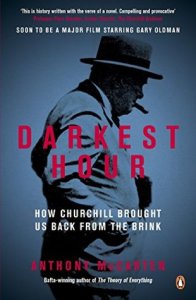
 About the Book
May, 1940. Britain is at war. The horrors of blitzkrieg have seen one western European democracy after another fall in rapid succession to Nazi boot and shell. Invasion seems mere hours away. Just days after becoming Prime Minister, Winston Churchill must deal with this horror—as well as a sceptical King, a party plotting against him, and an unprepared public. Pen in hand and typist-secretary at the ready, how could he change the mood and shore up the will of a nervous people?
In this gripping day-by-day, often hour-by-hour account of how an often uncertain Churchill turned Britain around, the celebrated Bafta-winning writer Anthony McCarten exposes sides of the great man never seen before. He reveals how he practiced and re-wrote his key speeches, from ‘Blood, toil, tears and sweat’ to ‘We shall fight on the beaches’; his consideration of a peace treaty with Nazi Germany, and his underappreciated role in the Dunkirk evacuation; and, above all, how 25 days helped make one man an icon.
Using new archive material, McCarten reveals the crucial behind-the-scenes moments that changed the course of history. It’s a scarier—and more human—story than has ever been told.
Format: Paperback (336 pp.) Publisher: Viking
Published: 28th September 2017 Genre: History, Non-Fiction
Purchase Links*
Amazon.co.uk ǀ Amazon.com ǀ Hive.co.uk (supporting UK bookshops)
*links provided for convenience, not as part of any affiliate programme
Find Darkest Hour on Goodreads
My Review
Subtitled How Churchill Brought England Back from the Brink, the book provides a fascinating insight into one of the most pivotal periods of the Second World War, namely the few weeks in May 1940 when the British Government faced the reality of German advances into Belgium and the Netherlands, the prospect of the capitulation of France, the possible entry into the war of Italy as an ally of Germany and the loss of the British Expeditionary Force pinned down in Dunkirk.
The author provides the reader with a potted history of Churchill’s childhood, school days, military service, career in journalism, marriage to Clementine Hozier and his entry to Parliament. For those interested in learning more about Churchill’s early life and his troubled relationship with his father, Randolph, I can recommend searching out the film Young Winston starring Simon Ward. The author also provides biographical information about Winston Churchill’s main opponent in the War Cabinet, Lord Halifax.
The key new ground explored in the book is the author’s contention that Winston Churchill, at the urging of Lord Halifax and Neville Chamberlain, did at least consider the terms on which negotiations with Germany for peace might take place. It’s clear he had significant reservations about such a course of action, both for strategic reasons and also because it flew in the face of everything he believed in. Churchill had recognised as early as 1933 the threat that a resurgent Germany might pose and had urged rearmament. At the time, this view was against the sway of public opinion and in Government circles there was greater fear about the spread of Communism than the threat from Hitler. Churchill was proved right in his warnings when on 9th May 1940 the Germans invaded Belgium and The Netherlands. No wonder then that the idea of peace negotiations never progressed beyond discussion.
Thank goodness that key figures of the time chose to record their thoughts in diaries and journals giving the author access to fascinating insights into the shifting opinions and power struggles within the War Cabinet and wider Government. The reader gets an almost ‘fly on the wall’ view of the meetings, the discussions, the arguments, the motives and the political manoeuvring of the various individuals involved.
The author spends quite a bit of time examining the impact of Churchill’s oratory, dissecting key speeches and the phrases in them that have now become the stuff of legend – ‘I have nothing to offer but blood, toil, tears and sweat’, ‘victory at all costs’, ‘we shall fight on the beaches’. He provides fascinating information about the literary inspirations for some of these speeches and Churchill’s meticulous preparation for them.
McCarten also argues that the idea to co-opt the so-called ‘little ships’ to aid the evacuation of the British Expeditionary Force from Dunkirk (Operation Dynamo) was the brainwave of Churchill himself, an idea for which he has not previously been recognised. The result of the operation was that 330,000 men were evacuated from the beaches of Dunkirk ensuring they were available to defend Britain against a possible invasion.
Among the many things that struck me whilst reading the book was the so-called ‘fog of war’. Today, our military leaders have drones, satellites and instant communication at their disposal. It’s easy to forget what it must have been like to make crucial decisions about the direction of a war based on information that could be both unreliable and/or out of date. This was a time when communication still relied on letters, telegrams or face-to-face meetings.
One can’t really review a book like this without mentioning some of the idiosyncrasies of Churchill the man that it reveals. For example, his preferred breakfast tray which would contain a glass of Scotch and soda between the rack of toast and plate of eggs, his penchant for a two-hour afternoon nap followed by a hot bath from which he would rise clad only in a bath towel or sometimes not even that. Furthermore, one has to marvel at his capacity for alcohol. After the aforementioned whisky and soda at breakfast, ‘a bottle of Pol Roger champagne would be consumed at lunch, and another bottle at dinner, chased by a fine port or brandy digestif into the small hours’. The author reports that when Churchill was asked once how he managed to drink during the day he replied, “Practice”.
The author describes Churchill when he became Prime Minister as ‘an amalgam of irreconcilable parts: showman, show-off, blow-hard, poet, journalist, historian, adventurer, melancholic…’. But, by golly, if ever there was a case of the right person in the right place at the right time, it was Winston Churchill in 1940.
I found this book absolutely fascinating and would recommend it to anyone interested in this period of European history or the role of leadership in time of crisis. It has extensive references and also some fabulous photographs of which my favourite is one captioned ‘Londoners listening to Churchill’ which shows people in a pub gathered around the radio.
Darkest Hour is my choice for this month’s theme of the Bookbum Book Club. It also forms part of my From Page to Screen Reading Challenge. Look out for my comparison of the book and the film (for which the author wrote the screenplay) in the next few days.
In three words: Compelling, detailed, insightful
Try something similar…Darkest Hour (the film, starring Gary Oldman)
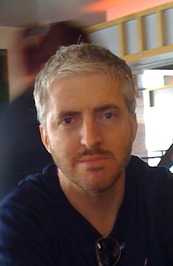 About the Author
Anthony McCarten’s debut novel, Spinners, won international acclaim, and was followed by The English Harem and the award winning Death of a Superhero, and Show of Hands, all four books being translated into fourteen languages. McCarten has also written twelve stage plays, including the worldwide success ‘Ladies’ Night’, which won France’s Molière Prize, the Meilleure Pièce Comique, in 2001, and ‘Via Satellite’, which he adapted into a feature film and directed, premiered at the 1999 Cannes Film Festival. Also a filmmaker, he has thrice adapted his own plays or novels into feature films, most recently Death Of A Superhero (2011) which premiered at the Toronto International Film Festival. Anthony divides his time between London and Los Angeles.
Connect with Anthony

 About the Book
 About the Author

 What Cathy Read Next...