To mark the publication yesterday of The Mirror & The Light, the long-awaited final book in Hilary Mantel’s trilogy about Thomas Cromwell, Waterstones branches around the country staged special events. In the case of my local branch in Reading, this took the form of ‘A Very Tudor Evening’ featuring three eminent guest speakers talking about Reading at the time of Thomas Cromwell.
 Of course, first there was the little matter of getting my hands on my very own pre-ordered copy of The Mirror & The Light – all 900 pages of it. You may have to wait a while for my review!
Once everyone had taken their seats, Waterstones Reading Events Manager, Cheryl, introduced the three speakers:
- Ralph Houlbrooke, historian of Tudor England and Emeritus Professor of Early Modern History at the University of Reading
- Joan Dils, local history tutor, President of The History of Reading Society and author of Reading: A History
- John Painter, co-author with Peter Durrant of Reading Abbey and the Abbey Quarter
Ralph gave an eloquent potted history of Thomas Cromwell’s life and rise to power, the background to England’s split from Rome and the downfall of Anne Boleyn as a result of Henry VIII’s need for a male heir. He also talked about the Royal Court, how it became the centre of power and patronage -“an intensely competitive environment” – and Thomas Cromwell’s role in ‘managing’ Parliament and the trial of Thomas More.
Given Cromwell was an ardent Protestant, Ralph was asked why he thought Anne Boleyn, who held similar religious views, became an enemy rather than an ally? Ralph felt it was partly because Cromwell never forgot Anne’s part in the downfall of his mentor, Cardinal Wolsey, and because he was willing to do whatever was necessary to achieve the King’s will. Was Thomas Cromwell a ‘man on the make’ or someone looking for an opportunity to advance the Protestant cause? Ralph thought probably a bit of both. Cromwell did some unpleasant things but he was never unnecessarily cruel.
Joan gave an extremely engaging talk in which she imagined what Thomas Cromwell would have seen if he had visited Reading in July 1535. (Although there is historical evidence Henry VIII and Anne Boleyn visited Reading around that time, there’s no firm proof Thomas Cromwell did). Joan outlined the route Thomas would have taken through the town, mentioning place names and buildings that many Reading residents would recognise. She also painted a vivid picture of the sights, sounds and smells he would have experienced, from the busy town wharf on the River Kennet where barges were loading and unloading, to the market place crowded with shops and housing the town pillory, to the rather unpleasant smelling workshops of the dyers and tanners.
Asked about the population of Reading at the time, Jean estimated around 3,500 many of whom were children. She explained the importance of Reading arose from its location, its good road and river links and the wealth of its citizens. A lot of this wealth was created from the high quality broadcloth it produced and exported across Europe.

Ralph Houlbrooke and Joan Dils

John Paints and Peter Durrant
John Painter talked about Reading Abbey in the time of Thomas Cromwell, his role in its dissolution and some of the other figures involved, many of whom profited from its demise through acquiring property or land previously owned by the Abbey or by being granted valuable annuities. He described the demise of the last Abbot, Hugh Cook of Faringdon, whose trial and eventual execution was ‘managed’ by Cromwell. This was despite Hugh appointing Thomas Cromwell to the office of Seneschal, or High Steward, of Reading, in 1538 in an attempt to gain favour.
Each talk was followed by a short Q&A. To be honest, although all three speakers gave fascinating talks, I would have welcomed a little more focus on Hilary Mantel’s book. Like me, the majority of people attending wouldn’t yet have had the opportunity to read The Mirror & the Light, so readings of short extracts would have been nice and preferable to some of the more abstruse questions asked by certain members of the audience.
Having said that, huge thanks to Cheryl and the Waterstones Reading team for organising such an interesting (free) event.
This review is based on notes I took during the event and my own recollections. Any errors in recording views expressed are my own.

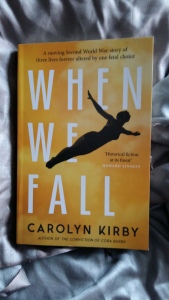 When We Fall by Carolyn Kirby will be published in paperback by No Exit Press on 7th May 2020 to coincide with the 75th anniversary of VE Day. At the heart of the novel is the tragedy of the Katyn Massacre of 1940, in which over 22,000 Polish military officers were murdered on the orders of the Soviet Union. April 2020 marks the 80th anniversary of this horrific WWII crime.

 What Cathy Read Next...