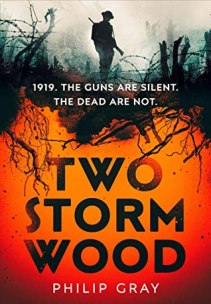
#BookReview Two Storm Wood by Philip Gray @vintagebooks

Two Storm WoodAbout the Book

1919. On the desolate battlefields of northern France, the guns of the Great War are silent. Special battalions now face the dangerous task of gathering up the dead for mass burial.

Captain Mackenzie, a survivor of the war, cannot yet bring himself to go home. First he must see that his fallen comrades are recovered and laid to rest. His task is upended when a gruesome discovery is made beneath the ruins of a German strongpoint.

Amy Vanneck’s fiance is one soldier lost amongst many, but she cannot accept that his body may never be found. She heads to France, determined to discover what became of the man she loved.

It soon becomes clear that what Mackenzie has uncovered is a war crime of inhuman savagery. As the dark truth leaches out, both he and Amy are drawn into the hunt for a psychopath, one for whom the atrocity at Two Storm Wood is not an end, but a beginning.

Format: Hardcover (368 pages)         Publisher: Vintage Publishing
Publication date: 13th January 2022 Genre: Category: Historical Fiction, Mystery

Find Two Storm Wood on Goodreads

Pre-order/purchase links
Bookshop.org
Disclosure: If you buy a book via the above link, I may earn a commission from Bookshop.org, whose fees support independent bookshops

Hive | Amazon UK
Links provided for convenience only, not as part of an affiliate programme


My Review

Two Storm Wood is billed as a historical thriller and whilst there is certainly a thriller element to it, it wasn’t the most compelling aspect of the book for me. In fact, I guessed a key part of the plot pretty early on thanks to some detail in the prologue.

For me, the key strength of the book was how it revealed the ‘debris’ of war, whether that’s material debris, such as abandoned military equipment or bombed out buildings, human debris such as the bodies (or remains of bodies) of fallen soldiers like those Captain Mackenzie’s battalion is tasked with recovering and identifying, or physical debris in the form of the damaged and scarred bodies of those who survived but were terribly injured.

And then there’s the psychological debris: the survivors traumatised by what they witnessed and what they were forced to do. If you’ve never considered just what close combat, such as carrying out a silent raid on an enemy trench, involves in reality, Two Storm Wood will leave you under no illusions. ‘An enemy who chose the bayonet, the knife or the club was an enemy who had lost touch with self-interest, the calculating instinct for self-preservation, an enemy devoted to the collective cause, unafraid to die.’ As the book reveals, often only drugs could provide the necessary impulse to carry out orders, to blank out the dreadful memories or to provide the strength to endure days spent in endless watchfulness.

Amy Vanneck encapsulates the grief of those whose siblings, spouses or loved ones never came back or whose fate remained unknown.  Perhaps unusally given the times, she travels alone to the heart of the now abandoned battlefields searching for the truth about how her fiancé Edward Haslam died, or if indeed he did.  As she edges closer to the truth, it becomes increasingly clear that ‘War is a contest of violence, not virtue’ and the cruelty of what one human being can do to another knows no bounds.

With its vivid battle scenes, Two Storm Wood conjured up pictures in my mind that I’m not sure I want to recall in a hurry. The book powerfully, and at times graphically, illustrates that ‘War poisons everything that it does not destroy’. It also features one of the most evil and ruthless fictional characters I’ve come across in a long time, a key ingredient for a really absorbing thriller.

I received an advance review copy of Vintage via NetGalley.

In three words: Chilling, dark, immersive

Try something similarThe Glorious Dead by Tim Atkinson

Follow this blog via Bloglovin


Philip GrayAbout the Author

Philip Gray was inspired to write Two Storm Wood by his grandfather who fought in the First World War. (Photo credit: Author website)

Connect with Philip
Website | Twitter

#BookReview The Unfortunate Englishman (Joe Wilderness #2) by John Lawton @groveatlantic

The Unfortunate EnglishmanAbout the Book

Berlin, 1963. East End-Londoner turned spy Joe Wilderness has had better days. He is sitting in a West Berlin jail, arrested for shooting someone he thought was about to kill him. His old boss, Lieutenant Burne-Jones of MI6, comes to Berlin to free him, but only under the condition that he rejoin British Intelligence. The knowledge that Wilderness gained of Berlin’s underworld while working the black market just after World War II will prove useful to Queen and country now that the city has become the epicenter of the Cold War, dividing the world in two with its wall.

On the other side of the Iron Curtain, another MI6 man, Geoffrey Masefield, is ruing the day he first agreed to be a spy. In the beginning, it had all seemed so simple, so glamorous: the international travel, the top secret files, the vodka, the women. . . . But now Masefield is stuck in Lubyanka, the KGB’s Moscow prison, waiting for a lifeline from his former employer. Meanwhile, over in England, a Russian spy is pining for his homeland. Having lived as Bernard Forbes Campbell Alleyn for years and taken a wife and had two daughters under that alias, he’s now been exposed as KGB Captain Leonid Liubimov. Arrested for treason and then for espionage, he is in prison at Wormwood Scrubs, London. The only ticket out for these two men is a spy exchange.

Posted back to Berlin, Wilderness is to oversee the exchange of Masefield and Liubimov, but his black market nous hasn’t diminished. There’s money to be made and ten thousand bottles of fine Bordeaux that Wilderness hasn’t forgotten about.

Format: Hardcover (368 pages)   Publisher: Grove Press
Publication date: 5th May 2016  Genre: Historical Fiction

Find The Unfortunate Englishman (Joe Wilderness #2) on Goodreads

Purchase links
Bookshop.org
Disclosure: If you buy a book via the above link, I may earn a commission from Bookshop.org, whose fees support independent bookshops

Hive | Amazon UK
Links provided for convenience only, not as part of an affiliate programme


My Review

The Unfortunate Englishman is the second book in the author’s Joe Wilderness series, the follow-up to Then We Take Berlin. I listened to the audiobook version of that in 2020 and you can read my review here. I was fortunate enough to win a copy of the third book in the series, Hammer To Fall, from Readers First last year so I thought it was about time I read its predecessor (a copy of which I spotted in my local Oxfam bookshop).

The book’s opening chapter continues directly on from the final scene in Then We Take Berlin. Once more Joe Holderness (known to his friends as Wilderness) is in a scrape and on course to get a tongue lashing from his wife Judy, if and when he gets home. (By the way, I love Judy. She always knows when Joe’s up to something nefarious, dangerous, or both.)

Then it’s back to 1945 and the story of how a KGB agent managed to assume the identity of another man, Bernard Alleyn, and live undiscovered for nearly fifteen years, all the time passing secrets back to the Soviet Union until he is unmasked.

Moving forward to 1960, Wilderness is involved in recruiting business man and metallurgy expert Geoffrey Masefield to travel to the Soviet Union as part of a trade delegation in the hope of discovering information about the Soviets missile capability. The storyline is reminiscent of the case of Greville Wynne, arrested as a spy and sentenced to eight years in a Soviet prison. (His experiences have recently been dramatized – with quite a lot of artistic licence – in the film The Courier, starring Benedict Cumberbatch.) Wilderness disappears from the picture in this part of the book, the focus instead on Masefield’s time in Moscow. Masefield is rather the innocent abroad, fulfilling his boyhood dream of becoming spy yet a little disappointed that it’s not quite like in the James Bond books. He’s rather easy prey for the KGB who know exactly how to take advantage of a man’s weaknesses.

There’s a brief trip back in time to Berlin in 1947 to discover more about those ten thousand bottles of Bordeaux before the book picks up where it started, with Burne-Jones rescuing Wilderness from a Berlin jail in 1963. After a few frustrating years shuffling paperwork, Wilderness is ordered to return to Berlin to oversee the spy exchange.  As you might expect, not everything goes to plan, especially when Wilderness encounters two old sparring partners from the past plus the woman who, for a brief time, captured his heart. Perhaps he should have heeded the advice of his friend Eddie: “Joe, Berlin has been a disaster area for you. It’s marked on the map with a big black cross and a sign saying ‘here be dragons’.”

Although written five years ago, the book seems surprisingly up-to-date. Proving nothing much changes, the failure of the Americans and British to anticipate the construction of the Berlin wall cutting off West Berlin is described as a ‘failure of intelligence’. Where have we heard that recently? And no doubt Burne-Jones’s observation that ‘it is far better to say nothing and appear ignorant than to admit we knew and appear futile’ still applies as well.

I loved the brief appearance by a character from the author’s other series and also how the title of the book could be interpreted in a number of ways.  Is ‘the unfortunate Englishman’ Alleyn, separated from his family and languishing in a British jail, Masefield, the inept spy captured by the Soviets, or even Wilderness, more at home in the field than behind a desk?

The author clearly has a love of short chapters – The Unfortunate Englishman has 171! – but it’s a classy, perfectly paced spy thriller with great period atmosphere and a plot which is a satisfying blend of the personal and the political. I can’t wait to pluck Hammer To Fall off my bookshelf and get stuck in.

The Unfortunate Englishman is book 19 of my 20 Books of Summer 2021. Nearly there!

In three words: Gripping, pacy, action-packed

Try something similar: The Spy Who Came In From The Cold by John le Carré

Follow this blog via Bloglovin


John LawtonAbout the Author

John Lawton worked for Channel 4 for many years. He is the author of Then We Take Berlin, the first in the Joe Wilderness series. He has also written seven novels in his Troy series, the standalone novel, Sweet Sunday, a couple of short stories, and the occasional essay. He writes very slowly and almost on the hoof in the USA or Italy, but professes to be a resident of a tiny village in the Derbyshire Peak District. (Photo credit: Goodreads author page)

Connect with John
Goodreads