#BookReview The Man in the Bunker (Tom Wilde 6) by Rory Clements @ZaffreBooks

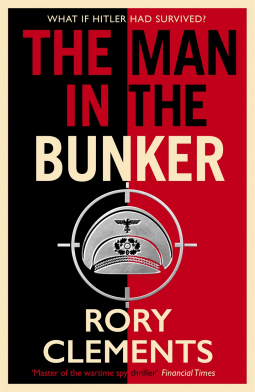
The Man in the BunkerAbout the Book

Germany, late summer 1945 – The war is over but the country is in ruins. Millions of refugees and holocaust survivors strive to rebuild their lives in displaced persons camps. Millions of German soldiers and SS men are held captive in primitive conditions in open-air detention centres. Everywhere, civilians are desperate for food and shelter. No one admits to having voted Nazi, yet many are unrepentant.

Adolf Hitler is said to have killed himself in his Berlin bunker. But no body was found – and many people believe he is alive. Newspapers are full of stories reporting sightings and theories. Even Stalin, whose own troops captured the bunker, has told President Truman he believes the former Führer is not dead. Day by day, American and British intelligence officers subject senior members of the Nazi regime to gruelling interrogation in their quest for their truth.

Enter Tom Wilde – the Cambridge professor and spy sent in to find out the truth…

Format: Hardback (460 pages)          Publisher: Zaffre
Publication date: 20th January 2022 Genre: Historical Fiction, Thriller

Find The Man in the Bunker (Tom Wilde #6) on Goodreads

Purchase links
Bookshop.org
Disclosure: If you buy a book via the above link, I may earn a commission from Bookshop.org, whose fees support independent bookshops

Hive | Amazon UK
Links provided for convenience only, not as part of an affiliate programme


My Review

Rory Clements’ books featuring Cambridge professor turned spy, Tom Wilde, have become one of my absolute favourite series. I’ve devoured every one of them and The Man in the Bunker was no exception. (I’m also a fan of his John Shakespeare series set in Elizabethan England.)

Who do the intelligence services in Britain and the United States call on when they’ve a tricky problem to solve? Why Cambridge professor of history turned spy Tom Wilde of course – much to the exasperation of his wife, Lydia, in this case.

The brilliantly dramatic and chilling opening chapter is a prelude to everything you could possibly want from a spy thriller: plenty of action scenes, car chases, narrow escapes, assassins waiting in the shadows, wily and ruthless villains, double-crosses galore. There are also a host of interesting secondary characters, such as the colourful Boris Minsky, Jerzy ‘the boy with the camera’ and the dedicated Dr. Angie Gray.  The skilfully crafted plot means there are plenty of side stories the reason for whose inclusion remains deliciously intriguing for a large part of the book.

Wilde is assigned a companion in his investigation, Lieutenant Mozes Heck. Heck is a wonderfully drawn character. Whilst, as readers of the previous books will know, Wilde has his own share of traumatic memories, Heck’s are beyond imagining. His first-hand and very personal experience of the atrocities committed by the Nazis has given him a deep-seated hatred of those Nazis who survived the war and ‘an overpowering hunger’ for revenge. As a result he is utterly ruthless – shoot first, think later – meaning at times he is difficult for Wilde to control.  ‘Heck was in a blood-red world of his own, and no amount of reasoning was going to alter that.’ On the other hand, Heck’s sharp-shooting skills, physical resilience and ability to pass unnoticed are definitely things you want in a difficult situation, and Wilde and Heck experience plenty of those.

Wilde’s investigation into whether Hitler remains alive takes him to the heart of post-war Germany giving the reader a vivid insight into the destruction visited upon cities such as Berlin by Allied bombing and the advance of the Russian army.  ‘This is real life, this is the detritus of war, right here.’ Berlin has become a place of ruined buildings, piles of rubble and people trying to eke out a living in the shattered remains of their city. It’s a dangerous place as well.  ‘The problems start after dark when the desperate and the dispossessed come out and defy the curfew. It’s kill or be killed.’

There also unsettling scenes in the makeshift camps for people displaced by the War including those who survived the concentration camps. And a visit to a particular site in Berlin brings Wilde a chilling reminder of the evil of the Nazi regime. ‘He did not believe in the occult, nor even an afterlife, yet he could hear the children’s cries.’

I can’t say much more about the plot without giving too much away. But, I hear you ask, does Wilde discover if Hitler survived the Berlin bunker? Sorry, not telling. Read the book and find out.

I thought The Man In The Bunker was absolutely fabulous, another masterly spy thriller from the pen of Rory Clements. A few loose ends left subtly dangling at the end of the book leaves me hoping this is not the last outing for Tom Wilde. In the meantime Tom, Lydia deserves her holiday.

In three words: Compelling, action-packed, suspenseful

Try something similar: V2 by Robert Harris

Follow this blog via Bloglovin


Rory ClementsAbout the Author

Rory Clements was born on the edge of England in Dover. After a career in national newspapers, he now writes full time in a quiet corner of Norfolk, where he lives with his wife, the artist Naomi Clements Wright, and their family. He won the CWA Ellis Peters Historical Award in 2010 for his second novel, Revenger, and the CWA Historical Dagger in 2018 for Nucleus. Three of his other novels – Martyr, Prince and The Heretics – have been shortlisted for awards.

To find out more about The Man In The Bunker and the previous books in the series, join the Rory Clements Readers’ Club via the link in his website. (Photo credit: Author website)

Connect with Rory
Website | Twitter | Facebook

The Man in the Bunker

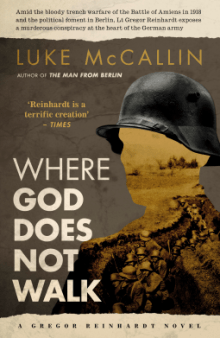
#BookReview Where God Does Not Walk (Gregor Reinhardt #4) by Luke McCallin @noexitpress

Where God Does Not WalkAbout the Book

The Western Front, July 1918. Gregor Reinhardt is a young lieutenant in a stormtrooper battalion on the Western Front when one of his subordinates is accused of murdering a group of officers, and then subsequently trying to take his own life. Not wanting to believe his friend could have done what he is accused of, Reinhardt begins to investigate. He starts to uncover the outline of a conspiracy at the heart of the German army, a conspiracy aimed at ending the war on the terms of those who have a vested interest in a future for Germany that resembles her past.

The investigation takes him from the devastated front lines of the war, to the rarefied heights of Berlin society, and into the hospitals that treat those men who have been shattered by the stress and strain of the war. Along the way, Reinhardt comes to an awakening of the man he might be. A man freed of dogma, whose eyes have been painfully opened to the corruption and callousness all around him. A man to whom calls to duty, to devotion to the Fatherland and to the Kaiser, ring increasingly hollow…

Format: Hardcover (432 pages)            Publisher: Oldcastle Books
Publication date: 9th December 2021 Genre: Historical Fiction, Thriller

Find Where God Does Not Walk ( Gregor Reinhardt #4) on Goodreads

Purchase links
Bookshop.org
Disclosure: If you buy a book via the above link, I may earn a commission from Bookshop.org, whose fees support independent bookshops

Hive | Amazon UK
Links provided for convenience only, not as part of an affiliate programme


My Review

I’ve been a fan of this series ever since I read the The Man From Berlin in 2016. I then read, in quick succession, the next two in the series, The Pale House and The Ashes of Berlin. And that’s where, much to my disappointment, it seemed the adventures of Gregor Reinhardt might end. (I’ll admit to having developed a bit of a crush on Reinhardt by that time.) So you can imagine how thrilled I was to learn there was a new book on the way and that it was a prequel as I love a good prequel.

A prequel obviously presents both opportunities and challenges for an author. The main challenge is that the author can’t change what will happen in later, already written, books.  So it’s no spoiler to say the reader knows that, however dangerous the situations in which he finds himself – and they are often extremely dangerous – Reinhardt isn’t going to die in Where God Does Not Walk.  But, of course, he doesn’t know that and thanks to the skilful writing of the author, Reinhardt’s many dices with death don’t lose any of their impact, tension or excitement.

On the other hand, the main opportunity presented by a prequel is the ability to delve more deeply into the past of the main character, to explain the background to decisions or actions they may take in later books, and to fill in more of their back story.  Where God Does Not Walk does that in spades, taking the reader back to the First World War and introducing us to a young Gregor Reinhardt, only nineteen years old but already battle-hardened. From the off, he shows early signs of the intelligence, curiosity and, let’s face it, rather dismissive attitude to authority he displays in later books. However, what he also shows is a fierce loyalty towards the soldiers he commands, a strong sense of justice as well as a remarkable ability to survive the most perilous of situations.  I also loved the first appearance of small details, such as a watch, that readers who’ve read the previous books may recognise.

If you’ve ever wondered what it must have been like to serve in the frontline in the First World War then this book will leave you under no illusion that it was hell on earth. The descriptions of the result of artillery and machine gun fire on human bodies leave little to the imagination. In one memorable scene an appalled Reinhardt, looking around at the severely injured soldiers in a casualty clearing station, wonders at ‘such a butchery of men’. However, if anything, the most shocking thing is the seemingly casual attitude of those who put soldiers into situations where they know few will survive intact, if at all. ‘Men die in all kinds of ways, for all kinds of reasons. Some of them are avoidable. Some of them are accidental. Many of them are stupid. Many are unthinkable’. The book also explores the psychological effects of war, exposing some of the crude treatments inflicted on those suffering from what we would today recognise as post-traumatic stress.

It’s clear a massive amount of amount of research has gone into the book and from time to time I did find I needed to refer back to the list of characters at the beginning of the book to remind myself who was who and what position they occupied in the military hierarchy.

Of course, Where God Does Not Walk also incorporates an astonishingly complex mystery that had me perplexed for most of the time – as was Reinhardt too for a large proportion of the book.  As he becomes involved in the investigation of a series of gruesome murders, Reinhardt lurches from one violent confrontation to another as he attempts, in any way he can, to tease the truth from those reluctant, or too afraid, to reveal it. As hints of a conspiracy emerge that may involve some in the highest level of the country’s institutions, there are also signs of a nascent anti-Semitism.

If you’re new to the series, Where God Does Not Walk is the perfect place to start, although I warn you you’ll probably be adding the other books to your wishlist by the time you finish it.  And it gets better because the author promises us this is just the start of a new cycle of books taking Reinhardt from where we leave him in this book up to the point we meet him in The Man From Berlin.

Where God Does Not Walk is both a complex thriller and a stark and, at times, unflinching exposition of what it was like in the frontline during the First World War. As one character observes, ‘No man survives a war and is the same man he was at its beginning’. Welcome back, Reinhardt.

I received an advance review copy courtesy of No Exit Press via NetGalley.

In three words: Dark, intense, compelling

Try something similarTwo Storm Wood by Philip Gray

Follow this blog via Bloglovin


LukeMcCallinAbout the Author

Luke McCallin was born in Oxford, grew up around the world and has worked with the United Nations as a humanitarian relief worker and peacekeeper in the Caucasus, the Sahel, and the Balkans. His experiences have driven his writing, in which he explores what happens to normal people – those stricken by conflict, by disaster – when they are put under abnormal pressures. (Photo/bio: Goodreads author page)

Connect with Luke
Website | Facebook | Goodreads