
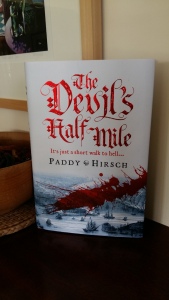
 About the Book
New York, 1799: Justy Flanagan, lawyer, soldier, policeman, has returned to his native city, bloodied and battered after fighting in the Irish Rebellion against the English. Determined to hunt down the man who murdered his father, his inquiries lead him to Wall Street and the fledgling stock market there. But as his investigations into the past move ahead, the horrific murders of young slave women in the present start to occupy his time. Convinced that there is a link between his father’s murder, the deaths of the young women, and a massive fraud that nearly destroyed New York’s economy, Justy can trust no one.
As the conspiracy deepens, it becomes clear that those involved will stop at nothing to keep their secrets. Justy is forced to choose: will he betray his father’s memory, compromise his integrity, and risk the lives of his closest friends, to get to the bottom of a tale so dangerous it could change the landscape of America forever?
Format: Audiobook, hardcover, ebook (304 pp.) Publisher: Corvus
Published: 5th July 2018 Genre: Historical Fiction, Historical Crime
Pre-order/Purchase Links*
Amazon.co.uk ǀ Amazon.com ǀ Hive.co.uk (supporting UK bookshops)
*links provided for convenience, not as part of any affiliate programme
Find The Devil’s Half Mile on Goodreads
My Review
In The Devil’s Half Mile, the author transports the reader to a violent, dog-eat-dog world of dark alleys and even darker deeds – protectionism, violence, corruption and vice – carried out by people who never go anywhere without weapons and have no compunction about using them. It’s all told in colourful, sparkling prose generously sprinkled with colloquialisms that give a real sense of authenticity and include some great curses and one-liners. There is a helpful glossary at the back of the book in case you need help deciphering phrases such as ‘beard splitter’, ‘coat buzzer’ ‘shooting the cat’ or ‘lambskin man’.
The author brilliantly conjures up the sights, sounds and particularly the smells of an 18th century New York that is miles away from the sophisticated city we think of today. Coming ashore in the harbour, Justice Flanagan is greeted by: ‘Wood smoke from a thousand hearth fires, urine from the tanners’ shops, horse shit from the streets, sewage from the septic tanks, fresh blood from the abattoirs, rotting meat and produce from the tips. Bad breath, sour beer, raw spirits, stale sweat.’
I also loved this description of the population going about their business in the Broad Way. ‘Shoppers and passersby competed for space with a crush of handsellers and their carts: chive fencers selling cutlery, swell fencers touting the sharpness of their sewing needles, flying stationers flogging their penny ballads and histories, crack fencers offering bags of nuts, and everywhere the cakey pannam fencers, whose trolleys were piled with pies, sweet bowlas tarts and savoury chonkeys, the minced-meat pastries that no true New Yorker could resist.’ (See why you need that glossary?)
There is a fantastic cast of characters – some likeable, some definitely not. In the latter category, is Justice’s uncle, Ignatius Flanagan, known as ‘The Bull’, who strikes fear into those who oppose him and boasts ‘I own the waterfront’. In his own words, The Bull is ‘a teaguelander, a six and tips, a jumped-up Fenian boglander Paddy bastard’. (Sorry, you’re going to need that glossary again.) Or as Justy accuses him: ‘You cheat and lie and steal. You enslave, and you kill. For money and for power.’ But when it comes to it, is blood thicker than water?
There’s street-wise Kerry, Justice’s cousin, who’s had to learn to be independent in a world that’s male-dominated and has more to lose than the reader initially realises. There’s Justice’s friend, Lars Hokkanssen, a tough red-bearded sailor of Irish/Norwegian descent who prides himself on his charm with the ladies (without much evidence to support it) and who knows and understands the demons that sometimes haunt Justice.
And of course, there’s the man himself, known to his friends as Justy. His brutal experiences fighting the English in the Irish Rebellion mean he sometimes finds himself repelled by the anger and violent impulses he senses within himself. He fears he may have got some perverted pleasure from what he did in the heat of battle, carried away by blood lust and a belief in the righteousness of the cause for which he fought. ‘He had the sense that there was a box inside him that, if he opened it, would let all the evil of the world come pouring out.’ This moral complexity makes Justy an absolutely fascinating character. He’s also clever, observant, resourceful and handy in a tight spot. Probably a bit of a dish as well.
Initially on the hunt for the person responsible for his father’s death, Justy becomes involved in the investigation into a series of murders of prostitutes that suggest a serial killer may be on the loose in the streets of New York. What follows is plenty of twists and turns as Justy hunts for clues among the great and good and the not-so-great and not-so-good. It also brings him into the world of the traders and financiers who inhabit the ‘Devil’s Half Mile’, the nickname for Wall Street. It becomes apparent that it’s a world of speculative investments offering high returns most of which have little behind them or, if they do, perhaps not what the investors in them imagine. Sound familiar?
When he gets too close, Justy’s faced with a dreadful choice which means risking losing something that has become very dear to him. Justy fights back (of course) but it will take every ounce of cunning and experience (plus the help of trusted allies, assuming he can work out who they are) to uncover the truth. In the end, what helps reveal the malefactors and the dreadful nature of their enterprise is the diligent collection of information. Tempting wouldn’t you say for an author who is also a journalist?
The Devil’s Half Mile is fast-moving, intricately plotted historical fiction with fantastic period atmosphere and a wonderful cast of characters. The good news for appreciative readers like me is that the ending is all set up for further books in the series. (Yes, please.) I’ve read some great historical fiction already this year and The Devil’s Half Mile joins that list. Historical crime fiction fans, put this one on your wishlist or, better still, click on the pre-order/purchase button. To my mind, if The Devil’s Half Mile doesn’t feature in The Walter Scott Prize for Historical Fiction for 2019, there’s no Justice in the world (see what I did there?).
I received a review copy courtesy of Readers First and publishers, Corvus , in return for an honest and unbiased review.
Try something similar…Golden Hill by Francis Spufford or Stone’s Fall by Iain Pears
 About the Author
Paddy writes: I’m a writer, a journalist, and an explainer. I’ve worked in news for nearly 20 years, but recently I’ve been writing fiction. My first novel, The Devil’s Half Mile, comes out in the US on June 5, 2018. It’s an historical thriller, set in New York in 1799. The Devil’s Half Mile is a nickname for Wall Street, so it won’t surprise you to hear the story has themes of high finance, corruption and criminality. I’m also the author of a book called Man vs Markets, Economics Explained, Plain and Simple. It’s a light-hearted, jargon-free guide to the financial markets, aimed at regular people who just want to understand what on earth happens on Wall Street.
I got my start in journalism with an internship at the BBC in Glasgow, Scotland. I became a field producer for CNBC in Hong Kong and later was a consultant to the Open Broadcast Network in Bosnia. I’ve worked as an editor for Direct Capital Markets, Institutional Investor Newsletters, Standard & Poor’s, and the Vietnam Economic Times. Prior to becoming a journalist, I served for nearly ten years as an officer in the Royal Marines. I went to school at Campbell College in Belfast and received a bachelor’s degree in French and International Studies from the University of Warwick.
I was born in Weymouth, England, raised in Ireland and I now live in Los Angeles. During my free time, I like to run, surf and climb big hills.
Connect with Paddy
Website ǀ Facebook ǀ Twitter ǀ Instagram ǀ Goodreads

 About the Book
 About the Author

