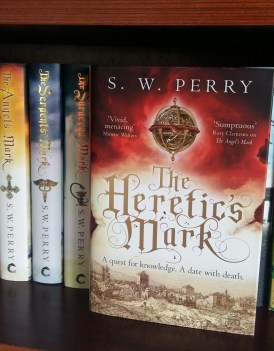
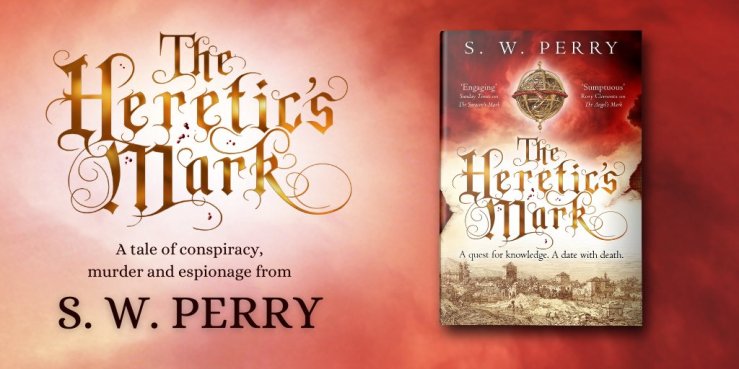
Welcome to today’s stop on the blog tour for The Heretic’s Mark by S. W. Perry, the fourth book in the Jackdaw Mysteries series. My thanks to Kate at Corvus for inviting me to take part in the tour and to Readers First for my advance review copy.
 About the Book
The Elizabethan world is in flux. Radical new ideas are challenging the old. But the quest for knowledge can lead down dangerous paths.
London, 1594. The Queen’s physician has been executed for treason, and conspiracy theories flood the streets. When Nicholas Shelby, unorthodox physician and unwilling associate of spymaster Robert Cecil, is accused of being part of the plot, he and his new wife Bianca must flee for their lives. With agents of the Crown on their tail, they make for Padua, following the ancient pilgrimage route, the Via Francigena. But the pursuing English aren’t the only threat Nicholas and Bianca face.
Hella, a strange and fervently religious young woman, has joined them on their journey. When the trio finally reach relative safety, they become embroiled in a radical and dangerous scheme to shatter the old world’s limits of knowledge. But Hella’s dire predictions of an impending apocalypse, and the brutal murder of a friend of Bianca’s forces them to wonder: who is this troublingly pious woman? And what does she want?
Format: Hardcover (448 pages) Publisher: Corvus
Publication date: 1st April 2021 Genre: Historical Fiction, Crime, Mystery
Find The Heretic’s Mark (The Jackdaw Mysteries #4) on Goodreads
Purchase links
Bookshop.org
Disclosure: If you buy a book via the above link, I may earn a commission from Bookshop.org, whose fees support independent bookshops
Hive | Amazon UK
Links provided for convenience only, not as part of an affiliate programme
My Review
S. W. Perry’s novels featuring physician Nicholas Shelby and tavern owner Bianca Merton have fast become one of my favourite historical mystery series. I’ve loved all three previous books – The Angel’s Mark, The Serpent’s Mark and The Saracen’s Mark. Although The Heretic’s Mark is the fourth in the series, the author has ensured it can be enjoyed by new readers and established fans alike thanks to brief recaps of events from previous books and sketches of the main characters.
Aside from Nicholas and Bianca, amongst those making a return appearance are Rose and Ned Monckton, now charged with overseeing the rebuilding of the Jackdaw tavern following its dramatic destruction at the end of the previous book. Such is Ned’s gratitude to both Bianca and Nicholas for the new life they’ve made possible, that Ned decides to try to discover the person responsible for denouncing Nicholas as a co-conspirator in a plot against the Queen.
No historical mystery set in the reign of Elizabeth I would be complete without a member of the Cecil family featuring in the plot and in this case it’s Sir Robert Cecil. Nicholas is hoping that having treated Cecil’s son, he may be able to call on Cecil’s help should it be needed. However, perhaps you can never be quite sure with one of the Cecils.
As fans of the series have come to expect, the book vividly conjures up the sights, sounds – and smells – of 16th century London. However, the need to seek refuge from their unknown enemy allows the author to transport Nicholas and Bianca to a whole new landscape. Having travelled across the Narrow Sea to Den Bosch in Brabant, two significant events occur. Firstly, Nicholas catches sight of Hieronymus Bosch’s triptych, The Last Judgment, and is a witness to a brutal attack. Secondly, he and Bianca encounter a strange young woman, Hella Mass, whose joins them on their arduous journey along the pilgrim route towards Italy.
In Hella, the author has created an enigma, possibly a monster, but most certainly an unforgettable character. Is she a latter day Cassandra whose predictions of impending doom are destined to be ignored, a delusional young woman damaged by her traumatic experiences who should be pitied not reviled, or a skilled manipulator and charlatan? You’ll have to read the book to find out. Whichever it is, there’s certainly no love lost between Hella and Bianca who quickly tires of Hella’s predictions, especially when she believes them to have turned personal. As Bianca observes, ‘There is only so much a woman with blisters on her feet, who’s sure she stinks of mule, and has a mountain range ahead of her to cross, can suffer with equanimity.‘
Although initially the result of a forced departure from England, before long Nicholas finds himself enjoying the journey through Europe. ‘Here, on the path down to the northern shore of Lake Geneva, the air is sharper, more bracing even than a tub of cold Thames water, more cleansing than the stinking fug he breathes in the narrow lanes of London.’ And for Bianca, the journey gives her the freedom to practice her Catholic faith openly.
Alongside the account of Nicholas and Bianca’s journey, there are regular updates on the progress of Ned’s investigation back in London. Another storyline involves Bianca’s cousin, Bruno Barrani, who has a bold scheme to acquire an object that he hopes will bring him both wealth and powerful patronage. The arrival of Nicholas and Bianca in Padua, the city of Bianca’s birth, sees the convergence of a number of plot lines as result of which dramatic events ensue. To borrow from the musical Kiss Me Kate, it’s not so much a case of “I’ve come to wive it wealthily in Padua” as “I’ve come to knife them steathily in Padua“.
A multitude of twists and turns had me at more than one than point silently entreating the author, ‘No! You can’t end a chapter like that!’ The book builds to a wonderfully dramatic climax that makes full use of the historic sites of Padua and the city’s traditions. And I’ll freely admit the closing chapters left me a little tearful.
Fans of the series will be delighted to learn The Heretic’s Mark is another historical page-turner from the pen of S. W. Perry. And to readers looking for a new historical mystery series to follow, I can only say ‘Get thee to a bookshop’. I, for one, can’t wait for the next instalment.
In three words: Gripping, atmospheric, dramatic
Try something similar: Rags of Time by Michael Ward
Follow this blog via Bloglovin
 About the Author
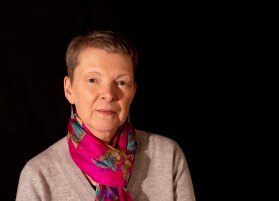
S. W. Perry was a journalist and broadcaster before retraining as an airline pilot. He lives in Worcestershire with his wife.
Connect with S. W. Perry
Website | Twitter | Facebook

 About the Book
 About the Author