
Book Review – Time of the Child by Niall Williams @BloomsburyBooks

About the Book

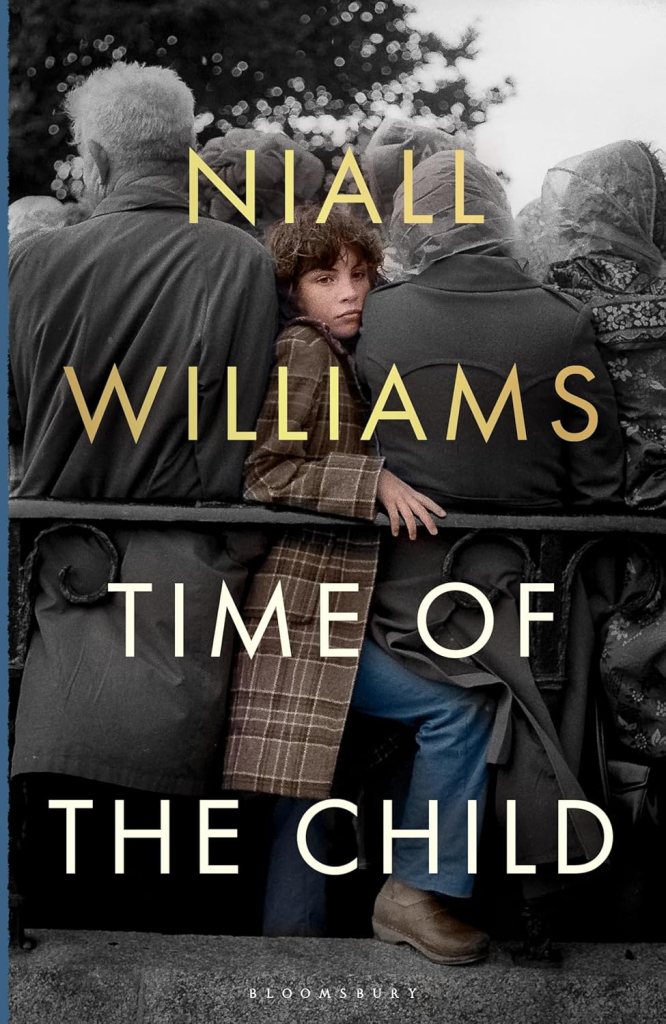
Book cover of Time of the Child by Niall Williams

Doctor Jack Troy was born and raised in the little town of Faha, but his responsibilities for the sick and his care for the dying mean he has always been set apart from his community. A visit from the doctor is always a sign of bad things to come.

His youngest daughter, Ronnie, has grown up in her father’s shadow, and remains there, having missed her chance at real love – and passed up an offer of marriage from an unsuitable man.

But in the advent season of 1962, as the town readies itself for Christmas, Ronnie and Doctor Troy’s lives are turned upside down when a baby is left in their care. As the winter passes, father and daughter’s lives, the understanding of their family, and their role in their community are changed forever.

Format: Hardcover (304 pages) Publisher: Bloomsbury
Publication date: 24th October 2024 Genre: Historical Fiction

Find Time of the Child on Goodreads

Purchase Time of the Child from Bookshop.org [Disclosure: If you buy books linked to our site, we may earn a commission from Bookshop.org, whose fees support independent bookshops]


My Review

Having read and enjoyed This Is Happiness it was a joy to return to the Irish village of Faha in Time of the Child, one of the five books shortlisted for the Winston Graham Historical Prize 2026. I definitely think Time of the Child could be enjoyed without having read the earlier book.

Although Jack Troy may appear distant and someone who rarely shows emotion, inside we see a man struggling to come to terms with the death of his wife and another woman he cared about, and guilt that he may have stood in the way of his daughter’s happiness. Time after time, I found myself inwardly urging Jack to express his thoughts out loud and not keep them to himself, particularly when it came to his daughter. Tell her how much you appreciate her, tell her you’re sorry…

As we learn, Jack Troy does not have a heart of stone, as outward appearances would suggest, he has a heart as big as anyone. We see his compassion in the way he cares for the ailing Doady and her husband Ganga who grasps at any sign she might be improving despite there being none. (Both Doady and Ganga had starring roles in the previous book.) And we see it again in his tender dealings with Father Tom who is exhibiting signs of confusion.

The discovery of an abandoned baby gives Jack the opportunity to demonstrate his compassion once again. His dilemma is how to explain the presence of a baby in his household, a baby whom his daughter has grown to love. He cannot disappoint her again by allowing the baby to be taken into the care of the authorities. The solution: keep it a secret. The problem: Faha is not a place where it’s easy to keep a secret. In fact, it’s almost impossible. And actions can have unintended consequences.

A warm, wry humour runs through the book, such as the scene in which the curate, Father Coffey, has his first encounter with Napoleon brandy. And the author’s flair for the colourful is in evidence when describing the travelling traders who set up at Faha’s Christmas Fair.

‘There was Noone the knife-sharpener who looked like Douglas Fairbanks in The Corsican Brothers; McGreal, the pots-and-pans man, wire wool extra; a Dodd from the north who sold old brushes, and his own version of Chimno, Soot-Go he called it; Mrs Peggy who sold men’s underpants three-in-the-pack, and socks, five-in-the-pack, all grey, Good enough to wear to your own funeral, neither of which were bought by men, whose socks and underpants never surrendered, but by wives and mammies who had seen the toenail and blast damage.’

At the same time there are intensely moving moments, especially towards the end of the book. So as not to give anything away I’ll just say ‘Father Tom’, ‘crying baby’ and ‘Christmas box’.

Religion plays a strong part in the lives of Faha’s inhabitants and there are moments where the prose is psalm-like. ‘[He] drew back the curtain for the universal remedy of daylight, but the dark was still on the land and in the bare trees and on the river beyond, and dawn’s mercy unavailable.’

At its heart, the book is about a man trying to do his best and ‘the always inconvenient actuality of love’. Time of the Child is the perfect Christmas story, showing the best of human nature: generosity of spirit, a sense of community and being true to your values. Whether you celebrate Christmas or not, I think these are things to which we can all aspire.

I received an advance review copy courtesy of Bloomsbury via NetGalley.

In three words: Tender, poignant, uplifting
Try something similar: Small Things Like These by Claire Keegan


About the Author

Author Niall Williams
Photo: John Kelly

Niall Williams was born in Dublin. He is the author of nine novels, including History of the Rain, which was longlisted for the Booker Prize and Four Letters of Love, which will soon be a major motion picture starring Pierce Brosnan, Helena Bonham Carter and Gabriel Byrne. His most recent novel, This Is Happiness, was nominated for the Irish Books Award and the Walter Scott Prize, and was one of the Washington Post‘s Books of the Year. He lives in Kiltumper in County Clare, Ireland.

Connect with Niall
Website | Goodreads

Book Review – The Land in Winter by Andrew Miller

About the Book

Book cover of The Land in Winter  by Andrew Miller

December 1962, the West Country. In the darkness of an old asylum, a young man unscrews the lid from a bottle of sleeping pills.

In the nearby village, two couples begin their day. Local doctor, Eric Parry, mulling secrets, sets out on his rounds, while his pregnant wife sleeps on in the warmth of their cottage.

Across the field, in a farmhouse impossible to heat, funny, troubled Rita Simmons is also asleep, her head full of images of a past life her husband prefers to ignore. He’s been up for hours, tending to the needs of the small dairy farm he bought, a place where he hoped to create a new version of himself, a project that’s already faltering.

There is affection – if not always love – in both homes: these are marriages that still hold some promise. But when the ordinary cold of an English December gives way to violent blizzards – a true winter, the harshest in living memory – the two couples find their lives beginning to unravel.

Where do you hide when you can’t leave home? And where, in a frozen world, could you run to?

Format: Hardcover (384 pages) Publisher: Sceptre
Publication date: 24th October 2024 Genre: Historical Fiction

Find The Land in Winter on Goodreads

Purchase The Land in Winter from Bookshop.org [Disclosure: If you buy books linked to our site, we may earn a commission from Bookshop.org, whose fees support independent bookshops]


My Review

The Land in Winter is the story of two couples: Eric and Irene, and Bill and Rita. The author deftly interrogates each character, exploring their hopes and fears, and uncovering the fractures in their relationships that threaten to split wide open. Set in a remote part of the West Country, there’s a real feeling of isolation not just physical but also emotional.

Bill is the epitome of a good man struggling against the odds. His father wanted him to join the family business but Bill’s determined to strike out on his own and make a success of his dairy farm. But it’s hard work involving long hours out of the house and every day seems to throw up a new problem, such as a recalcitrant bull. Bill starts to realise that doing things the way they’ve always been done is not going to work; he needs to think differently, to take a leap of faith in himself.

It’s no wonder that Bill’s wife Rita, already in a fragile mental state, is struggling with the hours she spends alone in their draughty farmhouse and the drudgery of the chores that need doing. And her fears about her pregnancy are becoming overwhelming. It’s all very different from her former untamed lifestyle even if that has come with consequences. I thought Rita the most deftly drawn character in the book. There’s a real sense of constrained wildness about her you feel will be released at some point.

Irene, the wife of Eric the local doctor, is also concerned at the prospect of motherhood, although for different reasons. Despite Irene’s efforts to make a comfortable home her marriage to Eric has become stale. Sometimes she wonders how much she really knows him, or he her. She and Rita find themselves thrown together because of the proximity of their two houses and gradually they form a bond through visits to the local cinema and the sharing of Rolos.

Eric has his own problems but they are entirely of his own making and I found him a largely unsympathetic figure. Having said that, there are glimpses of the compassionate man he might have been.

The author is particularly good at the minituae of domestic life. There’s humour in the book, notably the Boxing Day party Eric and Irene host for their neighbours which could give Mike Leigh’s play ‘Abigail’s Party’ a run for its money when it comes to social pretension and awkward moments. Cheese sticks and Acker Bilk on the record player anyone?

As the weather turns colder and the feeling of isolation intensifies so does the sense of foreboding. A crisis is coming and for many it will be life-changing.

The legacy of war is an element in both the previous books I’ve read by Andrew Miller. In Now We Shall Be Entirely Free, Captain John Lacroix is haunted by an atrocity he witnessed during the Napoleonic War, whilst in The Slowworm’s Song a man dreads his daughter learning about an incident when he was a young soldier in Northern Ireland. The Land in Winter has links to war too, in this case the Second World War. For instance the now disused Anderson shelter in the garden of Bill’s family home has become a place of retreat for Bill’s father. And the psychological impact of things that once seen firsthand can never be unseen becomes apparent in the final chapters.

Although things do happen, some of them quite dramatic, The Land in Winter is essentially a beautifully crafted, character-led novel.

I received an advance read copy courtesy of Sceptre via NetGalley.

In three words: Insightful, intense, poignant
Try something similar: Small Pleasures by Clare Chambers


About the Author

Author Andrew Miller

Andrew Miller’s first novel, Ingenious Pain, was published by Sceptre in 1997. It won the James Tait Black Memorial Prize, the International IMPAC Dublin Literary Award and the Grinzane Cavour Prize for the best foreign novel published in Italy. It has been followed by Casanova, Oxygen, which was shortlisted for the Booker Prize and the Whitbread Novel of the Year Award in 2001, The Optimists, One Morning Like A Bird, Pure, which won the Costa Book of the Year Award 2011, The Crossing, Now We Shall Be Entirely Free and The Slowworm’s Song.

Andrew Miller’s novels have been published in translation in twenty countries. Born in Bristol in 1960, he currently lives in Somerset. (Photo: Goodreads author page)