
Book Review – The Diamond Eye by Kate Quinn

About the Book

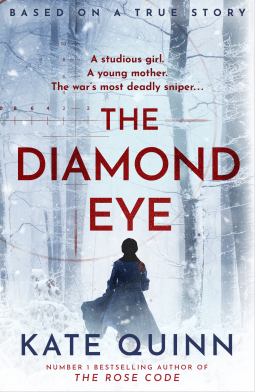
Book cover of The Diamond Eye by Kate Quinn

In 1937 in the snowbound city of Kyiv, wry and bookish history student Mila Pavlichenko organizes her life around her library job and her young son – but Hitler’s invasion of Ukraine and Russia sends her on a different path. Given a rifle and sent to join the fight, Mila must forge herself from studious girl to deadly sniper – a lethal hunter of Nazis known as Lady Death. When news of her three hundredth kill makes her a national heroine, Mila finds herself torn from the bloody battlefields of the eastern front and sent to America on a goodwill tour.

Still reeling from war wounds and devastated by loss, Mila finds herself isolated and lonely in the glittering world of Washington, DC – until an unexpected friendship with First Lady Eleanor Roosevelt and an even more unexpected connection with a silent fellow sniper offer the possibility of happiness. But when an old enemy from Mila’s past joins forces with a deadly new foe lurking in the shadows, Lady Death finds herself battling her own demons and enemy bullets in the deadliest duel of her life.

Format: Hardcover (448 pages) Publisher: HarperCollins
Publication date: 31st March 2022 Genre: Historical Fiction

Find The Diamond Eye on Goodreads

Purchase The Diamond Eye from Bookshop.org [Disclosure: If you buy books linked to our site, we may earn a commission from Bookshop.org, whose fees support independent bookshops]


My Review

A female sniper who became known as ‘Lady Death’ because of the number of authenticated ‘kills’ she made and who served in the Russian army on the frontline in World War 2. That’s got to be a work of the imagination, right? But it’s not because The Diamond Eye is based on the real life story of Lyudmila Pavlichenko. And if you think she must have be an exception then you’ll be fascinated to learn from the author’s Historical Note that over 800,000 woman served in the Soviet armed forces, many in non-frontline roles but also employed as tank drivers and snipers. The author’s earlier novel, The Huntress, revealed the role of a Russian all-female night bomber regiment known as the ‘Night Witches’.)

The story alternates between Lyudmila’s experiences on the front line from 1941 during the siege of Odessa and her visit to the United States in 1942 as part of a Soviet delegation attempting to obtain the intervention of America in the war in Europe. At that time, Soviet forces were under severe pressure from the German army. There is also a secondary plot involving an unnamed marksman seeking to use Lyudmila as a scapegoat for an assassination attempt on a high-profile figure (think Day of the Jackal) which is purely the product of the author’s imagination.

With the exception of the aforementioned subplot, the book closely follows events in Lyudmila’s life, including the strangely prurient questions she is asked by journalists during her time in the United States and the friendship that develops between her and the President’s wife, Eleanor Roosevelt. What the author adds is an insight into Lyudmila’s thoughts, fears and emotions, as well as filling in some of the gaps and inconsistencies in the historical record. Soviet propaganda sought to present Lyudmila in a particular light in order to further its aims. The author cleverly exposes this by including excerpts from two versions of Lyudmila’s memoirs at the start of certain chapters: one ‘official’ and one ‘unofficial’, the latter revealing her true thoughts about her experiences and her sparky humour.

The most compelling parts of the book for me were the section describing Lyudmila’s experiences on the front line. These scenes are vividly realisitic, demonstrating the visceral and brutal nature of war. ‘We lived fear, breathed fear, ate and drank and sweated fear.’ One minute a comrade is standing beside you, the next they’re blown to pieces. Lyudmila herself is seriously injured a number of times, as she was in real life. It’s no wonder that in such situations people seek an emotional connection with others even, as it often turns out, it is fleeting and destined to end in tragedy.

One of Lyudmila’s most important relationships is that with her fellow sniper, Kostia, who becomes her partner on missions. It’s a relationship that requires the utmost trust on both sides and Lyudmila discovers that Kostia shares her precise attention to detail, guile, relentless determination and superb markmanship. Their partnership becomes such that they instinctively know each other’s intentions. The descriptions of the long hours they spend staking out targets waiting for that perfect moment to strike are utterly compelling. The technical details of these missions is obviously the product of an immense amount of research by the author.

The fact that Lyudmila was a Ukranian fighting in the army of the Soviet Union in defence of its enemies (in this case Nazi Germany) is just one of the ironies about her story given current events in Ukraine.

The Diamond Eye is a completely absorbing story, punctuated by moments of drama and intense emotion.

I received a review copy courtesy of HarperCollins via NetGalley. (This was previously the oldest title on my NetGalley shelf. That honour now goes to The Belladonna Maze by Sinead Crowley.)

In three words: Powerful, moving, immersive
Try something similar: The Women by Kristin Hannah


About the Author

Author Kate Quinn

Kate Quinn is the New York Times and USA Today bestselling author of historical fiction. A native of southern California, she attended Boston University where she earned a Bachelor’s and Master’s degree in Classical Voice. She has written four novels in the Empress of Rome Saga, and two books in the Italian Renaissance, before turning to the 20th century with The Alice Network, The Huntress, The Rose Code and The Diamond Eye. All have been translated into multiple languages. Kate and her husband now live in San Diego with three rescue dogs. (Photo: Goodreads)

Connect with Kate
Website | Facebook | Instagram | Goodreads

#Extract The Tudor Prophecy by Julie Strong

My guest today on What Cathy Read Next is Julie Strong whose novel The Tudor Prophecy will be published on 25th January 2025 by OC Publishing. It’s described as an ‘epic, literary tale – a Game of Thrones meets Little Women’ and ideal for fans of the Wolf Hall trilogy by Booker Prize winner, Hilary Mantel. Personally, the description also brought to mind the recent film, Firebrand, based on the book Queen’s Gambit by Elizabeth Fremantle.

I’m delighted to bring you an extract from The Tudor Prophecy which is available to pre-order now from Amazon UK.

My thanks to Anne O’Connell at OC Publishing for inviting me to take part in the launch celebrations for The Tudor Prophecy. You can find details of the virtual tour for the book here.


About the Book

Front cover of The Tudor Prophecy by Julie Strong

England, 1541. An ailing Henry VIII reigns from a contested throne. In parallel story lines, The Tudor Prophecy follows two young women, Lady Alice Grantmire and Hester Vaughan, cousins who each suffer greatly from the King’s unjust decrees.

Lady Alice and her mother are evicted from their estate and take residence in a cottage where they earn a subsistence selling herbal remedies – until they are accused of witchcraft.

After being molested by the King, Hester is summoned to her estranged father’s home in Wales. There she becomes betrothed to a Welsh bard whose mentor has visions foretelling the ascendancy of Henry’s second daughter, Elizabeth.

When Hester encounters the eight-year-old Lady Elizabeth, the two forge a relationship whereby Hester can persuade the future queen to temper her own rule with mercy. 

Find The Tudor Prophecy on Goodreads


Extract from The Tudor Prophecy by Julie Strong

The cousins reached the chestnut tree and dropped to the grass, panting, and leaned back against its trunk. A crow, disturbed among the topmost branches, cawed in protest. Had it been interested in living flesh it would have noticed Hester, a young woman with hazel eyes wearing a red woolen dress and a white coif over her hair. It would also have observed Alice, slightly younger, garbed in blue silk and a black satin hood. But the crow, interested only in the dead, flew away.

“I have waited all day to show you,” gasped Hester, withdrawing a parchment from her sleeve. “I have an audience with His Majesty tomorrow!”

Alice’s eyes widened and her hand flew to her mouth. “Surely you jest!”

Hester frowned at this response and stared up at the chestnut tree’s canopy of pink and white flowers. The tree had been late to bloom this year of Our Lord, 1541. It had been a harsh winter, and folks whispered this was God’s punishment of England. King Henry VIII should never have defied the Holy Father in Rome and installed himself as Head of the Church. But folks whispered softly, for fear of losing their tongues to a steel blade.

A petal drifted onto Hester’s skirt. “In the legends of King Arthur, the knight always weds the damsel who heals him. And I shall heal his Majesty’s leg ulcers.” She spoke vehemently, then under her breath murmured, “I must, for I have no other recourse.” She twirled the petal between fingers and thumb a moment before crushing it. “Father will send for me soon, and I do not want to return to Wales to marry a gentleman farmer of his choosing.” Wales. The very name sounds dismal.

The young women sat halfway up a hill overlooking Hartbourne, the ancestral home of Sir Hugh, Alice’s father, situated near Richmond, ten miles south of London. The old stone mansion was surrounded by fields in which workers scythed the first of the new hay, sending the fragrance upwards.

“Do you forget the King has a wife already?” asked Alice, taking out her embroidery.

“Cat Howard?” Hester sniffed, grimacing. “They are wed near a year and she is not yet with child. She is barren.” Hester dropped her voice. “And ’tis said she has a paramour at court.” She looked around to ensure they were alone, then louder asserted, “Besides, she was penniless when the King wed her, so he will not mind my being so.” Hester stared above at a solitary cloud that drifted, white and fluffy, in a perfect blue sky. Blue was the colour of the Virgin Mary’s mantle, and it seemed fitting that the month of May was dedicated to Our Lady.

“I know you are doing this for Dickie,” said Alice, her eyes softening as she touched her cousin’s arm. “If Father comes to grief and Mother and I are forced to leave Hartbourne, we women may find refuge in the remains of a convent, but…”

“Dickie would not be permitted,” concluded Hester, her eye- brows knitted together. “But,” she added with a gnawing of envy in her gut, “you are an heiress, you would not remain there for long.”

“If Henry takes our land, I shall. But I would love to have a family. Mother worries I shall marry a Protestant and damn my soul for eternity.” Alice sighed, then laughed. “I shall not meet any men, Protestant or otherwise, in a nunnery.” She pouted. “But have you thought how any woman could have marital…. The king is so huge larded every prize hog in the land is called Harry after him.” Alice selected a strand of crimson thread for the poppies bordering the figure of Saint Anne teaching her daughter, the Virgin Mary, to read.

Hester pretended not to hear and stretched her arms above her head. This last winter had seen her develop from a wild colt of a girl into a comely young woman. Fresh stitching ran down the sides of her bodice, where the seams had been let out again just the previous week. Hester knew Alice spoke truth about the King’s huge bulk, but she squeezed her eyes shut and focused on enjoying the warmth of the spring sun on her face.

“I am tired, for I was singing lullabies to Dickie until past mid- night. John is a great help, but he does not understand Dickie’s fear of the dark, or that he doesn’t like getting soap in his eyes when his hair is washed.” Hester brushed away a fly that landed on her forehead.

“You have been like a mother to him, bathing him, helping him dress,” said Alice, “but now John can—ouch!”

Hester sat up. “Are you hurt?”

“I jabbed my finger, but it is fine. What I was saying is that John has only been with us a week, and—but look, here comes Dickie.”


About the Author

Julie Strong, author of The Tudor Prophecy

Julie Strong is a soon-to-be-retired family physician in Halifax, Nova Scotia; she has an ongoing shamanic practice where she addresses the spiritual causes of illness. 

Julie was born in Manchester, England, grew up in Wales, Australia, and Ireland, and emigrated to Canada in 1980. Her medical degree is from Trinity College, Dublin University, Ireland, and she holds a BA in Classics from Dalhousie University, Halifax. Her shamanism training is from the Foundation for Shamanic Studies in Marin County, California. 

Dr. Strong has given presentations in Canada, the US, and Europe on the subject of insanity in ancient Greek literature. She presented a three-part series on Greek mythology at Halifax Central Library in spring 2018 and also “Finding Comfort in Difficult Times,” an overview of shamanism, in fall 2021. She is a lecturer with the Senior College Association of Nova Scotia (SCANS) and delivered a six-week course, The Goddess in Antiquity, in spring 2024, which emphasized humanity’s need to reconnect with Nature and the Divine Feminine. 

Julie’s essays appear in several anthologies, including Letting Go (Bacon Press Books, 2016) and Much Madness, Divinest Sense (Pottersfield Press, 2017). Her story “Alice’s Bonfire” won the Budge Wilson Short Fiction Prize from the Writers’ Federation of Nova Scotia in 2010, and her play, Athena in Love, was awarded “best new play” in the Halifax Fringe Festival in 2012. The Tudor Prophecy is her first novel. Julie is presently working on Keeping it Together Down Under, a memoir of how she and her younger sister were transplanted from their home in the UK to an orphanage in Tasmania, Australia, in the mid-1960s.

Julie, who has three grown children and three grandchildren, plays viola in an amateur string quartet and orchestra and loves dancing and pickleball.