Book Review: City of Masks by S. D. Sykes

Engaging historical mystery set in 14th century Venice
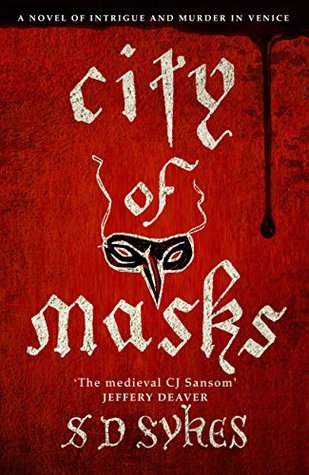
CityofMasksAbout the Book

Description (courtesy of Goodreads): It’s 1358, and young Oswald de Lacy, Lord Somershill, is delayed in Venice as he awaits a pilgrim ship to the Holy Land. While the city is besieged by the King of Hungary, Oswald stays at the house of an English merchant, and soon comes under the spell of this decadent and dazzling island state that sits on the edge of Europe—where East meets West.

But Oswald has secrets. He is running away from something in England—a shadow that still haunts him, no matter how much he consoles himself with the delights of Venice. When he finds a dead man at the carnival, he is dragged into a murder investigation that draws him deep into the intrigues of this paranoid, mysterious city.

From the dungeons of the Doge’s Palace to the convent-brothel of Santa Lucia, Oswald must search for a murderer in this bewildering maze of alleys and canals. When he comes up against the feared Signori di Notte, the secret police, Oswald learns that he is not the only one with something to hide. Everyone is watching (or trailing) someone else; and nobody in Venice is who they appear to be. Masks, it seems, are not only for the carnival…

Book Facts

  • Format: Hardcover
  • Publisher: Hodder & Stoughton
  • No. of pages: 336
  • Publication date: 13th July 2017
  • Genre: Historical Fiction, Historical Mystery

To pre-order/purchase City of Masks from Amazon.co.uk click here (link provided for convenience, not as part of any affiliate programme)

Find it on Goodreads


My Review

This is the third book in S. D. Sykes’ Somershill Manor series. I felt it worked fine as a standalone book and I didn’t consider not having read the earlier books affected my enjoyment. If anything, it made me curious to read the previous books in the series.

In fact, the reader is given some insights into the past of our hero, Oswald de Lacy, Lord Somershill, which may or may not be part of previous books.   In a very inventive way, the author gives us clues about the reason for Oswald’s tendency to lapse into periods of troubled melancholy.  However, most of the time, he is a sprightly hero with an eye for a beautiful lady, a love of wine and not averse to a spree at the gambling tables.

Alongside Oswald is a cast of colourful characters who may or may not be involved in the murder he sets out to investigate. You will probably suspect just about everyone before the true culprit is revealed.  My favourite character was Oswald’s domineering mother (who I suspect in reality would have been dead for many years, life expectancy then being much less). Fourteenth century Venice makes the ideal setting for a mystery with its narrow streets, spies, canals, political intrigue, masks and its situation as a melting pot of different nationalities on the pilgrimage trail to Jerusalem. There are plenty of twists and unexpected reveals that make City of Masks a thoroughly entertaining read for fans of historical mysteries.

I received an advance reader copy courtesy of NetGalley and publishers, Hodder & Stoughton, in return for an honest review.

Follow my blog with Bloglovin

In three words: Lively, engaging, mystery

Try something similar…The Venetian Contract by Marina Fiorato


SDSykesAbout the Author

S. D. (Sarah) Sykes lives in Kent, but grew up in Somerset and then South London. She is a graduate from Manchester University and was inspired to finish her first novel, Plague Land, after attending the novel writing course at literary agents, Curtis Brown. She has also written for radio and has developed screenplays with Arts Council funding. She has a passion for medieval history, and her books in the Somershill Manor series, are set in 14th Century England.

Connect with Sarah

Website http://www.sdsykes.co.uk/
Twitter https://twitter.com/SD_Sykes
Goodreads


Book Review: House of Names by Colm Toibin

HouseofNamesAbout the Book

Publisher’s description: ‘They cut her hair before they dragged her to the place of sacrifice. Her mouth was gagged to stop her cursing her father, her cowardly, two-tongued father. Nonetheless, they heard her muffled screams.’ On the day of his daughter’s wedding, Agamemnon orders her sacrifice. His daughter is led to her death, and Agamemnon leads his army into battle, where he is rewarded with glorious victory. Three years later, he returns home and his murderous action has set the entire family – mother, brother, sister – on a path of intimate violence, as they enter a world of hushed commands and soundless journeys through the palace’s dungeons and bedchambers. As his wife seeks his death, his daughter, Electra, is the silent observer to the family’s game of innocence while his son, Orestes, is sent into bewildering, frightening exile where survival is far from certain. Out of their desolating loss, Electra and Orestes must find a way to right these wrongs of the past even if it means committing themselves to a terrible, barbarous act.

Format: ebook Publisher: Viking Pages: 260
Publication: 18th May 2017 Genre: Historical Fiction    

Purchase Links*
Amazon.co.uk ǀ Amazon.com ǀ Barnes & Noble
*links provided for convenience, not as part of any affiliate programme

Find House of Names on Goodreads


My Review

House of Names is Colm Tóibín’s retelling of the myth of Clytemnestra, wife of Agamemnon, and mother of Orestes, Electra and Iphigenia. According to one of many versions of the legend, Iphigenia is sacrificed by Agamemnon in order for the Gods to grant a favourable wind for his fleet of ships to sail to Troy. In revenge, Clytemnestra murders Agamemnon on his return from the Trojan Wars and she is in turn murdered by her son, Orestes.

At the outset, I have to say that, although some of the names were familiar to me, I was unfamiliar with the detail of the myth, or its different versions, until I researched it once I’d finished the book. So while reading it I had no idea how much of the story was from the author’s own imagination or an embellishment of a well-established legend.

Colm Tóibín presents the story from the viewpoints of Clytemnestra, Orestes and Electra. Clytemnestra’s story is told in the first person and this allows the reader to experience first-hand her grief at the death of her daughter, Iphigenia, her anger at the deception which delivered Iphigenia to her death and her implacable desire for revenge against her husband, Agamemnon.  As Electra later reflects, ‘She was a woman filled with a scheming hunger for murder’.

Electra’s story is also told in the first person. She is observant, watchful, interpreting character from gestures and looks that others might miss. For example, this description of her mother’s lover, Aegisthus:

‘Aegisthus is like an animal that has come indoors for comfort and safety. He has learned to smile instead of snarl, but he is still all instinct, all nails and teeth. He can sniff out danger. He will attack first. He will arch his back and pounce at the slightest hint of a threat.’

Unlike her mother, Electra maintains her belief in the gods and that they will assist her in revenging the murder of her father by Clytemnestra when the time comes.

‘Each day, I appeal to the gods to help me prevail…I appeal to them to give my own spirit strength when the time comes. I am with the gods in their watchfulness as I watch too.’

Between the accounts narrated by Clytemnestra and Electra, are sections describing the kidnap (as it turns out to be) of Orestes, his escape alongside his friends, Leander and Mithros, and his eventual return to the Palace. I liked the way the author captured Orestes’ initial confusion about his kidnap, about where he was being taken and his understandable obsession with food and drink. With childish simplicity, Orestes categorises his two guards as the ‘nice’ one and the ‘nasty’ one but doesn’t understand why the ‘nice’ one won’t engage in sword play with him as before.  For me, these sections, written in the third person, didn’t have the immediacy of the sections from the point of view of Electra and Clytemnestra.   The latter part of the book, once Orestes has returned to the Palace, were more engaging as he gradually realises he has been used as a tool by most of those around him, even his close friend, Leander.

Although this is my first book by Colm Tóibín, his reputation precedes him and I think I was expecting to be more blown away by his writing than I was in this book. There were only a few passages that came close to what I was hoping for and these tended to be in the sections focusing on Clytemnestra and Electra. For instance, Electra’s observation on Aegisthus’ sexual conquests: ‘The rooms beneath us were thus filled with this fecundity as the corridors were filled with rough desire.’ Having said this, I enjoyed the book and I will certainly look forward to reading other books by this author.

I received an advance reader copy courtesy of NetGalley and publisher s, Viking, in return for an honest review.

Follow my blog with Bloglovin

In three words: Dramatic, intimate, mythology

Try something similar…The Song of Achilles by Madeline Miller


Colm ToibinAbout the Author

Colm Tóibín was born in Enniscorthy, Co. Wexford in 1955. He studied at University College Dublin and lived in Barcelona between 1975 and 1978. On his retur to Ireland in 1978 he worked as a journalist becoming features editor of ‘In Dublin’ in 1981 and editor of Magill, Ireland’s current affairs magazine, in 1982. He left Magill in 1985 and travelled in Africa and South America. His novels include: The Blackwater Lightship (shortlisted for the IMPAC Dublin Prize and the Booker Prize and made into a film starring Angela Lansbury); The Master (winner of the Dublin IMPAC Prize, the Prix du Meilleur Livre, the LA Times Novel of the Year and shortlisted for the Booker Prize); Brooklyn (winner of the Costa Novel of the Year). His work has been translated into thirty languages and he has received honorary doctorates from the University of Ulster and from University College Dublin. In 2006 he was appointed to the Arts Council in Ireland. He is currently Leonard Milberg Lecturer in Irish Letters at Princeton University.

[Can I just say that the photo is how I imagine the study of every writer should look]

Connect with Colm

Website ǀ Goodreads


BookConnector