Fred’s Funeral by Sandy Day

When an author contacts you about reviewing their book and the description sounds enticing it’s frustrating to know that it’s going to be several months before you’ll be able to get around to reading and reviewing their book.  Such is the case when Sandy Day contacted me about her book, Fred’s Funeral.    However, although it’s going to be a while until I get to read it, that doesn’t mean I should hide it away from followers of my blog who may not have such a large review pile as I do…

You can find an extract from the book below.  Also, click here to read an interview with Sandy in which she talks about the inspiration for Fred’s Funeral and her approach to writing.
Follow my blog with Bloglovin


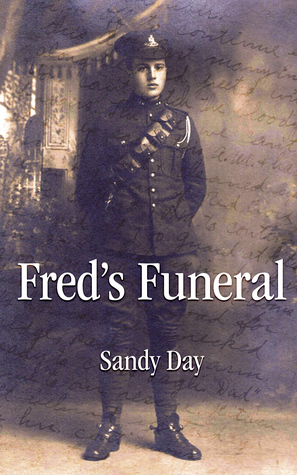
Fred's FuneralAbout the Book

Fred’s Funeral is a short novel set in 1986. Fred Sadler, a WWI veteran, has just died of old age and his dismayed ghost now discovers that the arrangement of his funeral has fallen to his prudish sister-in-law, Viola. As Viola dominates the remembrance of Fred, he agonizes over his inability to set the record straight. Was Fred Sadler really suffering from shell shock? Why was he locked up most of his life in the Whitby Hospital for the Insane? Could his family not have done more for him? Fred’s memories of his life as a child, his family’s hotel, the War, and the mental hospital, clash with Viola’s version of events as Fred’s family gathers one rainy October night to pay their respects. Readers of literary historical fiction will enjoy Fred’s Funeral.

Format: eBook, paperback (129 pp.)       Publisher:
Published: 28th November 2017              Genre: Literary Fiction

Purchase Links*
Amazon.co.uk  ǀ  Amazon.com  ǀ Kobo ǀ iBook
*links provided for convenience, not as part of any affiliate programme

Find Fred’s Funeral on Goodreads


Extract from Fred’s Funeral by Sandy Day

1928, Ontario.

At his father’s repeated insistence, Fred finds work away from Lakeview House with a highway construction crew. It’s hot. Hotter than Arabia and dustier than a coal shed. He’d much rather be puzzling over a 36-degree gradient with a slide rule and graph paper, but jobs like that are for men with experience, and that, he has to admit he is a little short on. He detests physical labour – it gives his brain too much time to think. And it baffles him that the men around him don’t seem to mind the tedious digging and heaving and plodding in the heat he finds so torturous. They just toil away, humming, and talking, smoking their cigarettes.

Fred’s mind whirs like a radiometer as he works. He recalls the ass he made of himself when he last saw his cousins Pauline and Gertrude. He can never seem to catch Pauline alone. He is tongue-tied around her, and irritated by that nosy old Gertrude, whom he suspects laughs and makes fun of him behind his back. What is the point of it anyway? Pauline is his cousin for Chrissake. Why can’t he just leave her alone? Find another girl he likes?

And he replays the argument he had with Thomas on the weekend about the Chinese family their father hired to work in the hotel laundry. That one old Chinese lady scolded him for parking on the lawn where he always parks the car! And he told her to go fuck herself. Oh, that had been a mistake. Why did Thomas never lose his temper? Why was it always Fred getting into trouble?

His mind frets over the money he owes his father and how it keeps racking up and he never seems able to pay it back. He kicks himself for spending all his pay from the service – it had seemed like such a large sum at the time – he didn’t realize how quickly he’d fritter it away.

There must be something wrong with his nerves. This can’t be normal. He’s afraid he’s done permanent damage and reminds himself again to go pick up a bottle of vitamins at the drug store. That must be why his hands are so tremulous. He wonders if anyone notices. It can’t be something he’s doing to himself, can it? He needs an outlet for his pent up energy, but he could scarcely talk to a woman, which brings him back to Pauline, and the whole circus starts up again.

By the time the foreman blows the whistle, Fred has sweated off more pounds, which is no good whatever because his stomach is in such a knot these days he barely eats anymore. His belt is well past the last notch and hangs down the leg of his work pants. He should just cut it off. But what if he gains the weight back? He doesn’t want to go ruining a perfectly good belt.

Fred’s back is to him so he doesn’t know how or why the damn fool plunges his hand into a pail of boiling tar but Fred hears the man howl and the whole world goes black. The rat-a-tat-tat of guns shatters the air and missiles whistle past Fred’s head. He ducks and instinctively curls into a ball, pulling for his tin hat. The foreman shakes Fred by the shoulder. “Sadler! Sadler! What the hell’s the matter with you?” A sergeant is shouting. Fred can still hear the poor sod wailing. Slowly, and with growing mortification, Fred realizes the bawling is coming from his own throat and that he’s crouching on a dry dusty roadbed somewhere in Southern Ontario.

Fred’s pants are wet. He’s pissed himself.

He watches helplessly as the tar-scalded man is whisked away to the hospital. “You better go home, Sadler.” The foreman shakes his head.

Fred’s parents will be angry. He’s gone and messed up another perfectly good job, disgraced himself. What is wrong with his damn head?


Sandy DayAbout the Author

Sandy Day is the author of the soon to be released, Chatterbox, Poems. She graduated from Glendon College, York University, with a degree in English Literature sometime in the last century. Sandy spends her summers in Jackson’s Point, Ontario on the shore of Lake Simcoe. She winters nearby in Sutton by the Black River. Sandy is a trained facilitator for the Toronto Writers Collective’s creative writing workshops. She is a developmental editor and book coach.

Connect with Sandy

Website ǀ  Facebook  ǀ  Twitter  ǀ  Goodreads


Blog Tour/Q&A: The Runaway Wife by Rosie Clarke

The Runaway Wife - Blog Tour banner

I’m delighted to be hosting today’s stop on the blog tour for Rosie Clarke’s latest historical novel, The Runaway Wife.  Rosie is pretty much an unstoppable force when it comes to writing, having written around 100 books under different pen names.  Therefore, I’m so pleased she’s taken a temporary break to give us an insight into how she comes up with the ideas for her books and how she lets her characters tell their stories.

Follow my blog with Bloglovin


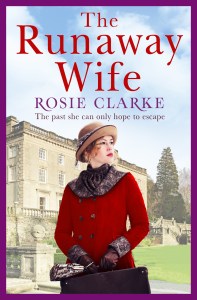
THE RUNAWAY WIFE COVERAbout the Book

Love, marriage, obsession, betrayal and treachery in 1920s London –  a powerful and gritty saga perfect for fans of Kitty Neale, Josephine Cox and Rosie Goodwin.

The hedonism of London in the roaring ’20s is a world away from Annabel Tarleton’s ordinary country existence. Until a chance meeting with the charming Richard Fortescue at a society ball changes her life for ever. Swept off her feet by the dashing Richard, and his renowned fortune, Annabel soon realises that all that glitters isn’t gold. Her bid for freedom has come at a terrible price and she finds herself trapped inside a marriage that behind closed doors is cruel and brutal.

Annabel has no choice but to flee, and will do everything to save herself, and her unborn baby, from destitution. But the very rich and very powerful expect to get what they want – and Richard wants only one thing – Annabel…

Format: ebook (255 pp.)                    Publisher: Aria Fiction
Published: 1st February 2018          Genre: Historical Fiction

Purchase Links*
Amazon.co.uk  ǀ  Kobo ǀ iBooks ǀ Google Play
*links provided for convenience, not as part of any affiliate programme

Find The Runaway Wife on Goodreads


Interview with Rosie Clarke, author of The Runaway Wife

Without giving too much away, can you tell me a bit about The Runaway Wife?

Annabel is her mother’s daughter.  Taught to expect to marry well and to be a credit to her name, but that isn’t the reason she allows her mother to bully her.  Underneath her meekness, Annabel is brave and she seeks to protect those she loves: her younger sister and her brother, who is older but has to carry so much of the burden of a struggling estate and his mother’s displeasure.  When she is finally pushed into a marriage with a man who is as cruel as he is rich, a girl like that will break all the rules.

What was the inspiration for the book?

I never know why I write a particular book.  Usually there isn’t any particular reference point that turns a light bulb on and makes me think I’ll write about this or that.  However, things drip feed into your subconscious and perhaps I’d been watching or reading about abusive men.  I wanted a story that I could connect up with Jessie’s Promise without being a sequel to her story and Annabel just suddenly took root.  Once her mother started nagging I knew she had to make an unhappy marriage and Richard immediately strutted centre stage.  He was so damned sure of himself and so careless of others that I knew he had to be really nasty.

The book involves the portrayal of an abusive marriage.  Were there scenes you found difficult to write?

No, I enjoyed writing them.  Once I’m into Annabel’s character I’m feeling her misery and I wanted to hit back so I needed to really feel how she felt.  It was so difficult for her to think of actually walking out of her marriage so she tried other methods first until she understood that he might kill her in one of his rages and then she had to go.

How did you approach the research for the book? Do you enjoy the process of research?

I don’t do hours and hours of research.  I did this once for a period I didn’t know and it came out like a history lesson and I had to rewrite the whole thing.  I always know a bit about what I am writing and then when I need specific details I research that in books, internet and watch TV programmes set in the period if I can.  Watching the period you need is great, though it only gives you the feel and you still have to research dates and details.

The Runaway Wife is set in the 1920s. What do you think is the key to creating an authentic picture of a particular historical period?

First ask your characters to come and once they do you know where they belong.  All my books are character led and then I paint a picture in words of their surroundings.  Annabel is very much a young woman of the thirties, smart, intelligent but still chained by her mother’s old-fashioned ideas and strictures.  Only when she breaks free from her mother’s domination can she be herself. So once you know that you research that period and blend it into the story.

All your books are set in the first half of the 20th century.  What is it that attracts you to this period?

For my sagas I tend to write mostly about the period I know more about but I’ve also written other periods under other names, historical, twenties, all sorts.

You’ve written over one hundred books under a number of different pen names.  Where do you get all your ideas?

It is like a train station.  I have to use the signals to keep some of them waiting while the others are in the station.  New ideas come all the time.  [Cathy: I love that way of describing it!]

Do you have a special place to write or any writing rituals?

I have my study, which has all my printers, computers and books together and is very comfortable.

Which other writers do you admire or enjoy reading?

Oh, so many.  I love Georgette Heyer but I also love Matthew Harffy’s work, which is Saxons fighting in early Britain.  I’m just reading a good Viking trilogy, and I also enjoy Sarah Flint’s thrillers.  I like family sagas, though I try not to read these all the time because I don’t want to cross threads with my own work.

What are you working on next?

At the moment I’ve just started a standalone Christmas book but I am also thinking about the next in the Mulberry Lane series.  Thank you for having me on your blog and I hope your readers enjoy my answers, and try my books.


Clarke_RosieAbout the Author

Rosie Clarke was born in Swindon, but moved to Ely in Cambridgeshire at the age of nine. She started writing in 1976, combining this with helping her husband run his antiques shop. In 2004, Rosie was the well-deserved winner of the RNA Romance Award and the Betty Neels Trophy.

Rosie also writes as Anne Herries and Cathy Sharp.

Connect with Rosie

Website ǀ  Twitter  ǀ  Goodreads