
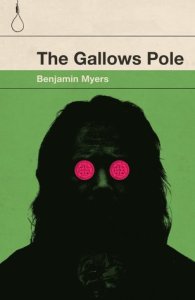
 About the Book
“I saw them. Stag-headed men dancing at on the moor at midnight, nostrils flared and steam rising…”
An England divided. From his remote moorland home, David Hartley assembles a gang of weavers and land-workers to embark upon a criminal enterprise that will capsize the economy and become the biggest fraud in British history. They are the Cragg Vale Coiners and their business is ‘clipping’ – the forging of coins, a treasonous offence punishable by death. A charismatic leader, Hartley cares for the poor and uses violence and intimidation against his opponents. He is also prone to self-delusion and strange visions of mythical creatures.
When excise officer William Deighton vows to bring down the Coiners and one of their own becomes turncoat, Hartley’s empire begins to crumble. With the industrial age set to change the face of England forever, the fate of his empire is under threat.
Forensically assembled from historical accounts and legal documents, The Gallows Pole is a true story of resistance that combines poetry, landscape, crime and historical fiction, whose themes continue to resonate. Here is a rarely-told alternative history of the North.
Format: ebook, paperback, hardcover (360 pp.) Publisher: Bluemoose Books
Published: 17th May 2017 Genre: Historical Fiction
Purchase Links* (Kindle edition currently 99p on Amazon UK)
Amazon.co.uk ǀ Amazon.com ¦ Publisher ǀ Hive.co.uk (supporting UK bookshops)
*links provided for convenience, not as part of any affiliate programmePublisher
Find The Gallows Pole on Goodreads
My Review
The Gallows Pole is one of the books long-listed for The Walter Scott Prize for Historical Fiction 2018. Click here for the full long-list and links to information or my reviews of the long-listed books.
The book recounts events that took place in Calderdale, West Yorkshire, over a few years in the 1760s: the exploits of a gang known as the ‘Cragg Vale Coiners’. ‘Coining’ was the illegal practice of removing shavings of gold from the edges of genuine coins, milling the edges of those coins smooth again and then using the shavings to produce counterfeit coins.
The narrative is interspersed with excerpts from a document written in the first person using vernacular dialogue, eccentric spelling and very little punctuation. Its author is the so-called ’King’ of the coiners, David Hartley. It’s his jail cell testimony – not confession, mind you – he’s keen to point that out. Hartley recounts his first exposure to the coining process in the forges of The Black Country: ‘…What they done is smelt and pour and hammer and mould What they done is hoist and heft and scald and steam And what they done was learn us a new trayde a new way.’
The Gallows Pole transports the reader to a period when the first impact of industrialization and mechanisation was starting to be felt by residents of places like Calderdale. Power was becoming concentrated in the hands of landowners, of factory and mill owners and employment was taking the place of self-employment or small-scale agriculture. Old ways were coming into conflict with the forces of progress and modernity. For many ordinary people, their whole way of life was changing, not necessarily for the better (reminiscent in some ways of the modern day impact of globalisation). It’s not surprising that desperation and poverty should force some to look outside the law for the means to survive. Or, that men like Hartley, should reject the notion of change altogether. [Readers who dislike swearing should skip the next quotation.]
‘An he seys the day of the hand loom is over mass produckshun is cumin wether you lyke it or not aye mass produckshun and organysed laber is what I’m talkin abowt and if youv got any sens about yer yerll embrayce the new ways. And I says fuck the new ways and fuck the company and fuck your fucken scut with a rusted nyfe if yor still thinken on telling King David of Cragg Vale wer it is he can or cannit wander you soppybolickt daft doylem fiddler of beests.’
I think you may be starting to get a sense that creative use of language is a key element of this book. [Can I give a shoutout to the copy editors and proof-readers of the book at this point.] The author evocatively conjures up the atmosphere of the moors; its bleakness but also its harsh beauty. ‘Then when the downpour eased and the clouds passed over to slowly bank across the open moors in the direction of Haworth, the valley slopes were left with a fresh dusting of white, a patchwork of powdered shapes divided by the black streaks of stone walls that snaked over and around copses, hamlets and the top quarries…’
There is a rhythmic, almost poetic quality to the language with frequent use of alliteration and assonance: ‘In to dell and dingle. Gulch and gully.’ ‘From the dells and dales and dingles.’ ‘Slipping and sliding. Gasping and striding.’ Some of the prose is positively audacious – for its use of repetition:
‘Tom Spencer walked to Horsehold and folk there gave up their coin. Tom Spencer walked to Burnt Stubb and folk there gave up their coin. Tom Spencer walked to Boulder Clough and folk there gave up their coin. Tom Spencer walked to Midgley and folk there gave up their coin…’
And for the lists – sometimes long lists – of names and of places giving a sing-song quality to the writing.
‘Up they came and over they came and through they came. Many men.
Isaac Dewhurst and Absolom Butts.
Thomas Clayton and Benjamin Sutcliffe.
Abraham Lumb and Aloysius Smith and Nathan Horsfall and Matthew Hepworth and Joseph Gelder and Jonathan Bolton.
John Wilcox and Jonas Eastwood.
Fathers and brothers and sons and uncles. Up they came. And others too.’
The language at times is earthy and raw with visceral descriptions of bodily sensations and creative evocations of sights, sounds, smells, tastes. ‘Soot and ash. Snot and spume. Quag and sump and clotted moss.’
The story that unfolds is as compelling as the language. However, despite his criminal activity and the violence perpetrated by those around him, the reader is left with a sense of David Hartley as a tragic figure. He certainly becomes a folk hero in the eyes of the local community. That is, to those who don’t attempt to resist him, swindle him, usurp him or bring him to justice. Retribution is swift and violent for them.
There is a real sense of period atmosphere in The Gallows Pole, of a time when life was hard for many and death was an often close companion. It was definitely not the time or place to be a woman; relegated to the role of child bearer, provider of sexual pleasure (willingly or not) and household drudge. The only sign of tenderness is between Hartley and his wife, and even that is relative.
The Gallows Pole made a deep impression on me. The story was powerfully told and had a marvellous sense of authenticity. However, it was the imaginative writing that really drew me in. It may not turn out to be the closest to my heart of the books on the long-list but its author has certainly earned my admiration. I realise it’s early to be making predictions, especially as I haven’t read all the books on the long-list yet. Nevertheless, I’m going to stick my neck out and say I can see The Gallows Pole being the Days Without End of 2018. In other words, not only making the shortlist but possibly being the eventual winner. If I’m wrong, forget you read this. If it turns out I’m right, remember, you saw it here first.
In three words: Gritty, compelling, immersive
Try something similar…Days Without End by Sebastian Barry (click here to read my review)
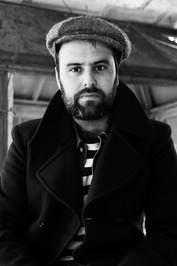 About the Author
Benjamin Myers was born in Durham, UK, in 1976. He is an award-winning author and journalist. As a journalist he has written about the arts and nature for publications including New Statesman, The Guardian, NME, Mojo, Time Out, New Scientist, Caught By The River, The Morning Star, Vice, The Quietus, Melody Maker and numerous others.
Pig Iron (2012) was the winner of the inaugural Gordon Burn Prize and runner-up in The Guardian’s Not The Booker Prize. A controversial combination of biography and novel, Richard (2010), was a bestseller and chosen as a Sunday Times book of the year. Myers’ short story ‘The Folk Song Singer’ was awarded the Tom-Gallon Prize in 2014 by the Society of Authors and published by Galley Beggar Press. His short stories and poetry have appeared in dozens of anthologies.
His novel Beastings (2014) won the Portico Prize For Literature, was the recipient of the Northern Writers’ Award and longlisted for a Jerwood Fiction Uncovered Award 2015. Widely acclaimed, it featured on several end of year lists, and was chosen by Robert Macfarlane in The Big Issue as one of his books of 2014. Turning Blue (2016) was described as a “folk crime” novel, and praised by writers including Val McDermid. A sequel These Darkening Days followed in 2017.
Recipient of the Roger Deakin Award, his novel The Gallows Pole was published to acclaim in 2017. His latest book, Under The Rock, a work of non-fiction, is published May 2018.
He currently lives in the Upper Calder Valley, West Yorkshire, UK.
Connect with Benjamin



 Plus…there’s a giveaway with a chance to win a $5 Amazon giftcard.
  About the Book
 About the Author


