

Top Ten Tuesday is a weekly meme created by The Broke and the Bookish and now hosted by Jana at That Artsy Reader Girl.
The rules are simple:
- Each Tuesday, Jana assigns a new topic. Create your own Top Ten list that fits that topic – putting your unique spin on it if you want.
- Everyone is welcome to join but please link back to The Artsy Reader Girl in your own Top Ten Tuesday post.
- Add your name to the Linky widget on that day’s post so that everyone can check out other bloggers’ lists.
- Or if you don’t have a blog, just post your answers as a comment.
This week’s topic is Frequently Used Words in (Genre) Titles. I read a lot of historical fiction so I’ve decided to concentrate on that genre. Browsing through my actual and virtual bookshelves, here are some words that caught my eye as cropping up frequently in titles:
King Queen Secret House Princess Mistress Crown Last Wife Daughter
Authors – combine all of those in a title and you’ve got a winner!
I’ve decided to concentrate on the last two and spotlight ten historical fiction novels with Wife or Daughter in the title. Clicking on the title will take you to the book’s description on Goodreads or my review.
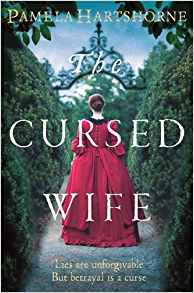 The Cursed Wife by Pamela Hartshorne
Mary is content with her life as wife to Gabriel Thorne, a wealthy merchant in Elizabethan London. She loves her husband and her family, is a kind mistress to the household and is well-respected in the neighbourhood. She does her best to forget that as a small girl she was cursed for causing the death of a vagrant child, a curse that predicts that she will hang. She tells herself that she is safe.
But Mary’s whole life is based on a lie. She is not the woman her husband believes her to be, and when one rainy day she ventures to Cheapside, the past catches up with her and sets her on a path that leads her to the gibbet and the fulfilment of the curse.
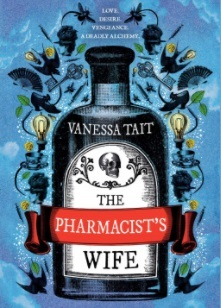 The Pharmacist’s Wife by Vanessa Tait
When Rebecca Palmer’s new husband opens a pharmacy in Victorian Edinburgh, she expects to live the life of a well-heeled gentlewoman. But her ideal is turns to ashes when she discovers her husband is not what he seems. As Rebecca struggles to maintain her dignity in the face of his infidelity and strange sexual desires, Alexander tries to pacify her so-called hysteria with a magical new chemical creation. A wonder-drug he calls heroin.
Rebecca’s journey into addiction takes her further into her past, and her first, lost love, while Alexander looks on, curiously observing his wife’s descent. Meanwhile, Alexander’s desire to profit from his invention leads him down a dangerous path that blurs science, passion, and death. He soon discovers that even the most promising experiments can have unforeseen and deadly consequences…
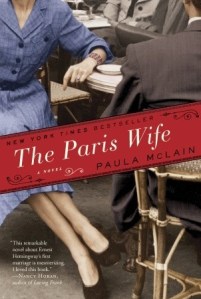 The Paris Wife by Paula McLain
Chicago, 1920: Hadley Richardson is a quiet twenty-eight-year-old who has all but given up on love and happiness—until she meets Ernest Hemingway and her life changes forever. Following a whirlwind courtship and wedding, the pair set sail for Paris, where they become the golden couple in a lively and volatile group—the fabled “Lost Generation”—that includes Gertrude Stein, Ezra Pound, and F. Scott and Zelda Fitzgerald.
Though deeply in love, the Hemingways are ill prepared for the hard-drinking and fast-living life of Jazz Age Paris, which hardly values traditional notions of family and monogamy. Surrounded by beautiful women and competing egos, Ernest struggles to find the voice that will earn him a place in history, pouring all the richness and intensity of his life with Hadley and their circle of friends into the novel that will become The Sun Also Rises. Hadley, meanwhile, strives to hold on to her sense of self as the demands of life with Ernest grow costly and her roles as wife, friend, and muse become more challenging. Despite their extraordinary bond, they eventually find themselves facing the ultimate crisis of their marriage—a deception that will lead to the unraveling of everything they’ve fought so hard for.
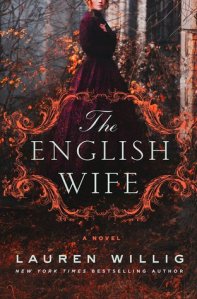 The English Wife by Lauren Willig
Annabelle and Bayard Van Duyvil live a charmed life: he’s the scion of an old Knickerbocker family, she grew up in a Tudor manor in England, they had a whirlwind romance in London, they have three year old twins on whom they dote, and he’s recreated her family home on the banks of the Hudson and renamed it Illyria. Yes, there are rumours that she’s having an affair with the architect, but rumors are rumors and people will gossip. But then Bayard is found dead with a knife in his chest on the night of their Twelfth Night Ball, Annabelle goes missing, presumed drowned, and the papers go mad. Bay’s sister, Janie, forms an unlikely alliance with a reporter to uncover the truth, convinced that Bay would never have killed his wife, that it must be a third party, but the more she learns about her brother and his wife, the more everything she thought she knew about them starts to unravel. Who were her brother and his wife, really? And why did her brother die with the name George on his lips?
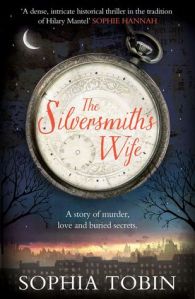 The Silversmith’s Wife by Sophia Tobin
The year is 1792 and it’s winter in Berkeley Square. As the city sleeps, the night-watchman keeps a cautious eye over the streets, and another eye in the back doors of the great and the good. Then one fateful night he comes across the body of Pierre Renard, the eponymous silversmith, lying dead, his throat cut and his valuables missing. It could be common theft, committed by one of the many villains who stalk the square, but as news of the murder spreads, it soon becomes clear that Renard had more than a few enemies, all with their own secrets to hide. At the centre of this web is Mary, the silversmith’s wife. Ostensibly theirs was an excellent pairing, but behind closed doors their relationship was a dark and at times sadistic one and when we meet her, Mary is withdrawn and weak, haunted by her past and near-mad with guilt. Will she attain the redemption she seeks and what, exactly, does she need redemption for…?
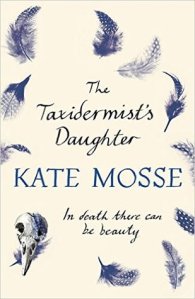 The Taxidermist’s Daughter by Kate Mosse
Sussex, 1912. In a churchyard, villagers gather on the night when the ghosts of those who will die in the coming year are thought to be seen. Here, where the estuary leads out to the sea, superstitions still hold sway.
Standing alone is the taxidermist’s daughter. At 17, Constantia Gifford lives with her father in a decaying house: it is all that is left of Gifford’s once world-famous museum of taxidermy. The stuffed animals that used to grace every parlour are out of fashion, leaving Gifford a disgraced and bitter man.
The bell begins to toll and all eyes are fixed on the church. No one sees the gloved hand pick up a flint. As the last notes fade into the dark, a woman lies dead.
While the village braces itself against rising waters and the highest tide of the season, Connie struggles to discover who is responsible, but finds herself under suspicion. Is Constantia who she seems – is she the victim of circumstances or are more sinister forces at work? And what is the secret that lies at the heart of Gifford House, hidden among the bell jars of her father’s workshop?
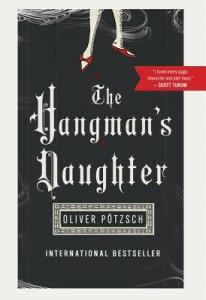 The Hangman’s Daughter by Oliver Pötzsch
Magdalena, the clever and headstrong daughter of Bavarian hangman Jakob Kuisl, lives with her father outside the village walls and is destined to be married off to another hangman’s son–except that the town physician’s son is hopelessly in love with her. And her father’s wisdom and empathy are as unusual as his despised profession. It is 1659, the Thirty Years’ War has finally ended, and there hasn’t been a witchcraft mania in decades. But now, a drowning and gruesomely injured boy, tattooed with the mark of a witch, is pulled from a river and the villagers suspect the local midwife, Martha Stechlin.
Jakob Kuisl is charged with extracting a confession from her and torturing her until he gets one. Convinced she is innocent, he, Magdalena, and her would-be suitor to race against the clock to find the true killer. Approaching Walpurgisnacht, when witches are believed to dance in the forest and mate with the devil, another tattooed orphan is found dead and the town becomes frenzied. More than one person has spotted what looks like the devil–a man with a hand made only of bones. The hangman, his daughter, and the doctor’s son face a terrifying and very real enemy.
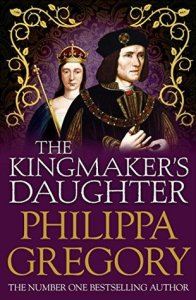 The Kingmaker’s Daughter by Philippa Gregory
The gripping and ultimately tragic story of Anne Neville and her sister Isabel, the daughters of the Earl of Warwick, the most powerful magnate in England through the Cousins’ Wars. In the absence of a son and heir, he ruthlessly uses the two girls as pawns but they, in their own right, are thoughtful and powerful actors.
Against the backdrop of the court of Edward IV and his beautiful queen, Elizabeth Woodville, Anne turns from a delightful child growing up in intimacy and friendship with the family of Richard Duke of York to become ever more fearful and desperate as her father’s enemies turn against her, the net closes in and there is, in the end, simply nowhere she can turn, no one she can trust with her life.
 The Scribe’s Daughter by Stephanie Churchill
Kassia is a thief and a soon-to-be oath breaker. Armed with only a reckless wit and sheer bravado, seventeen-year-old Kassia barely scrapes out a life with her older sister in a back-alley of the market district of the Imperial city of Corium. When a stranger shows up at her market stall, offering her work for which she is utterly unqualified, Kassia cautiously takes him on. Very soon however, she finds herself embroiled in a mystery involving a usurped foreign throne and a vengeful nobleman. Most intriguing of all, she discovers a connection with the disappearance of her father three years prior.
When Kassia is forced to flee her home, suffering extreme hardship, danger and personal trauma along the way, she feels powerless to control what happens around her. Rewarding revelations concerning the mysteries of her family’s past are tempered by the reality of a future she doesn’t want. In the end, Kassia discovers an unyielding inner strength, and that contrary to her prior beliefs, she is not defined by external things — she discovers that she is worthy to be loved.
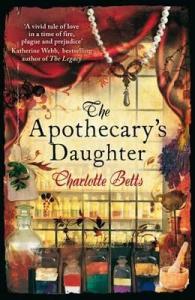 The Apothecary’s Daughter by Charlotte Betts
Susannah Leyton has grown up behind the counter of her father’s apothecary shop, surrounded by the resinous scents of lavender, rosemary, liquorice and turpentine. More learned than any apprentice, she concocts soothing medicines and ointments with great skill. Content with her life, Susannah is shocked when her widowed father announces his intentions to marry again, and later becomes caught in a battle of wills with her new step-mother. When she receives a proposal of marriage from handsome and charming merchant Henry Savage, she believes her prayers have been answered and resolves to be a good wife to him. But Henry is a complex and troubled man, haunted by his memories of growing up in Barbados. As the plague sweeps through the city, tragedy strikes, and the secrets of Henry’s past begin to unfold…
Next week’s Top Ten Tuesday topic: Books I’d Slay A Lion To Get Early

 About the Book
 About the Author

