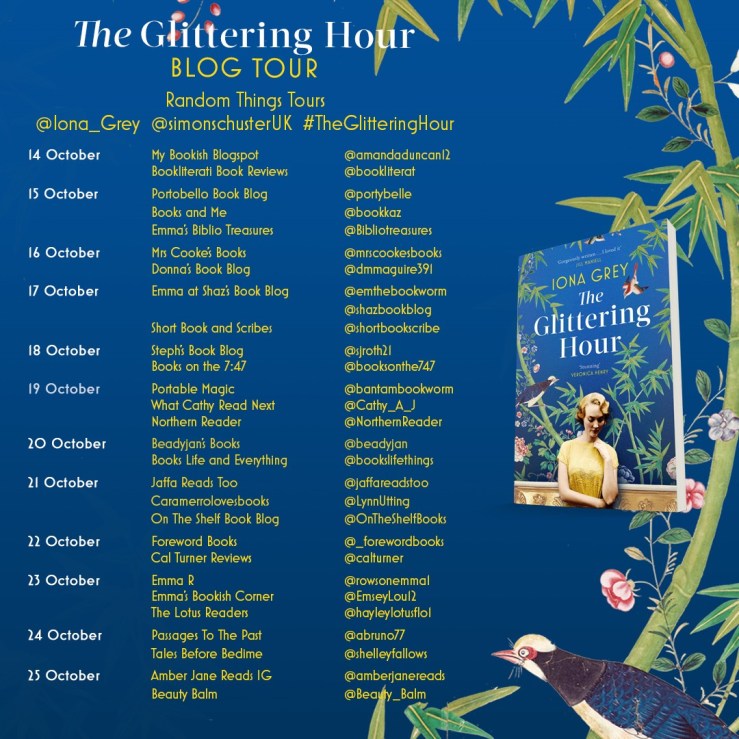
I’m delighted to be co-hosting today’s stop on the blog tour for The Glittering Hour by Iona Grey, alongside my tour buddies, Kate at Portable Magic and Joules at Northern Reader. The Glittering Hour is now available in paperback in the UK. (The hardcover edition is available to pre-order in the US).
Thanks to Anne at Random Things Tours for inviting me to participate in the tour and to Simon & Schuster UK for my digital review copy via NetGalley.
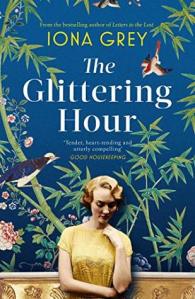 About the Book
1925. The war is over and a new generation is coming of age, keen to put the trauma of the previous one behind them.
Selina Lennox is a Bright Young Thing whose life is dedicated to the pursuit of pleasure; to parties and drinking and staying just the right side of scandal.
Lawrence Weston is a struggling artist, desperate to escape the poverty of his upbringing and make something of himself. When their worlds collide one summer night, neither can resist the thrill of the forbidden, the lure of a love affair that they know cannot possibly last.
But there is a dark side to pleasure and a price to be paid for breaking the rules. By the end of that summer everything has changed.
A decade later, nine year old Alice is staying at Blackwood Hall with her distant grandparents, piecing together clues from her mother’s letters to discover the secrets of the past, the truth about the present, and hope for the future.
Praise for The Glittering Hour
‘An epic story of joyous hedonism and desperate heartache. Just beautiful’ CATHERINE ISAAC
‘Stunning’ VERONICA HENRY
‘Gorgeously written … I loved it’ JILL MANSELL
‘An enchanting, evocative read’ THE SUN
Format: Paperback (496 pp.) Publisher: Simon & Schuster UK
Publication date: 17th October 2019 Genre: Historical Fiction, Romance
Find The Glittering Hour on Goodreads
Pre-order/Purchase Links*
Amazon.co.uk | Amazon.com | Hive (supporting UK bookshops)
*links provided for convenience, not as part of any affiliate programme
My Review
Although the title of the book is The Glittering Hour, it’s the glittering few hours I spent reading this book that is uppermost in my mind at the moment.
Events unfold over the course of a decade with the story alternating between 1936, as nine year old Alice embarks on a treasure hunt of a kind to uncover the secrets of her mother’s past, and 1925 in which Selina recalls her heady days as one of the ‘Bright Young People’ and the chance meeting that changed everything for her. Interspersed are insights from other characters, such as Selina’s faithful maid, Polly, and Alice’s governess, Miss Lovelock.
The main characters are so sensitively and vividly drawn it feels as though they could step right off the page. However, I also fell in love with some of the minor characters, such as Patterson the gardener at Blackwood Hall. I admired the way the author conjured up with equal ease 1920s London and the excesses of the ‘Bright Young People – extravagant parties, a never-ending stream of cocktails and champagne, wild late night treasure hunts – and the faded grandeur of Blackwood Hall in the 1930s with its overgrown gardens, chilly rooms and echoing corridors.
The legacy of war, in this case the First World War, is another theme explored in the book: the traumatic memories and survivors guilt of those who came back, and the ghostly presence of those who didn’t such as Selina’s brother Howard. The latter is cleverly connected with the art of photography through Lawrence Weston’s current occupation painting portraits of young men lost in the war based on photographs of them provided by their grieving families. Photographs – what they say and don’t say, the capturing of a likeness or of a moment in time – will play an important part in the book.
There are many more things I could say in praise of this book but I’ll confine myself to merely recommending that you read it for yourself. Be prepared for The Glittering Hour to take you on an intense but spellbinding emotional journey, some elements of which you may find confound your expectations. And definitely have a box of tissues handy.
In three words: Emotional, intense, heart-breaking
Try something similar: The Winter Soldier by Daniel Mason (read my review here)
 About the Author
Iona Grey has a degree in English Literature and Language from Manchester University, an obsession with history and an enduring fascination with the lives of women in the twentieth century.
She lives in rural Cheshire with her husband and three daughters.
Connect with Iona
Website | Twitter | Goodreads


 About the Book
 About the Author