

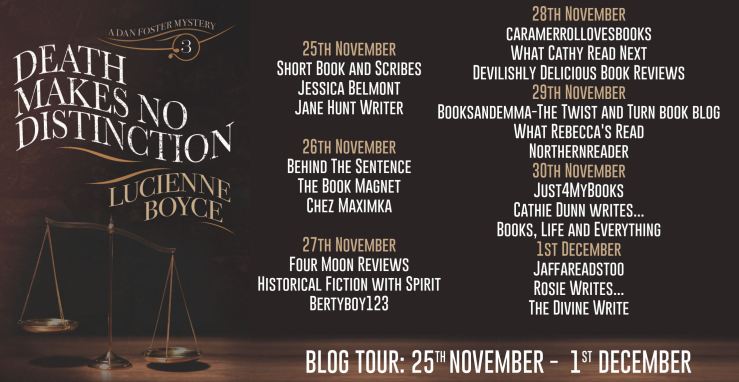
I’m delighted to be co-hosting today’s stop on the blog tour for Death Makes No Distinction by Lucienne Boyce, the third in the Dan Foster Mystery series. My thanks to Rachel at Rachel’s Random Resources for inviting me to take part in the tour and to the author for my review copy.
 About the Book
Two women at opposite ends of the social scale, both brutally murdered.
Principal Officer Dan Foster of the Bow Street Runners is surprised when his old rival John Townsend requests his help to investigate the murder of Louise Parmeter, a beautiful writer who once shared the bed of the Prince of Wales. Her jewellery is missing, savagely torn from her body. Her memoirs, which threaten to expose the indiscretions of the great and the good, are also missing.
Frustrated by the chief magistrate’s demand that he drop the investigation into the death of the unknown beggar woman, found savagely raped and beaten and left to die in the outhouse of a Holborn tavern, Dan is determined to get to the bottom of both murders. But as his enquiries take him into both the richest and the foulest places in London, and Townsend’s real reason for requesting his help gradually becomes clear, Dan is forced to face a shocking new reality when the people he loves are targeted by a shadowy and merciless adversary.
The investigation has suddenly got personal.
Format: ebook, paperback (264 pages) Publisher: SilverWood Books
Publication date: 20th September 2019 Genre: Historical fiction, crime, mystery
Purchase Links*
Amazon.co.uk | Amazon.com
*links provided for convenience, not as part of any affiliate programme
Find Death Makes No Distinction on Goodreads
My Review
Although Death Makes No Distinction is the third in the author’s historical mystery series featuring Bow Street Principal Officer, Dan Foster, it can be enjoyed as a standalone if, like me, you’ve not read the two previous books in the series. There are, however, a number of references to key events in the earlier books and nuggets of information about Dan’s early life, no doubt explored more fully in the first two books (Bloodie Bones and The Butcher’s Block). Therefore readers who like the sound of this book might want to start from the beginning of the series.
Although death may make no distinction, as the title proposes, there is certainly a distinction when it comes to the priority accorded to investigating and solving the two crimes. Louise Parmeter’s relationship with the Prince of Wales (amusingly described as ‘a tub in blue on a pink sofa’ at one point) means her murder is considered much more important than the death of a prostitute. Indeed the latter is looked upon much as an occupational hazard. Dan has a more egalitarian sense of justice and begs to differ. It has to be said, however, that the majority of the book is taken up with the investigation of Louise Parmeter’s murder.
The course of Dan’s investigation takes the reader from the lavish surroundings and hedonistic lifestyles of the nobility to the lower reaches of society and the criminal underworld encompassing everything from bare knuckle prize-fighting, smuggling, prostitution to kidnapping, blackmail and murder.
Death Makes No Distinction is an assured historical crime mystery with a wealth of period detail that is sure to entertain fans of the genre.
In three words: Engaging, atmospheric, mystery
Try something similar: Blood & Sugar by Laura Shepherd-Robinson (read my review here)
 About the Author
Lucienne Boyce writes historical fiction, non-fiction and biography. After gaining an MA in English Literature (with Distinction) with the Open University in 2007, specialising in eighteenth-century fiction, she published her first historical novel, To The Fair Land, in 2012, an eighteenth-century thriller set in Bristol and the South Seas.
Her second novel, Bloodie Bones: A Dan Foster Mystery (2015) is the first of the Dan Foster Mysteries and follows the fortunes of a Bow Street Runner who is also an amateur pugilist. Bloodie Bones was joint winner of the Historical Novel Society Indie Award 2016, and was also a semi-finalist for the M M Bennetts Award for Historical Fiction 2016. The second Dan Foster Mystery, The Butcher’s Block, was published in 2017 and was awarded an IndieBrag Medallion in 2018. The third in the series, Death Makes No Distinction, was published in 2019. In 2017 an e-book Dan Foster novella, The Fatal Coin, was trade published by SBooks.
In 2013, Lucienne published The Bristol Suffragettes, a history of the suffragette movement in Bristol and the west country. In 2017 she published a collection of short essays, The Road to Representation: Essays on the Women’s Suffrage Campaign.
Lucienne has appeared on television and radio in connection with her fiction and non-fiction work. She regularly gives talks and leads walks about the women’s suffrage movement. She also gives talks and runs workshops on historical fiction for literary festivals, Women’s Institutes, local history societies, and other organisations. She has been a radio presenter on BCfm, and a course tutor.
In 2018 she was instrumental in devising and delivering Votes for Women 100, a programme of commemorative events by the West of England and South Wales Women’s History Network in partnership with Bristol M Shed and others. She also campaigned and raised funds for a Blue Plaque for the Bristol and West of England Women’s Suffrage Society.
She is on the steering committee of the West of England and South Wales Women’s History Network, and is also a member of the Historical Novel Society, the Society of Authors, and the Alliance of Independent Authors.
She is currently working on the fourth full-length Dan Foster Mystery, and a biography of suffrage campaigner Millicent Browne. Lucienne was born in Wolverhampton and now lives in Bristol.
Website | Blog | Facebook | Twitter | Goodreads

 About the Book
 About the Author

