

The Walter Scott Prize for Historical Fiction 2020 Shortlist

WalterScottPrizeThe shortlist for the Walter Scott Prize for Historical Fiction was announced on 2nd April 2020.

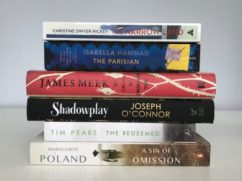
The six books are:

  • The Narrow Land by Christine Dwyer Hickey (Atlantic)
  • The Parisian by Isabella Hammad (Jonathan Cape)
  • To Calais, In Ordinary Time by James Meek (Canongate)
  • Shadowplay by Joseph O’Connor (Harvill Secker)
  • The Redeemed by Tim Pears (Bloomsbury)
  • A Sin Of Omission by Marguerite Poland (Penguin South Africa)

I’m disappointed my own personal favourite from the longlistOnce Upon A River by Diane Setterfield, didn’t make it through but my congratulations to the authors and publishers of those that did. You can find more details about the shortlisted books further on in this post.

In usual times, the winner would be crowned in June at the Borders Book Festival but, since we’re definitely not in ‘usual times’ and the Festival has had to be postponed, news of how and when the winner will be announced is still awaited. Something that is usual is how spectacularly unsuccessful I was once again in forecasting which books would appear on the longlist.  To be fair, I actually got three – The Hiding Game, Once Upon A River and The Offing.

As in previous years, I’ll try to read as many of the books on the shortlist as possible before the winner is announced.  This year that task is made harder by the fact I haven’t yet read any of them and don’t own copies of them all either.

Once again, I’ll also share my prediction of which book will win. Now there’s something I have been more successful at, having correctly picked last year’s winner, The Long Take by Robin Robertson, and the 2018 winner, The Gallows Pole by Benjamin Myers. (At this stage, just based on the book descriptions and judges’ comments, my money would be on To Calais, In Ordinary Time by James Meek because, if the past couple of years is anything to go by, the judges seem to favour books with an unusual narrative style.)
IMG_8790-low-res-e1585643526736About the Shortlisted Books

The Narrow Land by Christine Dwyer Hickey (in my TBR pile)

Described by the judges as ‘a quiet tour-de-force’, the book is a portrait of the marriage of artist Edward Hopper and his wife, Josephine.

The Parisian by Isabella Hammad (in my TBR pile)

Described as ‘a ground-breaking first novel’, it explores the unequal relationship between the Levant and Western Europe before the First World War. It’s a whopper at over 700 pages!

To Calais, In Ordinary Time by James Meek

According to the judges, the book is ‘an extraordinary novel’ but one which they also describe as ‘ambitious and challenging’. Set in the 14th century, it’s about a group of disparate characters en route to Calais.  It’s also been nominated for The Orwell Prize for Political Fiction 2020.

Shadowplay by Joseph O’Connor (currently listening to audiobook version)

Described as ‘a deep dive into late Victorian theatreland, the book explores the turbulent relationship between actress Ellen Terry, actor and impresario Sir Henry Irving and Bram Stoker.

The Redeemed by Tim Pears (in my TBR pile)

The final part of the author’s West Country trilogy, is set in 1916 and described as ‘a timeless, stirring and exquisitely wrought story of love, loss and destiny fulfilled, and a bittersweet elegy to a lost world’.

If there’s any justice, Tim Pears should be in with a chance because both the two previous books in the trilogy – The Horseman and The Wanderers – were longlisted in previous years.

A Sin Of Omission by Marguerite Poland

A book I’d never heard of before it appeared on the longlist, it’s the story of a young South African man trained for the Christian ministry in England who faces prejudice and conflicted loyalties when he returns to South Africa.

What do you think of the judges’ selection? If you’ve read any of the shortlisted books, what are your thoughts on them? 

#BookReview A Thousand Moons by Sebastian Barry

A Thousand MoonsAbout the Book

Even when you come out of bloodshed and disaster in the end you have got to learn to live.

Narrated by Winona – the young Lakota orphan adopted by soldiers Thomas McNulty and John Cole in Days Without EndA Thousand Moons continues Sebastian Barry’s extraordinary fictional exploration of late nineteenth century America.

Living with Thomas and John on the farm they work in 1870s Tennessee, educated and loved, Winona is employed by the lawyer Briscoe in the nearby town of Paris, as she tries to forge a life for herself beyond the violence and dispossession of her past. But the fragile harmony of this shared world, in the aftermath of the Civil War, is soon threatened by a further traumatic event, one which Winona struggles to confront let alone understand.

Format: Hardcover (272 pages)        Publisher: Faber & Faber
Publication date: 19th March 2020 Genre: Historical Fiction, Literary Fiction

Find A Thousand Moons on Goodreads

Purchase links*
Amazon.co.ukHive (supporting UK bookshops)
*links provided for convenience not as part of an affiliate programme


My Review

A Thousand Moons is the follow-up to Days Without End, a book I read in 2017 and absolutely loved.  It also won The Walter Scott Prize for Historical Fiction that year. A Thousand Moons continues the story of John Cole and Thomas McNulty but told from the point of view of Winona, the orphaned Indian girl they adopted. Although A Thousand Moons can be read as a standalone, I think you would be missing a literary treat in not reading Days Without End.

In a recent Faber Members’ Q&A, Sebastian Barry was asked if, when he completed Days Without End, he knew at that point he would write Winona’s story from her point of view in his next novel. He said he didn’t think so, partly because he wouldn’t dare to think he could, being in his words “a straight, white, old, Irish man”. However, he describes how Winona seemed to decide it for him, creeping very quietly into his workroom and instructing him to start. He said, “I borrowed a smidgen of her great courage and did.”

I think in that answer Sebastian Barry sums up his key achievement in A Thousand Moons, that of creating a distinctive and engaging narrative voice for Winona and communicating her resolve to take control of her life.  For the latter, she calls on the legacy of her mother and her Lakota heritage, recalling “Oh, but was I not the niece of a great leader, and the daughter of a warring woman?” And she has need of that courage when a dramatic event occurs which she scarcely understands but which she senses threatens the safety of the life John and Thomas have made for themselves.

“I come from the saddest story that ever was on the earth.  I’m one of the last to know what was taken from me and what was there before it was taken.” Along with everything she’s endured up until now, Winona has no illusions about her low status and the prejudice (and worse) she still faces. “The world wanted bad things to happen to Indian girls.” As she learns, an Indian isn’t regarded as a citizen and therefore has no protection from the law.

What I particularly liked about the book is the heartfelt, wise and non-judgmental view Winona gives the reader of the loving relationship between John Cole and Thomas McNulty.  “Their love was the first commandment of my world – Thou shalt hope to love like them.”  There is also a fabulous set of secondary characters all of whom, like Winona, Thomas and John, are in some way outsiders. Theses including Lige Magan, owner of the farm and Rosalee Bougereau and her brother, Tennyson, both ex-slaves.    A particularly lovely scene is the celebrations on the farm for Whit Monday when having feasted on roast sucklin pig, Lige picks up his fiddle, Thomas McNulty dons a dress from his performing days, Rosalee sings songs and Winona performs Lakota dances. It’s a time, Winona reflects, when love was palpable between us. And the way that John Cole touched Thomas”s back as the two of them stood watching in the long shadows of May.”

Thomas and John’s love is also directed towards Winona, for which she is daily grateful, musing “How was I so lucky to have these good-as-women men?”  However, the reader is reminded there can be a good and bad side to everyone. As depicted in Days Without End, Thomas and John were both soldiers involved in violence against the Lakota tribe. Yet they also killed to protect Winona and took her in to become part of their unconventional ‘family’.

As you might expect from a book by Sebastian Barry there is some wonderful writing.  For example, Winona’s description of herself as “a fragment, a torn leaf, torn away from the plains” or her description of her ‘mother and father’ (as she has come to think of them), “John Cole, the keel of my boat. Thomas the oars and the sails.”

There is a lot to love about A Thousand Moons.  My one slight reservation was I found the way the repercussions of the dramatic event referred to earlier was wrapped up a little rushed and unconvincing. However, the final scene was everything I hoped for. 

I received an advance review copy courtesy of Faber & Faber via NetGalley.

In three words: Moving, assured, insightful

Follow my blog via Bloglovin


SebastianBarryAbout the Author

Sebastian Barry was born in Dublin in 1955. His novels and plays have won, among other awards, the Kerry Group Irish Fiction Prize, the Costa Book of the Year award, the Irish Book Awards Best Novel, the Independent Booksellers Prize and the James Tait Black Memorial Prize. He also had two consecutive novels, A Long Long Way (2005) and The Secret Scripture (2008), shortlisted for the MAN Booker Prize. He lives in Wicklow with his wife and three children. (Photo/bio credit: publisher author page)

Connect with Sebastian
Website