
 Welcome to today’s stop on the blog tour for Talland House by Maggie Humm. My thanks to Anne Cater at Random Things Tours for inviting me to take part in the tour and to She Writes Press for my digital review copy.
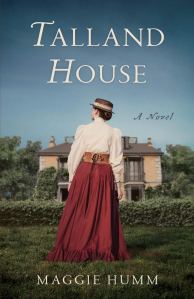 About the Book
Royal Academy, London 1919: Lily has put her student days in St. Ives, Cornwall, behind her – a time when her substitute mother, Mrs. Ramsay, seemingly disliked Lily’s portrait of her and Louis Grier, her tutor, never seduced her as she hoped he would. In the years since, she’s been a suffragette, a nurse in WWI,and now she’s a successful artist with a painting displayed at the Royal Academy.
Then Louis appears at the exhibition with the news that Mrs. Ramsay has died under suspicious circumstances. Talking to Louis, Lily realizes two things: she must find out more about her beloved Mrs. Ramsay’s death (and her sometimes-violent husband, Mr. Ramsay); and she still loves Louis.
Set between 1900 and 1919 in picturesque Cornwall and war-blasted London, Talland House takes Lily Briscoe from the pages of Virginia Woolf’s To the Lighthouse and tells her story outside the confines of Woolf’s novel – as a student in 1900, as a young woman becoming a professional artist, her loves and friendships, mourning her dead mother, and solving the mystery of her friend Mrs. Ramsay’s sudden death.
Talland House is both a story for our present time, exploring the tensions women experience between their public careers and private loves, and a story of a specific moment in our past – a time when women first began to be truly independent.
Format: (Paperback, 352 pages) Publisher: She Writes Press
Publication date: 3rd September 2020 Genre: Historical fiction
Find Talland House on Goodreads
Purchase links*
Amazon UK | Hive (supporting UK bookshops)
*links provided for convenience not as part of an affiliate programme
My Review
I haven’t read Virginia Woolf’s To The Lighthouse, the novel in which the character Lily Briscoe appears, so I came to Talland House without any knowledge of the book which inspired it. I think this probably placed me at a disadvantage when it came to appreciating how and to what extent Maggie Humm has incorporated elements of Woolf’s original into Talland House, and how much of the characterization of the individuals who appear in the book is drawn from the author’s own imagination or builds on what is in To The Lighthouse.
This is particularly the case with Mr. Ramsey who, in Talland House, is depicted as having few redeeming qualities. Described variously as ‘hot-tempered’ and ‘self-centred’, the reader witnesses sudden outbursts which, if carried out by a child, would probably be described as temper tantrums. However, since he is a grown man, and a heavily built one at that, these fits of temper, with their undercurrents of violence, are considerably more alarming. His wife’s attempts to prevent these outbursts or distract others’ attention from them I found unsettling.
Having lost her own mother, it’s no surprise when Lily finds herself drawn to Mrs. Ramsey, the very epitome of a caring mother. Not only is Mrs. Ramsay beautiful but she displays a keen interest in art, music and literature. Finding her friendship returned, Lily delights in the “rich essence of female connection, a fervent intensity because they were were both women”.
Having visited St. Ives in Cornwall, I enjoyed the sections of the book set there and could easily imagine the picturesque streets, houses and sea views inspiring artists like Lily. I could also appreciate the challenge of trying to capture the essence of the natural world in paint. For Lily, painting is a vital form of self-expression allowing her a freedom to communicate thoughts and feelings she feels unable to articulate verbally, either because of the inadequacy of words or because of social conventions. “She wanted always to paint as she’d dimly known she could paint, not imitating others but becoming herself.” Her inability to complete her portrait of Mrs. Ramsey, therefore, is more than just an irritation, it is a reflection of Lily’s doubts about her own artistic ability and, in a way, her feeling of incompleteness as a person.
The events in Talland House play out at a measured pace switching back and forth in time, from Lily’s first arrival in St. Ives in 1900 to the final scenes in 1919. This provides plenty of opportunities for descriptions of landscapes which emphasise their colours and shapes, as if seen through the eyes of an artist. I especially liked how the author captured the gloomy, eerily silent atmosphere of First World War London, such as in this passage in which Lily glimpses the tower housing Big Ben. “It was silent, the unlit white-and-black clock difficult to see in the smog. Missing the striking of hours and quarters, she felt outside of time, and the streets, too, seemed to float free, as if a grey ocean had swept up the Thames enveloping them all.”
Although a smaller element of the story than the blurb might suggest, Lily’s efforts to discover the true circumstances surrounding Mrs Ramsey’s death add a sprinkling of mystery to the final chapters of the book. However, I mean it in the best possible way when I say that I didn’t think the book needed this extra, rather melodramatic element. Personally, I found Lily’s story, as she grows in self-confidence and forges an independent path in life, sufficiently engaging in its own right. On the other hand, for those who have read To The Lighthouse, the author’s solution may provide the vital missing piece to complete the equivalent of a literary jigsaw. Or perhaps I should say, the last brushstroke on the canvas.
Rich in detail, Talland House is an absorbing story that celebrates female friendship during a period of upheaval and social change.
In three words: Thoughtful, engaging, detailed
Try something similar: Charlotte by Helen Moffett
Follow this blog via Bloglovin
 About the Author
Maggie Humm is an Emeritus Professor at the University of East London in the UK. An international Woolf scholar, she is the author/editor of fourteen books, the last three of which focused on Woolf and the arts. Talland House was shortlisted for the Impress and Fresher Fiction prizes in 2017 (as Who Killed Mrs. Ramsay? ) and the Retreat West and Eyelands prizes in 2018. She lives in London and is currently writing Rodin’s Mistress, a novel about the tumultuous love affair of the artists Gwen John and Rodin.
Connect with Maggie
Website| Twitter

 About the Book
 About the Author

