
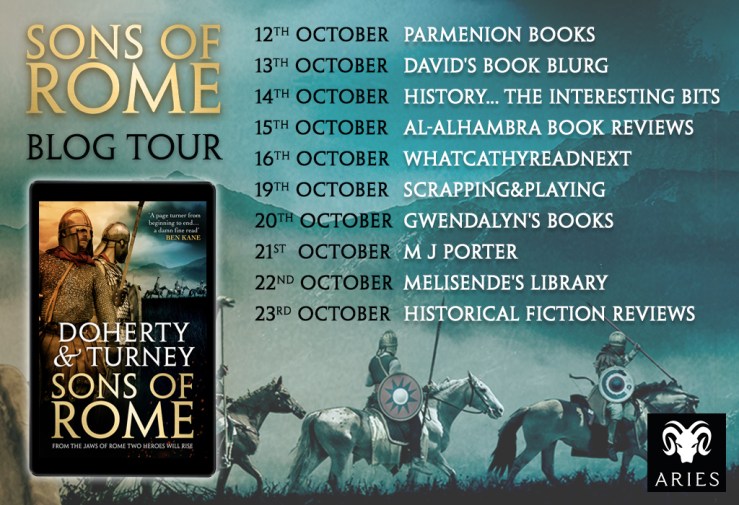
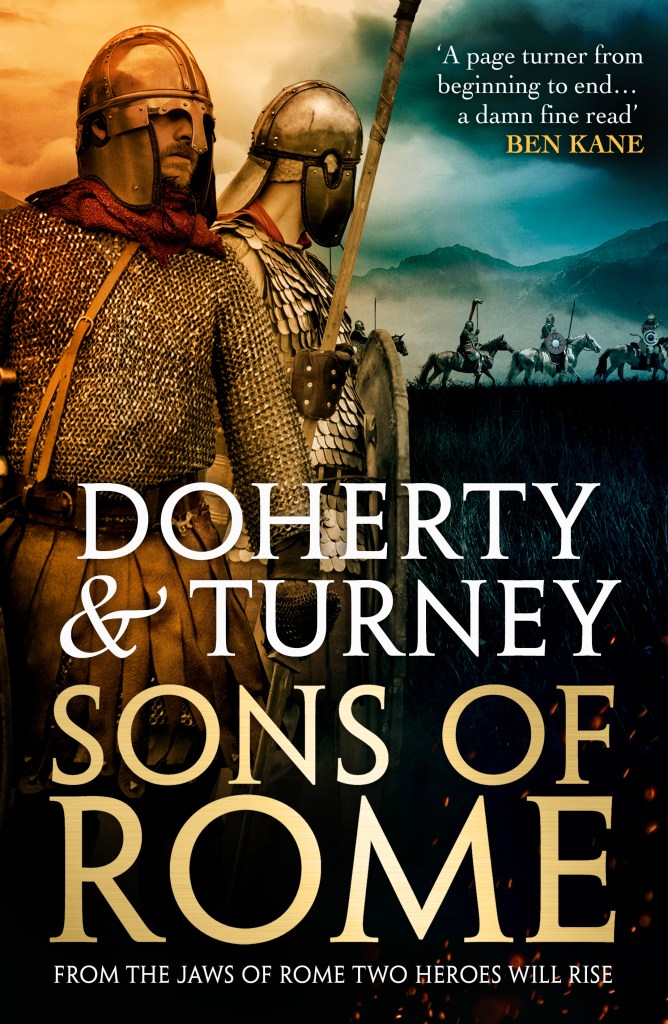
Welcome to today’s stop on the blog tour for Sons of Rome (Rise of Emperors #1). Co-authored by Simon Turney & Gordon Doherty, it was published as an ebook on 15th October and will be available in hardcover in December. I’m delighted to bring you an extract from the book. You can find out more about how Simon and Gordon approached their collaboration in this guest post hosted by Robin at Parmenion Books.
About the Book
Four Emperors. Two Friends. One Destiny.
As twilight descends on the 3rd Century AD, the Roman Empire is but a shadow of its former self. Decades of usurping emperors, splinter kingdoms and savage wars have left the people beleaguered, the armies weary and the future uncertain. And into this chaos Emperor Diocletian steps, reforming the succession to allow for not one emperor to rule the world, but four.
Meanwhile, two boys share a chance meeting in the great city of Treverorum as Diocletian’s dream is announced to the imperial court. Throughout the years that follow, they share heartbreak and glory as that dream sours and the empire endures an era of tyranny and dread. Their lives are inextricably linked, their destinies ever-converging as they rise through Rome’s savage stations, to the zenith of empire.
For Constantine and Maxentius, the purple robes beckon…
Format: ebook (433 pages) Publisher: Head of Zeus, Aries Fiction
Publication date: 15th October 2020 Genre: Historical Fiction
Find Sons of Rome (Rise of Emperors #1) on Goodreads
Purchase links*
Amazon UK | Hive (supporting UK bookshops)
*links provided for convenience not as part of an affiliate programme
Extract from Sons of Rome (Rise of Emperors #1)
MAXENTIUS
The figure whose shadow stretched across the room and threw my glorious civic centre into an oppressive gloom was a stocky, well-built young man, perhaps half as old again as I was, with bear-shoulders and close-cut fair hair. He was dressed in relative finery – not as rich as mine, I would say, but costly enough to make most families wince and touch their purses for reassurance. And yet something about its cut, colour and make-up spoke more of the battlefield than the throne room. He wore a thick leather belt with a place for a sword and dagger, though neither was currently in evidence. Even before he stepped forward and the light from the leaded window threw his face into sharp relief I had seen enough to form an instant dislike of him.
His face took things so much further.
It brought a fear that chilled me from the roots of my hair to the soles of my feet. The boy’s mouth was twisted into an expression of casual cruelty and his eyes were flinty hard and devoid of compassion or joy.
His shadow was the most pleasant part of him. The warmest. And it showed no sign of moving away.
As if his brooding appearance was not enough, there was a small gaggle of boys loitering behind him at the door that led back to the main hall. Each and every one had that look of a bully. Piggy eyes and leering faces, made no less brutal by the fine court clothes they wore. Even at perhaps eleven or twelve summers they would have looked more at home nailing a peasant to a cross and stripping him of his flesh than attending the court of the most powerful men in the empire.
A cold shudder ran through me at the sight, and at the realisation that I was at their mercy. I glanced at the other two doors in the room but they were both closed, and even as my eyes shot back and forth between them, the wicked-looking thug’s cronies entered the room at his silent cold-eyed instruction, moving around the perimeter and effectively sealing me in.
The main door – through which they had entered – was closed with a quiet, gentle click that might as well have been the resounding leaden boom of a mausoleum door slamming shut.
I tried to find my voice, but it seemed to have become lost somewhere beneath a layer of fear, and all that issued from between my dry lips was a faint croak.
‘What is this?’ asked the leader of this small pack of brutes, the distaste clear in his voice, as though he had come across a mangy dog eating its own waste.
It took me a moment to realise that he was actually referring to my city rather than to my person, and I knew then what would happen. I had met this boy’s sort before in my few short years, and had learned a few hard lessons. Such boys – and men, when they grow into them – exist only for the pleasure of causing distress and pain. There is no arguing with them or reasoning with them. They will not stop unless forced to do so.
My immediate future was bleak, and I was astute enough to recognise that.
Strangely, a calm settled over me at the thought that the thug had fixated upon my glorious wooden invention rather than upon my person. I was not a martial boy by nature. I shunned the sickening sights and sounds of inflicted wounds that the arena produced and had little interest in lessons from the swordsman Father had retained to ‘toughen me up’, my forays into the military largely restricted to reading from ancient masters such as the great Julius Caesar.
No. Not a warrior. Not yet.
I accepted that then, but despite my quiet, pacific demeanour, one thing had come down to me from my father’s personality, other than a tendency to anger easily: a bloody-minded unwillingness to bend. There was a steel in me, as yet untempered but beginning to show even as a child. Despite the fact that I knew this boy was here for violence, I found a disinclination to accept my fate, and my jaw hardened just a little.
The thug must have seen the change in me and recognised it for what it was, for one eyebrow twitched upwards just a little, and he goaded me beyond words by taking a step forward and deliberately knocking aside one of my carefully planned commercial centres with his foot.
‘I said what is this?’
The blocks tumbled away, distorting the immaculate lines of my city, and anger rose in the pit of my stomach. But I was no fighter – the anger had no outlet through fist or blade. My rage instead hardened to a diamond within me, amplifying my resolution to weather the storm.
‘That,’ I replied with the same inflection that he had used, ‘was a careful, thoughtful and artful construction of Rome as it should be. As I see it. That is what it was. What it is, is a mess of ruins and fallen buildings, knocked carelessly aside by an uncultured and mindless barbarian.’
CONSTANTINE
I butted the door open with my palms, hoping to find some other forgotten, quiet and empty chamber. Instead, to my astonishment, I beheld a poorly lit, drab room, wholly unremarkable were it not for the pack of baying youths at the far corner. They were huddled around something on the floor – no… someone. The largest boy in the group was raining punches and kicks onto this figure. Toy wooden blocks lay scattered nearby.
I froze, my eyes locked on the cowering victim: a dark-haired boy, wiry and lean, some years younger than his attackers. His narrow, tanned face was spattered in blood and his eyes were swollen almost shut, but his bloated gaze met mine. When his lips moved, I did not hear his words, but I understood.
Help me.
Suddenly, one of the young thugs looked up, his eyes widening upon seeing me in the doorway. ‘Candidianus, stop!’ he yelped in warning to the big one.
At once, the ring of youths broke away from the bloodied lad. The ringleader snarled, dragging his foul glare around to fix upon me, eyes shaded under his heavy brow as he struggled to discern my identity in the gloom. But I recognised him immediately – it was Galerius’ son. His nostrils were flaring like a bull’s. The gemmed necklace was spattered in the beaten boy’s blood… and I noticed a bite-wound on one of his ankles too, the blood trickling from that and staining his boot.
‘One man?’ Candidianus snarled at the six with him while jabbing a finger at me. ‘You crumble in fear at the sight of one man? You will never serve as my bodyguards – never!’
I noticed the six looking around sheepishly. At first, I had assumed they were Candidianus’ friends. Now it was clear they were merely acolytes.
Just then, the bloodied boy groaned and tried to prise himself from the floor.
‘You stay put!’ Candidianus roared, turning painfully back to the boy, lifting his fist and readying to swing it down.
I cared little for either of the two strangers before me, but the scene was sickening: a burly boy readying to strike at the face of a younger lad who was already beaten and near-unconscious.
I lurched across the chamber and caught the bully’s wrist before he could strike. His eyes bulged and he bared his teeth, his clenched fist shaking in my grasp. He tried to wrench free of my grip but I twisted his arm up his back and he winced like a whipped dog as I held him, back turned to me, using him like a shield against his cronies. At this, he cried to the nearest of his acolytes – a stocky, snub-nosed boy: ‘Get him off me!’ This one stepped forward, fists clenched. I turned a gimlet stare upon him that broke his stride, halted him and turned his scowl into a pallid, fearful look. I flashed the same look at the rest, and issued a silent thank you to Batius who had taught me the power of a confident glower. The truth is my gut was churning, but I had those six beaten with no weapon other than my demeanour.
Candidianus struggled in my grasp until it became clear he could not wriggle free. I growled in his ear. ‘Now I’m going to let go, and I want you and your group to leave. Do not make a fool of yourself by trying anything.’ He nodded, yet I could sense he was keen to become a fool. But what else was I to do? I relaxed my grip on him and he stumbled away, panting. He did not head for the door, as I had urged him. Neither did he fly at me. Instead, he turned to face me, standing tall, a few feet away. Despite the few years I had on him, his shoulders matched mine and our eyes were level. ‘You dare to lay a hand on the son of a nobleman?’ he growled.
I snorted at this. ‘Something of a contradiction, is it not?’ I gestured to the young lad on the floor. ‘Going by this one’s fine robes I’m certain he is no slave or peasant. Perhaps you should discuss this with his father—’
‘It’s you! Constantine, the son of Governor Constantius!’ Candidianus cut me off, one finger wagging, his eyes sparkling in recognition, grinning like a cat that had just spotted an injured mouse. ‘I saw you in the main hall.’
‘Aye, son of the Governor of Dalmatia,’ I snapped. ‘So perhaps you should avoid the habit of picking fights with men of noble blood and be gone, as I urged you.’
‘You?’ Candidianus continued with a burgeoning grin. ‘Noble blood?’ Then he threw his head back with a lungful of painfully forced laughter, clearly learned from another – doubtless his father. ‘He doesn’t know,’ he roared in delight, meeting the gaze of each of the six with him. One by one, the six laughed too. Sycophantic yet mocking laughter. ‘Your father brought you all the way here and didn’t think to tell you why?’
About the Authors
Simon Turney is the author of the Marius’ Mules and Praetorian series, as well as The Damned Emperor series for Orion and Tales of the Empire series for Canelo. He is based in Yorkshire.
Connect with Simon
Website | Twitter
Gordon Doherty is the author of the Legionary and Strategos series, and wrote the Assassin’s Creed tie-in novel Odyssey. He is based in Scotland.
Connect with Gordon
Website | Twitter



 What Cathy Read Next...