Welcome to today’s stop on the blog tour for The Hidden Child by Louise Fein. My thanks to Lauren Tavella and Jade Gwilliam at Head of Zeus for inviting me to take part in the tour and for my limited edition proof.
 About the Book
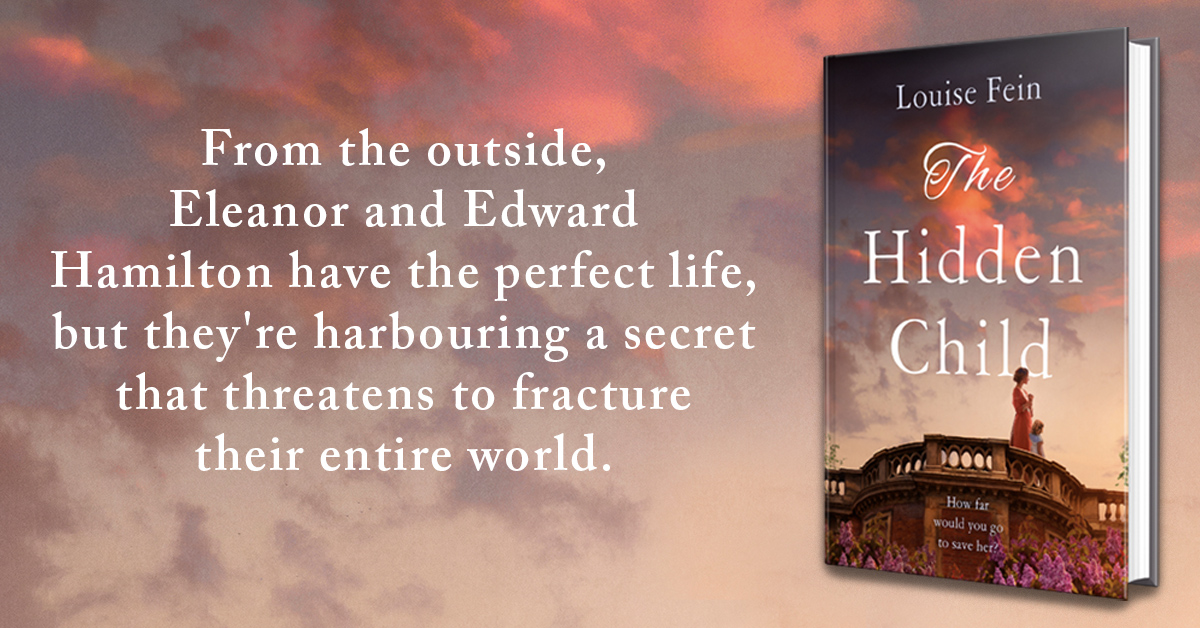
From the outside, Eleanor and Edward Hamilton are the epitome of the perfect marriage but they’re harbouring a shameful secret that threatens to fracture their entire world.
London, 1929. Eleanor Hamilton is a dutiful mother, a caring sister and adoring wife to a celebrated war hero. Her husband, Edward, is a leading light in the Eugenics movement. The Hamiltons are on the social rise, and it looks as though their future is bright.
When Mabel, their young daughter, begins to develop debilitating seizures, their world fractures as they have to face the uncomfortable truth – Mabel is an epileptic: one of the undesirables Edward campaigns against.
Forced to hide the truth so as not to jeopardize Edward’s life work, the couple must confront the truth of their past -and the secrets that have been buried. How far are they willing to go to protect their charmed life – even if it means abandoning their child to a horrific fate?
Will Eleanor and Edward be able to fight for their family? Or will the truth destroy them?
Format: Hardback (496 pages) Publisher: Head of Zeus
Publication date: 2nd September 2021 Genre: Historical Fiction
Find The Hidden Child on Goodreads
Purchase links
Bookshop.org
Disclosure: If you buy a book via the above link, I may earn a commission from Bookshop.org, whose fees support independent bookshops
Hive | Amazon UK
Links provided for convenience only, not as part of an affiliate programme
My Review
Having loved Louise Fein’s previous book, People Like Us, I was keen to read whatever she came up with next. However, I’ll freely admit that as someone with epilepsy – thankfully controlled with medication (as it happens the same one mentioned in the Author’s Note) – its subject matter made it a challenging read for me. However, I was reassured to learn the book was inspired by the author’s personal experience of bringing up a child with epilepsy and her desire to raise awareness of the stigma and misunderstanding that still exists about the condition, not least the fact that epilepsy can take many different forms.
For the reasons I’ve stated, it’s difficult for me to imagine what it must have been like to live with epilepsy at a time when it was viewed as something shameful, something to be hidden and that would have had you categorized as an ‘undesirable’.
At first I thought the author had set herself an impossible task in making me feel any empathy towards Edward. Seemingly heedless of his own hypocrisy, he espouses a belief in eugenics, a philosophy I find utterly repugnant. Although I appreciate such views were held in certain circles at the time, I couldn’t help but be appalled by Edward’s comments and those of his fellow eugenicists about ‘undesirables’, ‘hordes of defectives’ and ‘inferior races’. There were moments in the book that were too close to home, such as Edward’s inclusion of epileptics, alongside criminals and alcoholics, in a list of those judged to be the result of ‘overbreeding by the lower stratus of the population’. (The Author’s Note provides fascinating information about the history of the Eugenics Movement.)
Learning more about the tragic events in Eleanor’s life made me understand why she was susceptible to the theory of eugenics, although her fear that, if her sister Rose was to bear a child by her boyfriend Marcel, it might lower the quality of Rose’s ‘excellent genes’ made me shudder. On the other hand, I could well imagine Eleanor’s distress at witnessing her daughter Mabel’s seizures, her feeling of helplessness and the growing realisation that her sweet-natured little girl has been changed, in all likelihood, irrevocably. As it turns out, Eleanor is forced to revise her opinion of Marcel when he gives her a gift just as valuable as his devotion to Rose. Where initially I’d thought Eleanor weak, I began to admire her willingness to fight the forces arrayed against her in defence of Mabel’s future, and in the end I was cheering for her.
I was hoping Edward’s personal experience would make him revise his views on eugenics but his motivation continued to be fear of disclosure and how his reputation would be affected should Mabel’s condition become known. In addition, it transpires he has his own shameful secret he’d rather was not revealed. Will Edward’s realisation of his mistakes come eventually, or will it be too late?
One of the most striking elements of the book were the sections in which we hear the ‘voice’ of Mabel’s condition, revelling in its ability to wreak havoc on the human brain. ‘I am anti-order. I am chaos. I disrupt and disturb.’ I thought this was inspired. Depicting the human response to epilepsy as analogous to a contest of wits made me think of all those who have waged war on the condition over the decades: from those who carried out research and developed the drugs we now have to control it in many cases, to the specialists who support those with it and the charities who work to raise awareness.
As you have no doubt gathered from this review, The Hidden Child had a very personal resonance for me and it was a difficult read at times. In particular, I found much of what Mabel undergoes harrowing to witness. But those closing chapters… I’ll admit tears were shed. The Hidden Child is beautifully written and made me appreciate how far we have come as a society and how fortunate I am to be living in a more enlightened age. By the way, you can find out more about epilepsy on the Epilepsy Action website. They are just one of the many charities working in this area.
In three words: Thought-provoking, moving, immersive
Follow this blog via Bloglovin
 About the Author
Louise Fein was born and brought up in London. She harboured a secret love of writing from a young age, preferring to live in her imagination than the real world. After a law degree, Louise worked in Hong Kong and Australia, travelling for a while through Asia and North America before settling back to a working life in London.
She finally gave in to the urge to write, taking an MA in creative writing, and embarking on her first novel, Daughter of the Reich (named People Like Us in the UK and Commonwealth edition). The novel was inspired by the experience of her father’s family, who escaped from the Nazis and arrived in England as refugees in the 1930’s. Daughter of the Reich/People Like Us is being translated into 11 foreign languages, has been shortlisted for the 2021 RNA Historical Novel of the Year Award, and has been long listed for the Not The Booker Prize.
Louise lives in the beautiful English countryside with her husband, three children, two cats, small dog and the local wildlife who like to make an occasional appearance in the house. Louise is currently working on her third novel.
Connect with Louise
Website | Twitter | Instagram | Facebook | Goodreads