
 Welcome to today’s stop on the blog tour for Love in a Time of War by Adrienne Chinn which is published on 3rd March. My thanks to Rachel at Rachel’s Random Resources for inviting me to take part in the tour and to One More Chapter for my digital review copy via NetGalley. Do check out the post by my tour buddies for today, The Page Ladies.
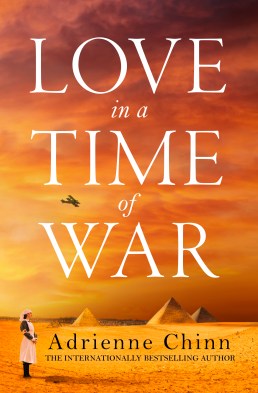 About the Book
Three sisters
The Great War
The end of innocence…
In 1913, in a quiet corner of London, the three Fry sisters are coming of age, dreaming of all the possibilities the bright future offers. But when war erupts their innocence is shattered and a new era of uncertainty begins.
Cecelia loves Max but his soldier’s uniform is German, not British, and suddenly the one man she loves is the one man she can’t have.
Jessie enlists in the army as a nurse and finally finds the adventure she’s craved when she’s sent to Gallipoli and Egypt, but it comes with an unimaginable cost.
Etta elopes to Capri with her Italian love, Carlo, but though her growing bump is real, her marriage certificate is a lie.
As the three sisters embark on journeys they never could have imagined, their mother Christina worries about the harsh new realities they face, and what their exposure to the wider world means for the secrets she’s been keeping…
Format: Paperback (480 pages) Publisher: One More Chapter
Publication date: 3rd March 2022 Genre: Historical Fiction
Find Love in a Time of War (The Three Fry Sisters #1) on Goodreads
Purchase links
Bookshop.org
Disclosure: If you buy a book via the above link, I may earn a commission from Bookshop.org, whose fees support independent bookshops
Hive | Amazon UK
Links provided for convenience only, not as part of an affiliate programme
My Review
I was first introduced to the writing of Adrienne Chinn when I read The English Wife in 2020 and I remarked then on the author’s ability to enable the reader to navigate multiple timelines. Love in a Time of War is a little more straightforward, moving between events in the years 1913 to 1919, with occasional trips back to the 1890s.
Love in a Time of War is the first book in a trilogy featuring the Fry sisters – Cecilia (Celie) and non-identical twins, Jessica (Jessie) and Etta – and their mother, Christina. The author has created distinct personalities for the three sisters. Celie, the eldest, is clear-headed, thoughtful and has a strong sense of justice particularly when it comes to the question of women’s suffrage. Etta is more headstrong, fired up by the desire to become an artist and willingly immersing herself in a bohemian lifestyle. Jessie is the most serious of the sisters, determined to put her nursing skills to use and resist the pressure to follow the conventional path of marriage and motherhood.
The latter is the path their mother Christina is determined they should follow. She appears almost puritanical in that respect, indeed one might say hyprocritical given what the reader learns about her early life. Being more generous, perhaps her actions are driven by a genuine desire to prevent her daughters making the same unwise decisions that she did in allowing her heart to rule her head. Whatever her motivation, it seems to have the opposite effect to that she intended as both Celie and Etta become involved in relationships with men who do not make ideal husband material in the eyes of Christina. Even Jessie, who was my favourite character, eventually embarks on a relationship with a man who for many reasons would probably not be welcomed with open arms in the Fry household. (I’d have welcomed him in any day!)
A character I’ve not mentioned so far is the sisters’ father, Gerald. He was the character with whom I empathised the most. Having done his best to provide a stable home for his daughters, encourage their interests and be a devoted husband, I was intensely moved by his discovery that all is not what it seems in his marriage. In keeping secrets from her family, I was reminded of the quotation from Marmion by Sir Walter Scott, ‘O what a tangled web we weave, when first we practice to deceive.’
Although the First World War provides the backdrop to many of the events in the book and transports the reader to a number of locations including Italy and Egypt, another constant element is the campaign for women’s suffrage. All three sisters reflect the ideals of the movement, albeit in different ways. Celie’s is the most obvious, becoming involved in organising marches for Millicent Fawcett’s National Union of Women’s Suffrage Societies and, later, writing newspaper articles and taking photographs to publicise the vital contribution of women to the war effort, such as those working in munitions factories. Etta’s unconventional lifestyle is a challenge to social conventions that sees her hobnobbing with leading lights in the Bloomsbury Group such as artists Vanessa Bell and Duncan Grant, and writer Virginia Woolf. Jessica’s determination to forge her own path in life and be judged on her ability rather than her gender, represents the independence that many women were fighting for.
Those who love the idea of chance encounters will be rewarded by some coincidences that conjure up that famous line from the film Casablanca, ‘Of all the gin joints in all the towns in all the world she walks into mine’. Indeed at one point, when a family connection is discovered between two strangers, one of them remarks, ‘Small world, isn’t it?’. Quite. However these encounters are pivotal to the storyline, on occasions in quite deadly ways. They also serve to demonstrate that, in war, soldiers on both sides experience the same level of fear and anxiety and face the same moral dilemmas.
As might be expected from the first instalment in a trilogy, Love in a Time of War ends at significant moments in the lives of the sisters. With the war finally ended, what new horizons await them? There will be plenty of readers eager to find out.
In three words: Romantic, dramatic, expansive
Try something similar: Daughters of War by Dinah Jeffries
Follow this blog via Bloglovin
 About the Author
Adrienne Chinn was born in Grand Falls, Newfoundland, grew up in Quebec, and eventually made her way to London, England after a career as a journalist. In England she worked as a TV and film researcher before embarking on a career as an interior designer, lecturer, and writer. When not up a ladder or at the computer writing, she often can be found rummaging through flea markets or haggling in the Marrakech souk.
Her second novel, The English Wife – a timeslip story set in World War II England and contemporary Newfoundland – was published in June 2020 and has become an international bestseller. Her debut novel, The Lost Letter from Morocco, was published by Avon Books UK in 2019. Her latest novel, Love in a Time of War, set during WWI, is the first in a series of three books based around the changing lives of three English sisters and their half-Italian mother, with a timeslip to 1890s Capri and London.
Connect with Adrienne
Website | Twitter | Facebook | Instagram

 West Indies, 1796. Alexander Charteris – the mixed-race son of an aristocratic planter and a slave mother – is raised as a gentleman amidst the country houses and London drawing rooms of Georgian England. Tricked out of his inheritance by his cousin Pemberton – Chart is kidnapped and transported to the island of Grenada where he endures the hell of slavery on a sugar plantation. When Pemberton arrives at the plantation, accompanied by Chart’s former lover, Lady Arabella, he orders Chart’s torture and execution.
 About the Author

