
 About the Book
July 1346. The Hundred Years’ War has begun, and King Edward and his lords are on the march through France. But this war belongs to the men on the ground.
Swept up in the bloody chaos, a tight-knit company from Essex must stay alive long enough to see their home again. With sword, axe and longbow, the Essex Dogs will fight, from the landing beaches of Normandy to the bloodsoaked field of Crecy.
There’s Pismire, small enough to infiltrate enemy camps. Scotsman, strong enough to tear down a wall. Millstone, a stonemason who’ll do anything to protect his men. Father, a priest turned devilish by the horrors of war. Romford, a talented young archer on the run from his past. And Loveday FitzTalbot, their battle-scarred captain, who just wants to get his boys home safe.
Some men fight for glory. Others fight for coin. The Essex Dogs? They fight for each other.
Format: Hardback (464 pages) Publisher: Head of Zeus
Publication date: 15th September 2022 Genre: Historical Fiction
Find Essex Dogs on Goodreads
Purchase links
Bookshop.org
Disclosure: If you buy a book via the above link, I may earn a commission from Bookshop.org, whose fees support independent bookshops
Hive | Amazon UK
Links provided for convenience only, not as part of an affiliate programme
My Review
Essex Dogs is the first book in a new trilogy set during the Hundred Years’ War. It’s the author’s first foray into fiction (unless you count his novella The Tale of the Tailor and the Three Dead Kings) but on the evidence of Essex Dogs it’s clear he’s as adept at fiction as he is at non-fiction.
The events at the outset of the Hundred Years’ War are thrillingly brought to life through the escapades of the fictional Essex Dogs, a group of men of different ages, from different parts of what is today Great Britain and who speak different languages even. What unites them is a talent for fighting – whether with axe, sword or bow – a desire to make their fortunes and the bonds of comradeship. ‘We are who we are. We do what we do. We look after each other.’
This foul-mouthed, dishevelled brotherhood is ‘led’ by Loveday FitzTalbot from whose point of view we witness most of the action. There are passing references and little nuggets of information about the backgrounds of the Essex Dogs, including mention of their previous leader, the enigmatic Captain. (It would be great to learn more of their back stories – a prequel in the making perhaps?) Besides Loveday, the person we learn most about is Romford, a troubled young man for whom the Essex Dogs have become a sort of family. Other notable characters are Father, a rather demented priest, and Scotsman, a giant of a man whose talent for fighting is second only to his highly imaginative and extremely crude cursing. I also loved the mystical element introduced by way of the mysterious woman from Valognes.
Although the Essex Dogs are entirely the product of the author’s imagination, real historical figures play a part as well. Here I think the author really has some fun giving us a whiny Edward, The Black Prince and – my favourite – an Earl of Northampton for whom the descriptions ‘colourful’ and ‘plain-speaking’ don’t do justice. He certainly gives Scotsman a run for his money when it comes to cursing with just about every utterance being peppered with the f-word and c-word. He’s the epitome of calling a spade a spade and not afraid to give his views on the foolishness of a proposed tactic. I would love to give you some examples of his imaginative cursing but most of them – actually all of them – are far too rude to repeat.
The book opens with a dramatic and bloody beach landing that could have come straight out of Saving Private Ryan or The Longest Day. Then there’s a long and arduous march through France in an effort to meet with a constantly retreating French army, stopping only for a spot of pillaging along the way. As they trudge through wind and rain, I was reminded of the scenes in Kenneth Branagh’s film of Henry V in which he leads his bedraggled army. Towards the end of the book the action really picks up with some terrific battle scenes, culminating with the Battle of Crécy. There is a real sense of the confusion of battle, the sheer brutality of hand-to-hand combat and of course the triumph of English longbows over French crossbows.
I thought Essex Dogs was a brilliant start to what promises to be a fantastic trilogy. And if you love a last minute revelation or an intriguing epilogue, then look no further.
I received a digital review copy courtesy of Head of Zeus via NetGalley.
In three words: Authentic, vivid, action-packed
Try something similar: The Blooding by David Gilman
 About the Author
Dan Jones is the Sunday Times and New York Times bestselling author of ten non-fiction books, including The Templars, The Colour of Time and Powers and Thrones. He is a renowned writer, broadcaster and journalist, and has for many years wanted to write authentic but action-packed historical fiction. He lives near London with his family.
Connect with Dan
Twitter | Facebook


 About the Book
 From Russia With Love stood out among Fleming’s work. Agent 007 doesn’t even make an appearance until a third of the way into the story, instead Fleming takes you behind the Iron Curtain in a detailed exploration of the dark operations of the MGB (precursor to the KGB) and SMERSH, Stalin’s counter-intelligence agency. Fleming wrote the book at the start of the Cold War, as Britain and the United States were coming to grips with a new, dangerous enemy. It was a new era, where the old rules no longer applied. It wasn’t the black and white world of earlier noir fiction or war novels, it was a world where you no longer knew who you could trust. Fleming isn’t always given his due as a writer but he opened the door for a broad range of Cold War novels which reflected the growing tension between East and West for decades.
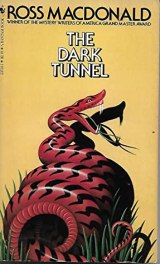 One of the best first novels is The Dark Tunnel (originally published in 1944 under the name Kenneth Millar) but later reissued under the more well-known pseudonym, Ross MacDonald. MacDonald was influenced by Raymond Chandler and John Buchan, but he puts his own twist on things. The book is set in the early days of WWII in a university town, not unlike Ann Arbor where MacDonald taught. It’s a fast-paced tale with protagonist Professor Robert Branch fighting for his life against a German spy conspiracy as well as petty crooks, rural rednecks, Union men and university politics. What makes the book especially tense is the conspiracy going on that’s bigger than Professor Branch realizes, and it just keeps getting darker. The pacing is a bit uneven compared to MacDonald’s later works but there’s a level of paranoia MacDonald never captured in his more famous Lew Archer PI series.
 Conspiracy and paranoia are two themes that also come out in Mickey Spillane’s fourth Mike Hammer novel, One Lonely Night (1951). Hammer is a US government-trained killer from WWII trying to adapt to life stateside as a private investigator.
 Len Deighton’s The Ipcress File (1962) is the definitive noir Cold War novel. Its unnamed hero was christened Harry Palmer and portrayed by Michael Caine in the 1965 adaptation and follow-on films. In this remarkable first novel, Deighton created the ultimate noir protagonist trying to survive in a system set against him. Palmer’s a street-smart working-class punter who is pulled into a game he cannot win. Assigned to track down a top military scientist who is being sold to the Soviets, Palmer is kidnapped, whisked behind the Iron Curtain and electronically brainwashed by Chinese captors. When he manages to escape, he finds a much more sinister interpretation that calls into question the nature of Cold War alliances. If you can’t trust your allies, who can you trust? Coming off the “special relationship” between Franklin Roosevelt and Winston Churchill in WWII and the brainwashing of US troops by the Chinese in the Korean War, this was pretty shocking stuff.
 John le Carré, pen-name for former intelligence officer David Cornwell, published his third novel The Spy Who Came In From The Cold in 1963 at the height of the Cold War. (My brother and I joke that virtually any novel set between 1957 and 2022 can be said to be “at the height of the Cold War” as global tensions continued to escalate.) The Spy Who Came In From the Cold became an immediate bestseller. Its protagonist, WW2 veteran Alec Leamas, takes on one last case in order to avenge the death of a colleague. It involves a descent into the underworld of working-class trade unions and local communist party reps in order to infiltrate East Germany and bring down his nemesis. As with the best noir fiction, Leamas succeeds, but pays the ultimate price.
 Walter Mosley’s first novel, Devil in the Blue Dress (1990), brought about a resurgence in the noir genre. His hard-boiled detective Easy Rawlins (who deserves an entire article to himself) like many noir protagonists before him, is a WWII veteran up against a system meant to keep him down. Rawlins, manages to survive and even win despite the institutional racial discrimination against him, a topic as relevant today as it was in the 1950s.
 About the Authors

