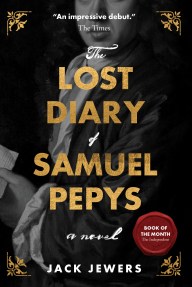
#BookReview The Lost Diary of Samuel Pepys by Jack Jewers

Samuel Pepys Paperback Cover copyAbout the Book

It is the summer of 1669 and England is in dire straits.

The treasury’s coffers are bare and tensions with the powerful Dutch Republic are boiling over. And now, an investigator sent by the King to look into corruption at the Royal Navy has been brutally murdered. Loathe to leave the pleasures of London, Samuel Pepys is sent dragging his feet to Portsmouth to find the truth about what happened.

Aided by his faithful assistant, Will Hewer, he soon exposes the killer. But has he got the right person? The truth may be much more sinister. And if the mystery isn’t solved in time, then England could be thrown into a war that would have devastating consequences . . .

Format: Hardback (360 pages)       Publisher: Moonflower Publishing
Publication date: 4th August 2022 Genre: Historical Fiction, Crime

Purchase links
Bookshop.org
Disclosure: If you buy a book via the above link, I may earn a commission from Bookshop.org, whose fees support independent bookshops

Hive | Amazon UK
Links provided for convenience only, not as part of an affiliate programme


My Review

As the author explains in the Historical Notes, Samuel Pepys kept a diary for almost ten years but then suddenly stopped for reasons that can only be speculated upon. The Lost Diary of Samuel Pepys imagines what events in Pepys’ life he might have recorded in his diaries had he continued. As a result we have the author to thank for giving us an insight into an unsettled period in English history following the Restoration of Charles II, a time when war with the Dutch was a real fear and whose side you had been on in the Civil War still mattered. The author cleverly incorporates elements of this into a plot that involves murder, conspiracy, treachery and political intrigue whilst at the same time being a rip-roaring adventure.

As imagined by the author, Samuel Pepys is not only a diligent diarist but an intrepid investigator, a faithful friend and someone who, in the course of the book, discovers a perhaps surprising taste for adventure. He also has a high pain threshold. If you don’t believe me, look up the word ‘lithotomy’ and then think ‘without anaesthetic’. He’s a less than faithful husband unfortunately with the result that his relationship with his wife Elisabeth is fraught, at least when the book opens.

The book immerses the reader in the London and Portsmouth of the period in all their grimy and fetid detail. The streets and alleyways are a place of danger and poverty is rife. For many it’s a miserable existence, enlivened only by attending cock-fights or watching a hanging.  Or in Pepys’ case frequenting whorehouses, which gives rise to a terrific scene at the start of the book.  There are plenty of action scenes as well depicted in a way which perhaps reflect the author’s experience as a filmmaker. Pepys ascending the stern of a ship via a rope ladder or the tactical use of a trail of gunpowder are scenes that spring to mind.

The book includes some great characters, some of whom are based on real individuals, such as Pepys’ longtime assistant Will Hewer. There are some fantastically feisty female characters, notably a sisterhood who in their resistance to a male hegemony in which ‘the law is an instrument of men’ prove themselves able to give just as good as they get, if not better. The plot has plenty of twists and turns leaving Pepys to observe ruefully at one point that ‘for every answer, another question’.

By the end of the book, it’s clear that not everything was as it seemed, things that seemed connected were perhaps not and that, for reasons of state, there are things that must be kept under wraps. With still some time to go between the end of the book and our hero’s demise in 1703, perhaps Jack Jewers may treat us to further adventures for Samuel and Will?

With its combination of intriguing plot, interesting characters and great period atmosphere, The Lost Diary of Samuel Pepys will definitely appeal to fans of historical crime mysteries.

My thanks to Funmi at Midas PR and Moonflower Publishing for my digital proof copy.

In three words: Entertaining, inventive, intriguing

Try something similar: Rags of Time by Michael Ward


Jack JewersAbout the Author

Jack Jewers is a filmmaker and writer, passionate about history. His career has been spent telling stories in all media, and his body of work includes film, TV, and digital media. His films have been shown at dozens of international film festivals, including Cannes, New York, Marseille, Dublin, and London’s FrightFest, garnering multiple accolades, including an award from the Royal Television Society and a nomination for Best Short Film by BAFTA Wales. The Lost Diary of Samuel Pepys is his first novel.

Connect with Jack
Website | Twitter | Facebook | Instagram

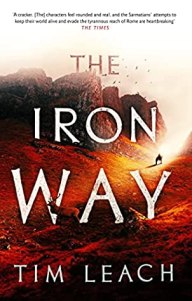
#BookReview The Iron Way by Tim Leach

The Iron WayAbout the Book

In the hard, unforgiving land at the northernmost point of the Roman Empire lies a great wall. Once, the edge had been but a thing of thought and dreams, but one day the great Emperor from across the water had grown tired of borders made from thoughts and dreams. So, a wall was raised from the earth at his command. From afar, it looked invincible.

Yet every wall has its weaknesses – if one looks close enough.

In its shadow, gather five thousand fearsome soldiers. Men bred to fight and kill. The Sarmatians have suffered capture and defeat, but under a new command they are prepared to fight again.

For of the other side of the wall there are rumours. Of men closer to giants, of warriors who fight without fear or restraint. And the Sarmatians are called to defend against them.

To stand and fight, to die for Rome.

Format: Hardback (320 pages)        Publisher: Head of Zeus
Publication date: 4th August 2022 Genre: Historical Fiction

Find The Iron Way on Goodreads

Pre-order/Purchase links
Bookshop.org
Disclosure: If you buy a book via the above link, I may earn a commission from Bookshop.org, whose fees support independent bookshops

Hive | Amazon UK
Links provided for convenience only, not as part of an affiliate programme


My Review

I really enjoyed Tim Leach’s The Last King of Lydia when I read it way back in 2013 and I loved The Smile of the Wolf, published in 2018, which I reviewed as part of the blog tour. Therefore I have no idea how I missed the fact he had a new series on the way – The Sarmatian Trilogy – or the publication of the first book, A Winter War, in September last year.  The Iron Way is the second book in the trilogy, set in 2nd century Britain. It can definitely be read without having read the first book – as I did – however, although there are references to events in the first book, I felt I missed out by not knowing more of the back stories of the main characters. (Reader, I may just have ‘happened’ to be in Waterstones yesterday and found myself at the till with a copy of A Winter War.)

I confess I had never heard of the Sarmatians before reading this book but it seems I can be forgiven because in his Historical Note the author reveals that very little is known for certain about them. A nomadic, warlike people, they left no written records and minimal archaeological evidence. However, the events in the first book – their defeat by the Romans and a peace settlement the terms of which saw thousands of their warriors sent to the north of Britain – are based on fact.

The book focuses on one band of Sarmatians, made up of five hundred warriors, under their Roman commander, Lucius, who as a result of previous events has become a sort of ‘honorary’ Sarmatian. He’s described at one point as having the soul of a Sarmatian locked in a Roman body.  Bound by an oath to serve as part of the Roman army for twenty-five years, the Sarmatians find themselves guarding one of the forts along Hadrian’s Wall against the threat of attack from tribes to the north. It’s not where they want to be. They pine for the wide open spaces of their homeland, ‘the long grass dancing with the wind, the wildflowers shining under the sun, the world open before them beneath an endless sky’. Instead they find themselves confined to the settlement around the fort, in the shadow of Hadrian’s  Wall. ‘They saw their prison, the chain of stone that bound them, the symbol of a shameful defeat.’

The author gives the reader a fascinating insight into the Sarmatian people. What we learn is that they are bound together not just by ties of kinship but by sacred oaths and the belief that to die in battle is glorious. Their philosophy? ‘Given the choice between two paths, between safety and danger, one must always go toward sword and spear, and choose the iron way.’  And that’s not just the men because the Sarmatian women are warriors too.

The story is told from the point of view of three main characters – Lucius, his Sarmatian comrade Kai and Arite, the wife of Kai’s former friend. None of them is where they want to be.  Lucius recognises his posting to the Wall is a sign of his fall from grace.  And he soon discovers he is pawn in the hands of powerful and ambitious men. Kai longs to return to his homeland and see his daughter once again. Arite finds herself unable to use her skills as a warrior, consigned instead to a life of household drudgery. The frustration felt by the Sarmatians creates an atmosphere of extreme tension. Unused to the discipline of a Roman army, there are drunken brawls and petty rivalries.

There are some terrific action scenes that put the reader in the heart of the battle and reveal some quite remarkable aspects of the Sarmatians as a fighting force. But the writing throughout flows beautifully giving a real insight into the thoughts and feelings of a people quite different from ourselves – or at least those of us who don’t gallop across the steppes on huge heavily armoured horses trained to kill.

Having endured one betrayal, the end of the book sees Lucius come to the realisation that what lies ahead for the Sarmatians is a conflict not of their own making but one driven by the personal ambition of others.

I thought The Iron Way was brilliant. Its blend of fascinating historical detail, absorbing storyline, interesting characters and full-on action made it a thoroughly engrossing read. Roll on book three.

My thanks to Head of Zeus for my digital review copy via NetGalley.

In three words: Compelling, pacy, immersive

Try something similar: The Capsarius by Simon Turney


Tim Leach credit Emma LeachAbout the Author

Tim Leach is a graduate of the Warwick Writing Programme, where he now teaches as an Assistant Professor. His first novel, The Last King of Lydia, was shortlisted for the Dylan Thomas Prize.  (Photo credit: Emma Leach)

Connect with Tim
Website | Twitter