
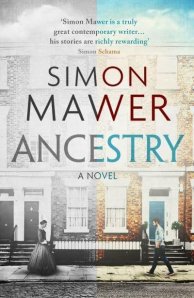
 About the Book
Almost two hundred years ago, Abraham, an illiterate urchin, scavenges on a Suffolk beach and dreams of running away to sea … Naomi, a seventeen-year-old seamstress, sits primly in a second-class carriage on the train from Sussex to London and imagines a new life in the big city … George, a private soldier of the 50th Regiment of Foot, marries his Irish bride, Annie, in the cathedral in Manchester and together they face married life under arms.
Now these people exist only in the bare bones of registers and census lists but they were once real enough. They lived, loved, felt joy and fear, and ultimately died. But who were they? And what indissoluble thread binds them together?
Format: Hardback (432 pages) Publisher: Little Brown
Publication date: 28th July 2022 Genre: Historical Fiction
Find Ancestry on Goodreads
Purchase links
Bookshop.org
Disclosure: If you buy a book via the above link, I may earn a commission from Bookshop.org, whose fees support independent bookshops
Hive | Amazon UK
Links provided for convenience only, not as part of an affiliate programme
My Review
‘That is the trouble with the usual historical documents: they don’t say how things happen, merely when.’ Ancestry is the author’s attempt to address this problem and to paint a picture of the lives of some of his ancestors, and a picture more vivid and immersive than that set out in official documents – birth, marriage and death certificates, census returns – although even these provide interesting detail and a few puzzles.
The story begins with the author’s great-great-grandfather Abraham Block, the illiterate son of agricultural labourers who in 1847 leaves home at the age of fifteen to sign on as an indentured (apprentice) sailor aboard a merchant ship travelling between ports in the Mediterrean, as well as further afield. Occasionally the ship docks in London and I particularly enjoyed, as imagined by the author, Abraham’s first impressions of the teeming city – its sights, sounds and smells – a place so different from the Suffolk village in which he grew up. ‘There were familiar smells – horse piss and horse shit, human shit, rotting vegetables – blended with smells he was only beginning to discover – the pungent smell of spices, the sour stench of vinegar, the stink of a tannery. The streets ran between cliffs of buildings. Pubs, factories, warehouses, a covered market, a church, shops, houses all slammed together as though by some ill-tempered child playing with pebbles and mud ….Whistles blew. Whips cracked. Shouts rang out.’
In London, Abraham meets Naomi Lulham, a young seamstress, who will eventually become his wife. As we discover, the life of a sailor’s wife in nineteenth century England is a lonely one with information about the whereabouts of crew, and even the ship, taking week, possibly months to arrive. And when it does, it may contain bad news.
Part two of the book focuses on another ancestor, George Mawer a soldier serving with the 50th Regiment of Foot. Married life for him and his Irish wife Annie involves frequent moves between barracks whose cramped conditions offer little privacy. When George’s regiment is sent to Crimea, he and Annie may be aware of the dangers but our sense of foreboding is greater knowing the history of that conflict. In fact, as the book demonstrates the danger was not restricted to the battlefield; many soldiers died of disease. Others died as a result of disastrous decisions by army leaders.
In George’s absence and later when she finds herself alone in the world, Annie has to find ways to fend for herself and her children. It’s a hostile world for a woman alone and Annie is forced to make desparately difficult decisions affecting her children’s future.
Alongside the human stories, there is a wealth of historical detail but this is subtly woven into the narrative in way that never makes it feel like you are reading a history text book. The details amplify the story, not interrupt it.
Throughout the book, the author makes plain the responsibility he feels to bring to life the experiences of his ancestors whilst respecting the documented facts, so far as they are known. ‘Abraham Block, Naomi Lulham, these are real people with whom I am playing – their live, their loves, their innermost secrets. I feel the obligation to place the pieces with infinite care.’ Where there are gaps, he uses his imagination to give the reader a sense of them as individuals. We learn about their hopes, dreams and struggles, of which there are plenty. At times, this involves speculation on his part. For example, at one point the author give us three possible versions of a pivotal moment in Annie’s life.
Another theme the author explores in the book is those things handed down through the generations. Not just genetic material but the ‘intangible, unmeasurable things that run through families – memory, stories, myths and legends’. He makes the point that physical evidence – not just documents but buildings, places – can disappear. For instance, November 1848 sees Abraham walking along a street that no longer exists towards a house that no longer exists.
I found myself especially drawn to the female characters, especially Annie. Her resilience and determination to find a way around the obstacles that confront her was inspiring. Sadly, both Naomi and Annie have to deal with the aftermath of tragedy, bringing up their children alone.
In comparison to the detail lavished on recounting the lives of the author’s distant ancestors, the manner in which the two branches become conjoined is covered in relatively short order. The absence of a family tree seems a strange omission. I would have found it helpful, especially given many names recur down the years.
At first sight, the lives of Abraham, Naomi, George and Annie may seem very different from our own but in Ancestry the author skilfully draws out the human connections that exist between them and us.
In three words: Fascinating, compelling, authentic
Try something similar: The Secret Diaries of Charles Ignatius Sancho by Paterson Joseph
 About the Author
Simon Mawer was born in 1948 in England and spent his childhood there, in Cyprus and in Malta. He then moved to Italy, where he and his family lived for more than thirty years, and taught at the British International School in Rome. He and his wife currently live in Hastings. He is the author of several novels including the Man Booker shortlisted The Glass Room, The Girl Who Fell From The Sky, Tightrope and Prague Spring.
Connect with Simon
Website | Twitter | Facebook




 What Cathy Read Next...