
About the Book
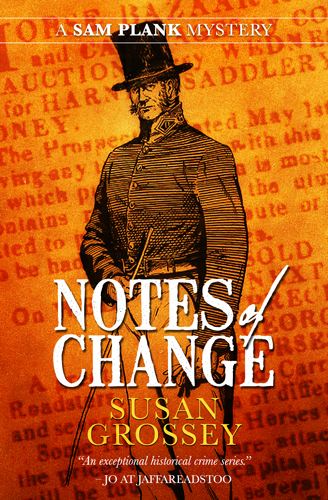
In the autumn of 1829, the body of a wealthy young man is found dumped in a dust-pit behind one of London’s most exciting new venues. Constable Sam Plank’s enquiries lead him from horse auctions to houses of correction, and from the rarefied atmosphere of the Bank of England to the German-speaking streets of Whitechapel. And when he comes face to face with an old foe, he finds himself considering shocking compromises…
The new and highly organised Metropolitan Police are taking to the streets, calling into question the future of the magistrates’ constables. Sam’s junior constable, William Wilson, is keen, but what is an old campaigner like Sam to do when faced with the new force and its little black book of instructions?
Format: ebook (290 pages) Publisher:
Publication date: 20th April 2022 Genre: Historical Fiction, Crime, Mystery
Find Notes of Change on Goodreads
Purchase Notes of Change from Amazon UK [Link provided for convenience, not as part of an affiliate programme]
My Review
I’m ashamed to say it’s almost two years since Susan contacted me about her book, Notes of Change, the seventh and final book in her Sam Plank historical crime series. You can read a brief summary of the preceding books in the whole series here. Sam’s final outing has been waiting in my review pile for all that time (sorry, Susan) but I’m so glad to have finally made his acquaintance.
The book’s clever title references the plot – the uttering [putting into circulation] of counterfeit notes, a capital offence at the time – but also the changes coming to Sam Plank’s life and career as the role of magistrate’s constable is supplanted by the new Metropolitan Police. For Sam’s junior, William, there’s also the prospect of change; a promising career in the new police force and an addition to his young family. Another interesting aspect of the book is the notion of whether a person can ever change, for example leaving behind a life of crime, and what might motivate that change.
As well as a clear interest in financial instruments, it’s evident the author has fully researched the period in which the story is set. (The glossary at the end of the book provides useful explanations of some of the more unfamiliar terms.) The streets and taverns which Sam and William frequent in the course of their enquiries – along with more unusual places such as a Horse Bazaar – are vividly brought to life.
Thanks to his decades of experience, Sam has amassed a number of useful contacts whose help and information he is able to call upon in solving the case. I imagine many of these are characters who have appeared in previous books. His reputation for probity gets him access to places to which many others wouldn’t, notably Newgate Prison. It also provides a stark contrast to the disreputable behaviour of others, demonstrating that misconduct in public institutions and cover-ups are nothing new.
I loved the tender relationship between Sam and his wife, Martha. And Martha’s unerring ability to detect when someone is telling the truth comes in handy. But no-one is more surprised than Martha when Sam proves to be something of a matchmaker. He’s a lovely character and I’ll leave you with one of Martha’s wise observations. ‘Do you know how wonderful it is, Sam, that after three decades in your uniform you can still see the good in people who have done bad things? I pray that you never change.’
If you’re a fan of historical police procedurals, I’m confident you’ll enjoy Notes of Change. Better still, don’t be like me; start the series from the beginning.
I received a digital review copy courtesy of the author.
In three words: Engaging, intriguing, authentic
Try something similar: Down a Dark River by Karen Odden
About the Author

Susan writes: ‘I graduated from Cambridge University in 1987 with a degree in English, and then taught secondary English for two years before realising that the National Curriculum was designed primarily to extinguish every spark of creativity in its teachers. I then became a technical author, and reached the pinnacle of this profession when I was asked to document the workings of a choc-ice wrapping machine in Cardiff, while wearing a fetching blue hairnet (which I forgot to remove until it was pointed out by a cashier in a petrol station on the M4).
From this unbeatable high point I moved into technical training, and one day was asked to help with a staff manual on fraud prevention. As I wrote the chapter on money laundering, I realised that here was a topic that could keep my interest for years – and so it has proved. Since 1998, I have been self-employed as an anti-money laundering consultant, providing training and strategic advice and writing policies and procedures for clients in many countries. As part of my job, I have written several non-fiction books with exciting titles like Money Laundering: A Training Strategy, The Money Laundering Officer’s Practical Handbook and Anti-Money Laundering: A Guide for the Non-Executive Director.
However, even this is not enough financial crime for me, and in my spare evenings and weekends I write fiction – but always with financial crime at the heart of it.’ (Photo/bio: Goodreads author page)
Connect with Susan
Website | Facebook | Instagram





 What Cathy Read Next...