
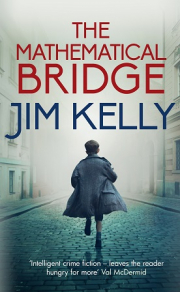
#BookReview The Mathematical Bridge by Jim Kelly @AllisonandBusby

the mathematical bridgeAbout the Book

Cambridge, 1940. It is the first winter of the war and the snow is falling thick and fast. A college porter, crossing the ancient Mathematical Bridge on his nightly rounds, is startled to hear a child’s cries for help coming from the icy river below. Detective Inspector Eden Brooke is summoned by police whistle and commandeers a punt in a desperate attempt to save the child, but the flood carries the boy away into the night. By dawn there is no trace of the victim.

The boy was Sean Flynn, part of a group of Irish Catholic children evacuated from a poor London parish. When an explosion causes damage at a factory engaged in war work and the bombers leave an Irish Republican slogan at the scene, Brooke questions whether there could be a connection between the two events. As more riddles come to light, he begins to close in on a killer, but there is one last twist: it seems that Sean Flynn had his own startling secret.

Format: Hardcover (352 pp)                  Publisher: Allison & Busby
Publication date: 21st February 2019 Genre: Historical Fiction, Crime

Purchase Links*
Amazon.co.uk | Amazon.com | Hive (supporting UK bookshops)
*links provided for convenience, not as part of any affiliate programme

Find The Mathematical Bridge on Goodreads


My Review

In The Mathematical Bridge, the author once again creates a vivid sense of what it must have been like to live in wartime Cambridge with familiar views transformed by the addition of rooftop observation posts and searchlights to detect enemy bombers. Detective Inspector Eden Brooke’s home life reflects the daily experience of families during wartime. He and his wife, Claire, are awaiting news of their son serving with the British Expeditionary Force and his pregnant daughter, Joy, is anxiously awaiting news of her submariner husband. Alongside this uncertainty, there are long night shifts, blackouts, air raid warnings and rationing to contend with, not to mention the threat of attacks by the IRA. One of the many things I enjoyed about the book is this mixture of the personal and the political, the local and the global.

Another theme, as in the first book in the series, is that of darkness and light. Eden Brooke himself is the most obvious manifestation of this. The damage to his vision and the insomnia caused by his traumatic experiences in the desert during the First World War make the night time streets of Cambridge a sanctuary. It’s one he shares with fellow “nighthawks”, such as cafe owner Rose King, expert in circadian rhythms Aldiss, or night porter  Doric, ‘condemned to live life out of the light, at home in the shadowy world of the college after dark’. There are also some wonderfully atmospheric night time scenes such as the search of the drained River Cam.

However, although Brooke may welcome the darkness in a physical sense, his moral and professional impulse is to seek just the opposite. ‘Joining the Borough, on his return from the desert, had offered an opportunity to tilt the world towards light, and away from the darkness, even by small fractions of a degree.’
cambridge-1423972__480
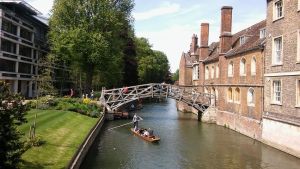
The Mathematical Bridge, Cambridge

As in The Great Darkness, the author makes the reader feel they are alongside Brooke as he travels the streets of Cambridge in the course of his investigations, crossing the various bridges over the River Cam, including the famous Mathematical Bridge of the book’s title. And I’m sure I’m not the only reader who reacted with joy when they opened the book and found there was a map in the front.

In the enthralling final chapters, there are dramatic events, surprising revelations, split second life and death decisions to be taken and some poignant moments. At one point, Brooke observes, ‘He didn’t like the sense that fate was contriving a circular narrative, a story that was being drawn back to the beginning’. As a reader, I can only disagree (sorry, Eden) because I loved the way the various storylines were skilfully brought together. Oh, and a word of advice for Eden – listen to your wife when it comes to making assumptions about the identity of a murderer in future.

I loved The Great Darkness and this follow-up certainly didn’t disappoint. The Mathematical Bridge would be perfect for those mourning the demise of TV’s Foyle’s War or for fans of James Runcie’s ‘Grantchester Mysteries’ series. Readers who enjoyed The Great Darkness and have read, or are looking forward to reading, The Mathematical Bridge will be pleased to learn (as I was) that a third book in the series is due to be published early next year. It already has a place on my wishlist.

I received a review copy courtesy of Allison & Busby.

In three words: Atmospheric, compelling, assured

Try something similar: Nucleus (Tom Wilde #2) by Rory Clements (read my review here)


Jim KellyAbout the Author

Jim Kelly was born in 1957 and is the son of a Scotland Yard detective. He went to university in Sheffield, later training and working as a journalist on publications including the Financial Times. His first book, The Water Clock, was shortlisted for the John Creasey Award and he has since won a CWA Dagger in the Library and the New Angle Prize for Literature. He lives in Ely.

Website | Twitter


#BookReview The Vanished Bride by Bella Ellis @HodderBooks @brontemysteries

cover171547-mediumAbout the Book

Yorkshire, 1845. A young wife and mother has gone missing from her home, leaving behind two small children and a large pool of blood. Just a few miles away, a humble parson’s daughters – the Brontë sisters – learn of the crime. Charlotte, Emily, and Anne are horrified and intrigued by the mysterious disappearance.

These three creative, energetic, and resourceful women quickly realize that they have all the skills required to make for excellent “lady detectors.” Not yet published novelists, they have well-honed imaginations and are expert readers. And, as Charlotte remarks, “detecting is reading between the lines – it’s seeing what is not there”.

As they investigate, Charlotte, Emily, and Anne are confronted with a society that believes a woman’s place is in the home, not scouring the countryside looking for clues. But nothing will stop the sisters from discovering what happened to the vanished bride, even as they find their own lives are in great peril…

Format: ebook (352 pp.)                             Publisher: Hodder & Stoughton
Publication date: 12th September 2019 Genre: Historical Fiction, Mystery

Purchase Links*
Amazon.co.uk | Amazon.com | Hive (supporting UK bookshops)
*links provided for convenience, not as part of any affiliate programme

Find The Vanished Bride on Goodreads


My Review

It’s 1851 and the prologue to the book sees Charlotte, now the last surviving member of the Brontë family, looking back on her and her sisters’ lives before they became famous authors.  It underlines how tragically short their lives were, Emily having died in 1848 and Anne in 1849.  Charlotte herself was to die in 1855.

The book’s very engaging premise is that the sisters were enterprising ‘detectors’ before they were novelists and The Vanished Bride represents their first case undertaken in 1845 (before, for example, the publication of Jane Eyre or Wuthering Heights in 1847).  In a clever nod to the fact that the Brontë sisters’ novels and poems were initially published under pseudonyms (Currer, Ellis and Acton Bell) in order to disguise their gender, the author has adopted Bella Ellis as her pen-name for this new series of historical mysteries. That’s only one of very many clever nods to the works of the Brontë sisters that feature in The Vanished Bride and readers who are familiar with any of the novels of the Brontës will have great fun in spotting the allusions.  I know I did but I probably missed just as many more.   (There is also at least one allusion to another famous fictional detective in the reference to what might be described as a ‘curious incident’.)

The book also makes references to events in the lives of the sisters.  There is one especially poignant scene where Charlotte and Anne visit Scarborough as part of their  investigation and Anne remarks that, apart from Haworth, Scarborough is ‘the only other place in the world that she ever wished to be…standing on the clifftops, marvelling at the boundless magnitude of the sea, and wondering at what might lie beyond it’.

The sisters take it in turns to relate the story and, as well as making engaging narrators, it allows the reader to appreciate their different strengths when it comes to the art of ‘detecting’, neatly mirroring what you might imagine were their characters in real-life.  For example, Emily is all action, emotional and instinct, whereas Anne is methodical and thoughtful, and Charlotte is in her element when dealing with people and eliciting information.  Collectively, the sisters find their gender is a positive advantage on a number of occasions, something very different from the position they find themselves in as members of society.   Fans of Branwell Brontë will be pleased to know that he also features, although very much in an assisting role.

I wouldn’t want what I’ve said so far to put off readers who are unfamiliar with the lives or works of the Brontë sisters because The Vanished Bride works perfectly well as an engaging historical mystery even without such knowledge (although, I suspect readers may be tempted to pick up one of the sisters’ novels afterwards).  The sisters’ investigation involves everything you’d expect from a mystery: examining the scene of the crime, looking for evidence, interviewing suspects, even a bit of undercover work and an early outing for what we’d probably recognise today as psychological profiling.  Those with good powers of observation may pick up clues along the way but you definitely won’t know if they were significant or ‘red herrings’ until the final chapters.

The Vanished Bride is an accomplished, entertaining historical mystery that is also great fun for Brontë fans.  I shall certainly be looking out for future books in the series.

I received an advance review copy courtesy of Hodder & Stoughton via NetGalley

In three words: Clever, engaging, mystery

Try something similar: Lady Helena Investigates by Jane Steen (read my review here)

Follow my blog via Bloglovin


Rowan ColemanAbout the Author

Bella Ellis is the Brontë-esque pseudonym of Rowan Coleman, an acclaimed author of numerous novels for adults and children. She first visited the former home of the Brontë sisters when she was ten years old. From the moment she stepped over the threshold she was hooked, and embarked on a lifelong love affair with Charlotte, Emily, and Anne; their life; their literature; and their remarkable legacy. (Photo credit: Goodreads author page)

Connect with Bella
Website | Twitter | Goodreads