
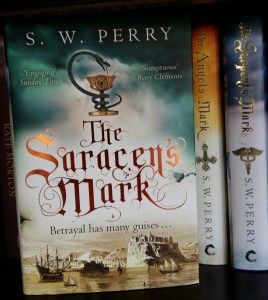
 Welcome to today’s stop on the blog tour for The Saracen’s Mark by S. W. Perry. My thanks to Anne at Random Things Tours for inviting me to participate and to Corvus Books and Readers First for my review copy.
The Saracen’s Mark is described as “a tale of conspiracy, murder and espionage in Elizabethan London and dazzling Marrakesh”. Sounds good, doesn’t it? But don’t take my word for it. Just read the following praise for the previous two books in the series – The Angel’s Mark and The Serpent’s Mark – by some of the most highly-regarded authors of historical fiction writing today.
Praise for The Jackdaw Mysteries series
“A gorgeous book – rich, intelligent and dark in equal measure. It immerses you in the late 16th century and leaves you wrung out with terror. This is historical fiction at its most sumptuous…” (Rory Clements, author of the John Shakespeare series, on The Angel’s Mark)
“Wonderful! Beautiful writing, and Perry’s Elizabethan London is so skilfully evoked, so real that one can almost smell it.” (Giles Kristian, author of Camelot, on The Angel’s Mark)
“An impressively dramatic and gripping debut novel. Elegantly written, thoroughly researched, The Angel’s Mark draws us into the murky world of Elizabethan London where life is a game of chance, and savage death a close neighbour, quick to pounce on the unsuspecting. I predict that we will be seeing much more of Nicholas Shelby, physician and reluctant spy.” (Anne O’Brien, author of Tapestry of Treason)
“I knew before I got to the bottom of the first page that The Angel’s Mark was the real thing. In an increasingly crowded field, this one is going to stand out.” (S. G. MacLean, author of The Seeker)
“No-one is better than S. W. Perry at leading us through the squalid streets of London in the sixteenth century.” (Andrew Swanston on The Serpent’s Mark)
“The writing is of such a quality, the characters so engaging and the setting so persuasive that, only two books in, S. W. Perry’s ingeniously plotted novels have become my favourite historical crime series.” (S G MacLean on The Serpent’s Mark)
“The Serpent’s Mark is an excellent evocation of Elizabethan England, with espionage, intricate conspiracies, strange medical practises and a gripping story. A rattling good read.” (William Ryan, bestselling author of The Constant Soldier)
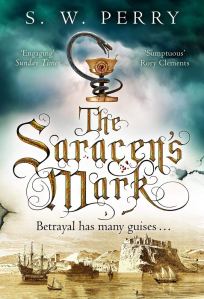 About the Book
Betrayal has many guises…
London, 1593: Five years on from the Armada and England is taking its first faltering steps towards a future as a global power. Nicholas Shelby – reluctant spy and maverick physician – and his companion Bianca Merton are settling into a life on Bankside. But in London there is always a plot afoot…
Robert Cecil, the Queen’s spymaster, once again recruits Nicholas to embark on a dangerous undercover mission that will take him to the back alleys of Marrakech in search of a missing informer. However, while Nicholas hunts for the truth across the seas, plague returns once more to London – ravaging the streets and threatening those dearest to him.
Can Bianca and Nicholas’ budding relationship weather the threats of pestilence and conspiracy? And will Nicholas survive the dangers of his mission in a hostile city to return safely home?
Format: Hardcover (464 pages) Publisher: Corvus Books
Publication date: 2nd April 2020 Genre: Historical Fiction, Mystery, Crime
Find The Saracen’s Mark on Goodreads
Purchase links*
Amazon UK| Hive (supporting UK bookshops)
*links provided for convenience not as part of an affiliate programme
My Review
The books of S. W. Perry have fast become one of my favourite historical crime mystery series. I loved both The Angel’s Mark and The Serpent’s Mark so, as you can probably imagine, I was very much looking forward to reading The Saracen’s Mark. I’m pleased to report that I wasn’t disappointed. In fact, I think it may be the best book in the series yet. The story gripped me from its enticing opening line – ‘In the moment before they caught him, Adolfo Sykes was dreaming of oranges‘ – to the poignant closing moments, and everything in between.
As before, the backdrop to the story is the turbulent period towards the end of Elizabeth I’s reign. The Spanish Armada may have been defeated but questions still remain about the succession, not everyone can practice their faith openly and the fear of Papist plots persists. No wonder then that the intelligence network of Lord Burghley and his son, Robert Cecil, seemingly has ears and eyes everywhere. And as Bianca observes, “A journey undertaken for Robert Cecil does not always end at the destination you are expecting.” Little does she know how right she will be. Great for us as readers, not so great for those persuaded to undertake such a journey. Add to this the threat of the plague and you have a situation of unexpected contemporary resonance in which the Lord Mayor has ordered the playhouses and the bear-pits closed in the fight against a disease described as ‘an exceptionally malign mystery’ that some see as a sign of God’s displeasure.
It was a delight to catch up with the two main characters: physician, Nicholas Shelby, and apothecary and owner of The Jackdaw tavern in Bankside, Bianca Merton. I love Bianca’s determination, independence and resourcefulness as well as her loyalty towards her employees Rose, Ned, Timothy and Farzad. However, in her eagerness to see the wicked brought to justice, she sometimes places herself in risky situations. Likewise, Nicholas’s sense of justice and unconventional views on medicine (no casting of horoscopes for him when diagnosing disease) have won him few allies. Only Robert Cecil values his ingenuity and plain speaking.
The author continues to tease the reader with the ‘will they/won’t they’ nature of the relationship between Nicholas and Bianca. Will it always be a partnership based merely on mutual respect and friendship or can Nicholas consign to the past his painful memories and feelings of guilt and let it grow into something more intimate? The staff and regulars at The Jackdaw would certainly like that to be the case. (This reader would too.)
One of the things I’ve loved about the previous books is the way the author conjures up the sights, sounds and smells of Elizabethan London. This time, he repeats that feat in transporting the reader to exotic Marrakech, as in this description of a public square thronged with people.
‘The sun beats down on merchants selling oils, honey, parsley and oregano; troupes of wrestlers; jugglers and snake-charmers; young boys with solemn faces and bells on their wrists, performing energetic dances to the applause of the crowd. There are men sitting on stools who turn spindles on foot-lathes, fortune-tellers, acrobats, professional storytellers, even a display of severed heads stinking and plum-dark on their poles, reminding Nicholas of the traitors’ heads that grace the top of the gatehouse on London Bridge. Were it not for the heat, it could be Bankside on any May Day.’
In addition, as part of Nicholas’ ‘cover story’, the reader is privy to some fascinating information about Arabic medical practices of the time which are much more advanced, enlightened and science based than those practised in England.
During the course of his secret mission for Robert Cecil, the true purpose of which he’s not even been able to share with Bianca, Nicholas strays into the path of some decidedly unsavoury characters, a few of whom definitely fall into the “boo hiss” villain category. And as Bianca tries to investigate back in London, she risks finding herself in a similarly perilous situation – as if the plague wasn’t enough of a threat. As she observes to Nicholas, reflecting on their past adventures, “When does it end, this dainty measure we dance with death?” For both of them, danger will bring clarity about what is really important to them.
Clever little touches by the author, such as shorter chapters and switching the action more frequently between Nicholas in Marrakech and Bianca back in London, help to accelerate the pace and build the tension in the final section of the book. And the author certainly knows how to craft a dramatic close to a chapter.
Although it’s the third in the series, The Saracen’s Mark can definitely be read as a standalone as the author includes brief details of events from the previous books for the benefit of new readers. If you’ve got the time or inclination though, I’d recommend reading the series from the beginning.
With its well-crafted plot, lashings of period detail and colourful cast of characters, The Saracen’s Mark – along with its predecessors – will appeal to fans of historical crime mysteries, such as C J Sansom’s Shardlake series or Rory Clements’ John Shakespeare series. And for those who have already discovered The Jackdaw Mysteries series, there’s good news as the author is working on a fourth book.
In three words: Gripping, atmospheric, suspenseful
Try something similar: Martyr (John Shakespeare #1) by Rory Clements
Follow this blog via Bloglovin
 About the Author
S. W. Perry was a journalist and broadcaster before retraining as an airline pilot. His debut novel, The Angel’s Mark, was listed for the CWA Historical Dagger and was a Walter Scott Prize Academy Recommended Read 2019. He lives in Worcestershire with his wife.
Connect with S. W. Perry
Twitter | Goodreads


 About the Book
 About the Author

