
 About the Book
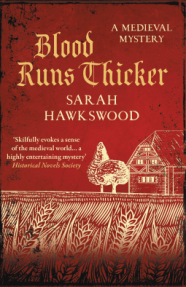
August 1144. Osbern de Lench is known far and wide as a hard master, whose temper is perpetually frayed.
After his daily ride to survey his land, his horse returns to the hall riderless, and the lifeless body of the lord is found soon after. Was it the work of thieves, or something closer to home?
With an heir who is cast in the same hot-tempered mould, sworn enemies for neighbours and something amiss in the relationship between Osbern and his wife, undersheriff Hugh Bradecote, the wily Serjeant Catchpoll and apprentice Walkelin have suspects aplenty.
Format: Paperback (300 pages) Publisher: Allison & Busby
Publication date: 18th March 2021 Genre: Historical Fiction
Find Blood Runs Thicker on Goodreads
Purchase links
Bookshop.org
Disclosure: If you buy a book via the above link, I may earn a commission from Bookshop.org, whose fees support independent bookshops
Hive | Amazon UK
Links provided for convenience only, not as part of an affiliate programme
My Review
Sarah Hawkswood’s Bradecote and Catchpoll historical mystery series set in medieval Worcestershire has been around for some time but it’s one I only discovered recently when I read River of Sins, the seventh in the series. That made me keen to read more so I was delighted when I spotted this latest book, Blood Runs Thicker, on NetGalley and even more delighted when my request was approved by the lovely people at Allison & Busby.
Readers new to the series can be reassured that Blood Runs Thicker can definitely be enjoyed without having read any of the previous books, the occasional references to earlier events and the back stories of the leading characters, including some personal tragedies and longstanding enmities, being subtly introduced.
It was a pleasure to be reunited with Hugh Bradecote, Undersheriff of Worcestershire, and Serjeant Catchpoll. Also, enthusiastic young Walkelin, Catchpoll’s apprentice, ever eager to prove his abilities and showing early signs of a keen intelligence. Bradecote and Catchpoll make an effective team each contributing something different. Bradecote has the status to ensure they get access to those they need to speak to whilst Catchpoll possesses the detective nous and a rather intimidating gaze. Once again, they deploy their equivalent of a ‘good cop, bad cop’ strategy or perhaps more accurately ‘toff cop, common cop’. At one point, as they plan how to go about questioning the villagers of Lench, Catchpoll proposes, “Do you come the high and mighty and let me act the willing vessel into which they pours their remembering?” In fact, Catchpoll exhibits a touching pride in the signs of Bradecote’s developing investigative instincts. Observing Bradecote’s questioning of a suspect, ‘Catchpoll very nearly sighed with pleasure. This was just how serjeanting worked.’
In my review of River of Sins I noted that it had all the features of a police procedural but transported to medieval Worcestershire. The same is true of Blood Runs Thicker. Like their modern day counterparts, Bradecote and Catchpoll visit crime scenes in the search for clues and physical evidence, closely examine the body of the victim to establish the cause of death, interview witnesses and explore possible motives.
What they refuse to do is accept without question the accusation by Osbern’s son, Baldwin, now the new Lord of Lench, that his half-brother, Hamo, is responsible for their father’s death. Whilst Baldwin has inherited the short temper and high-handed nature of his father, Hamo is a gentler character albeit with a rather single-minded and literal way of thinking, often showing little emotion. Today we would probably recognize Hamo as being on the autistic spectrum but it’s not surprising that the villagers of Lench find it strange and unsettling.
Bradecote and Catchpoll begin their search for suspects with the neighbouring lords of the manors, Raoul Parler and Walter Pipard, both of whom Osbern was widely known to have fallen out with. As Bradecote observes, “in dangerous times… petty rivalries hid beneath greater ones”. These greater ones include the constantly shifting loyalties of English nobles between Empress Maude and King Stephen, the warring rivals for the English throne.
As before, alongside what turns out to be a particularly complex mystery that had me a little baffled at some points, the author creates a vivid sense of what daily life for the inhabitants of an 11th century manor house and estate must have been like. Above all, the profound desire of everyone for a successful harvest to stave off hunger in the months to come. The latter is a concern Hugh Bradecote shares for his own estate. His wife, Christina, just wants Hugh back safely.
Blood Runs Thicker is another well-crafted historical mystery involving love, betrayal and family secrets. Fans of the series will be pleased to learn a further instalment is promised for later this year.
In three words: Intriguing, immersive, engaging
Try something similar: The Monastery Murders (Stanton and Barling #2) by E. M. Powell
Follow this blog via Bloglovin
 About the Author
Sarah Hawkswood describes herself as a ‘wordsmith’ who is only really happy when writing. She read Modern History at Oxford and her factual book on the Royal Marines in the First World War, From Trench and Turret, was published in 2006. The Bradecote and Catchpoll series are her first novels. She takes her pen name from one of her eighteenth century ancestors who lived in Worcestershire, and selected it because the initials match those of her maiden name. She is married, with two grown up children, and now lives in Worcestershire. She is a member of the Crime Writers’ Association, the Historical Writers’ Association, and the Historical Novel Society.(Photo/bio credit: Goodreads author page)
Connect with Sarah
Website | Twitter

 About the Book
 About the Author

