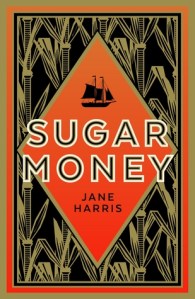
 About the Book
Martinique, 1765, and brothers, Emile and Lucien, are charged by their French master, Father Cléophas, with a mission. They must return to Grenada, the island they once called home, and smuggle back the 42 slaves claimed by English invaders at the hospital plantation in Fort Royal. While Lucien, barely in his teens, sees the trip as a great adventure, the older and worldlier Emile has no illusions about the dangers they will face. But with no choice other than to obey Cléophas – and sensing the possibility, however remote, of finding his first love Celeste – he sets out with his brother on this ‘reckless venture’.
Format: Hardcover, ebook (320 pp.) Publisher: Faber & Faber
Published: 5th October 2017 Genre: Historical Fiction
Purchase Links*
Amazon.co.uk ǀ Amazon.com ǀ Hive.co.uk (supporting UK bookshops)
*links provided for convenience, not as part of any affiliate programme
Find Sugar Money on Goodreads
My Review
There were a number of things that attracted me to Sugar Money. Firstly, it’s one of the six books shortlisted for The Walter Scott Prize for Historical Fiction 2018 – always an excellent hallmark for quality historical fiction – and I’m attempting to read all the shortlisted books before the winner is announced on 16th June. (Eek, time running out and only 4 of the 6 read so far.) Secondly, the book’s setting on the Caribbean islands of Martinique and Grenada. I’ve been lucky enough to visit both those islands – admittedly only for a day as part of a cruise itinerary – but I remember loving Grenada, particularly the colourful market in the capital, St George’s, (referred to by its previous name Fort Royal in the book) with the smell of spices in the air. In fact, I’m still using the nutmeg and mace I bought there. Thirdly, I read Jane Harris’s first book, The Observations, some time ago but remember being captivated by its quirky narrator, Bessy.
Jane Harris repeats that feat in Sugar Money. The narrator, Lucien, engages the reader from the start with his distinctive mode of speech that is a mixture of English, Creole, French and his own individual way of describing people, places, events and his own feelings. For example, after taking perhaps slightly too much rum: ‘Indeed, after several further swig, I came over all misty inside and considered myself to be quite invincible.’ I think many of us may have experienced the feeling of being ‘all misty inside’ after a touch too much to drink. There’s some lovely humour as well. During the voyage to Grenada in the rather dilapidated vessel owned by the strange Captain Bianco, Lucien observes a shooting star. ‘Magical sight. Perhaps it were a good omen. For a brief instant, I allowed myself to feel encouraged. But as the star died, trailing silver embers, old Bianco let flee a fart, startling as a blast of musketry, and the precious moment was ruined.’ I laughed out loud at that.
I also really liked the touching relationship between Lucien and Emile. Lucien looks up to his older brother but at the same time he is an acute observer of his moods and innermost thoughts. There might be a good deal of disputation and quarrelling but underneath there is loyalty and a real bond of love and affection. As he says, ‘I found myself too much in simple-hearted awe and adoration of my brother.’
In Sugar Money the author has taken what might be considered a footnote in Caribbean history and fashioned it into an adventure story crammed full of realistic detail. The reader gets a detailed account of the preparations for the mission the two brothers have been given, including the process of convincing the slaves to take part and the discussion about how the escape will be managed. I’ll confess there were times when I felt I was getting a little too much detail and the pace of the book slowed a bit but once the plan is under way the tension definitely builds again.
Behind the adventure story is a chilling depiction of the dreadful atrocities of slavery and the appalling life endured by the plantation slaves. Worked to exhaustion, surviving on meagre food, subjected to the vilest and most cruel punishments, the women frequently the subject of sexual abuse, it is a life of misery and early death. For the slaves of the hospital plantation in Grenada, what is on offer is the opportunity to escape the harsh conditions they are currently enduring in the hope of slightly less harsh conditions on Martinique. The change of location does not offer them the prospect of freedom. They will still be the possessions of someone else, put to work for the benefit of their owners with no say over their lives. In effect, they are being repossessed like objects. Furthermore, there are dire consequences for the slaves should the plan be discovered.
Sugar Money is both a compelling adventure story and a powerful indictment of the cruelties of the slave trade. I really did feel myself transported back to 18th century Grenada with its sights, sounds and smells conjured up brilliantly. In Lucien, the author has proved once again her remarkable ability to create a distinctive, original and engaging narrative voice.
Follow my blog with Bloglovin
In three words: Atmospheric, immersive, adventure
Try something similar…The Observations by Jane Harris
 About the Author
Jane was born in Belfast, Northern Ireland, and spent her early childhood there before her parents moved to Glasgow, Scotland, in 1965. She studied English Literature and Drama at the University of Glasgow then trained at East 15 Acting School in London.
She started writing by accident while living in Portugal in the early Nineties. She says, “I had no TV, hardly any books, no money. And so, just to amuse myself, I started writing a short story. It was about an ex-boyfriend who happened to be a transvestite. I had such a great time writing that story that I immediately wrote another one, about another ex-boyfriend; all my early stories were about ex-boyfriends. I kept writing these stories and they were getting published in anthologies and magazines. By this time, I had moved back to Scotland, having decided that I wanted to be a writer.”
She studied Creative Writing at the University of East Anglia, and then became writer-in-residence in Durham prison. It was there that she began her first novel, structured as a set of short stories. One of these short pieces was about a farmer-poet and a girl he acquires songs from. However, Harris says that as soon as she invented the voice of the girl, Bessy started taking over and she ended up ditching the farmer and focusing on Bessy and “Missus” – the woman who employs her as a maid.
The project ground to a halt at about 10,000 words when Harris started to write short scripts for her husband, film director Tom Shankland; two films, Going Down (2000) and Bait (1999), were nominated for Bafta awards. When she rediscovered her novel in a box in the attic in 2003 she says that she couldn’t believe she had abandoned Bessy. She sent the first 100 pages to publishers, and a bidding war took place between Faber, Fourth Estate and Hodder for UK rights. The Observations was published by Faber & Faber (UK) and Viking (USA) in hardcover in 2006. It was shortlisted for the Orange Prize for Fiction 2007 and has been published in over 20 territories worldwide. In the USA, The Observations won the Book of the Month Club’s First Fiction Prize and, in France, it was shortlisted for the Prix du Premier Roman Etranger.
In 2007 Jane was nominated for the British Book Awards Newcomer of the Year and for the Southbank Show/Times Breakthrough Award. Her second novel, Gillespie and I, was shortlisted for Popular Fiction Book of the Year in the Galaxy National Book Awards in 2011. Waterstones, the UK bookstore chain, selected Jane as one of its 25 Authors for the Future, and Richard and Judy chose The Observations as one of their 100 Books of the Decade. Jane’s third novel, Sugar Money, was published by Faber and Faber in October 2017.
Connect with Jane
Website ǀ Facebook ǀ Twitter | Goodreads

 About the Book
 About the Author

 What Cathy Read Next...