
I’m delighted to be hosting the penultimate stop on the blog tour for The Black Prince by Adam Roberts. It’s described as ‘a kaleidoscopic historical novel’ and is based on unpublished material by Anthony Burgess.
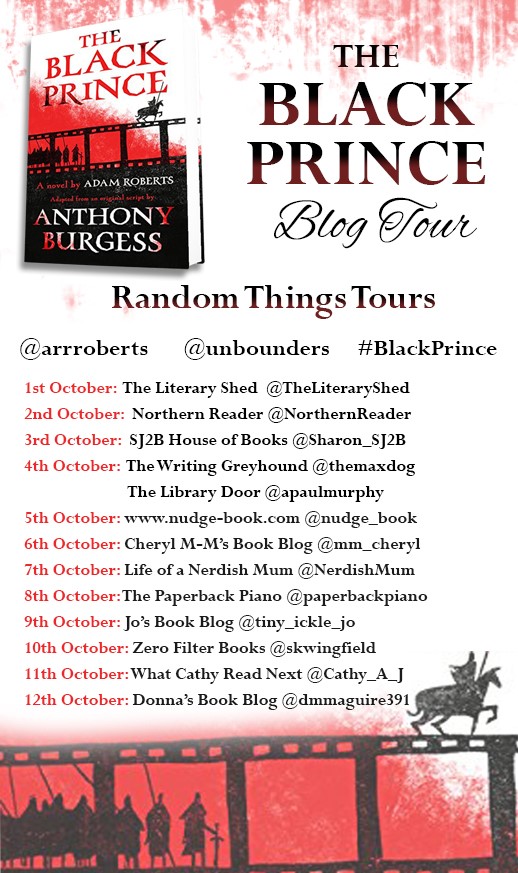
Do check out the tour banner at the bottom of this post to see the other great book bloggers taking part in the tour and supporting authors by sharing their love of books.
 About the Book
‘I’m working on a novel intended to express the feel of England in Edward III’s time… The fourteenth century of my novel will be mainly evoked in terms of smell and visceral feelings, and it will carry an undertone of general disgust rather than hey-nonny nostalgia’ – Anthony Burgess, Paris Review, 1973
The Black Prince is a brutal historical tale of chivalry, religious belief, obsession, siege and bloody warfare. From disorientating depictions of medieval battles to court intrigues and betrayals, the campaigns of Edward, the Black Prince, are brought to vivid life by an author in complete control of the novel as a way of making us look at history with fresh eyes, all while staying true to the linguistic pyrotechnics and narrative verve of Burgess’s best work.
Praise for The Black Prince
‘Burgess’s compulsive inventiveness has found its rightful twenty-first-century heir… cleverer than Cloud Atlas, bloodier than Blood Meridian’ [Francis Spufford, author of Golden Hill]
Format: Hardback (320 pp.) Publisher: Unbound
Published: 4th October 2018 Genre: Historical Fiction
Purchase Links*
Amazon.co.uk ǀ Amazon.com ǀ Hive.co.uk (supporting UK bookshops)
*links provided for convenience, not as part of any affiliate programme
Find The Black Prince on Goodreads
My Review
Edward of Woodstock, known as the Black Prince, was the eldest son of King Edward III of England. Heir to the English throne, he died before his father and so his son, Richard II, succeeded to the throne instead. Edward the Black Prince was a successful commander, leading the vanguard against the French at the Battle of Crecy, one of the key battles of the Hundred Years’ War.
According to some history books, Edward the Black Prince was regarded by his contemporaries as a model of chivalry. The Black Prince gives the reader a very different view of the man. The book reveals all too clearly how the chivalry lauded in poetry and knightly talk was sadly absent both on and off the battlefield. Instead there is murder, rape and ruthless pillaging of towns and villages as Edward’s army sweeps across France. Granted, the French army are no angels either. While the French are falling prey to Edward’s army, the population back in England is falling prey to a similarly merciless, indiscriminate and deadly enemy: the plague.
As well as a lesson in 14th century history, I got a lesson in literary history from this book. Adam Roberts expands on Anthony Burgess’s unpublished screenplay and notes for the novel using narrative techniques pioneered by American writer, John Dos Passos, whom Burgess admired. (Full disclosure: I’d never heard of Dos Passos before starting this book but was inspired to do some research as I was reading The Black Prince.)
The inclusion of sections entitled ‘Camera Eye’ written in ‘stream of consciousness’ style, ‘Newsreel’ reports written as if the events were happening now, illustrations, excerpts from poems and songs, potted biographies and even banquet menus alongside the accounts of Edward’s campaign create a ‘narrative collage’. There are changes in formatting and text size as well. The narrative incorporates multiple points of view representing all strata of society: from kings and queens, princes and nobles to soldiers and serfs. I’ll admit I found the stylistic inventiveness and the frequent switching of points of view a little challenging at times. However, I definitely admired the author’s creativity and the way the book paid homage to Anthony Burgess.
The creativity extends to the use of language as well. There are evocative descriptions, sentences with unusual words and rhythms, playful phrases and touches of humour. A few examples:
- ‘Overhead birds unspooled silver threads of song.’
- ‘Still: duty was duty. Honey twat. Key: many prance, and so on.’
- ‘And here was Old Sir Tom Felton, who had fought at Cressy, and who told everybody all about it every bloody day and twice on Sunday.’
- [From one of the ‘Newsreel’ sections] ‘BATTLE OF GATASKOGEN Swede battles Swede over which Swede is to sit on the Swedish throne. Albert III, the Sweet Swede of Sweden, sweeps swiftly the battleground.’
- ‘In Spain, in pain in Spain. Ill in Castile. Weary, weary.’
- ‘The English were an irrelevance to the splendour of Europe: a small, rainy and unfertile cluster of islands hidden in the fog, the very definition of marginal.’
[That last example is not intended to summarise the EU’s attitude to Brexit as far as I know….]
The Black Prince is a historical novel full of verve and wit, crammed with vivid period detail. It brings to life the violence of war in all its gory detail. As someone who has read and admired many of Anthony Burgess’s books (such as Earthly Powers with its memorable opening line, “It was the afternoon of my eighty-first birthday, and I was in bed with my catamite when Ali announced that the archbishop had come to see me.”), I believe that, in The Black Prince, Adam Roberts has achieved the next best thing to reading the novel envisaged by Anthony Burgess himself.
I received a review copy courtesy of publishers, Unbound and Random Things Tours.
Find out more about how the book came about here.
In three words: Imaginative, dynamic, compelling
Try something similar…The Gallows Pole by Benjamin Myers (read my review here)
About Anthony Burgess
Anthony Burgess—the pen name of John Anthony Burgess Wilson—was born in Manchester in 1917. He studied English at the Victoria University of Manchester between 1937-1940 and began writing poetry and prose; he also began composing music, in which discipline he was entirely self-taught.
During World War 2 he was posted to Gibraltar, and after the war he worked as a teacher in England, Malaya and Brunei, and published his first novel Time for a Tiger in 1958. Diagnosed with an inoperable brain tumour and believing (erroneously) that he had less than a year to live he quit teaching in 1959, returned to Britain and wrote six novels in short order, so as to provide financially for his wife after his death—amongst these were A Clockwork Orange (1962) and Inside Mr Enderby (1963).
Through the 1960s he published prolifically, establishing a reputation as one of the leading writers of his generation. His first wife, Lynne, died in 1968 and Burgess married the Italian translator Liana, moving to Continental Europe where he spent most of the rest of his life. Stanley Kubrick’s film of A Clockwork Orange (1971) brought Burgess global fame, and the 1970s saw him produce some of his best work, including the historical novels Napoleon Symphony: a Novel in four Movements (1974), Abba Abba (1977) and Earthly Powers (1980), considered by many his masterpiece. He continued writing, publishing and composing until his death in 1993.
 About the Adam Roberts
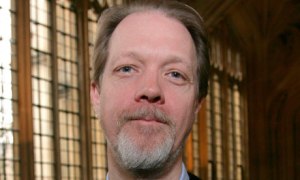
Adam Roberts is a writer, critic and academic based in the south East of England. He is the author of sixteen novels and many shorter works, including the prize-winning Jack Glass (2012) and The Thing Itself (2015). He is Professor of Nineteenth-century Literature at Royal Holloway, University of London, and has published critically on a wide range of topics, including 19th and 20th-century fiction and science fiction.
Connect with Adam

 About the Book
 About the Author
 What Cathy Read Next...