Event Review: Rachel Joyce at Henley Literary Festival


A few days ago, I shared my review of the first event I attended at this year’s Henley Literary Festival: best-selling historical fiction writers, Anne O’Brien and Rory Clements, in conversation with writer and presenter, Hephzibah Anderson.   You can read my review here.

Later that day, I was lucky enough to hear another best-selling author, Rachel Joyce, talk about her writing and her latest book, The Music Shop. Rachel was in conversation with author and journalist, Hannah Beckerman, and the setting was the magnificent Main Hall of Henley Town Hall.

Hannah started by asking Rachel about Frank, the protagonist of her latest book, The Music Shop and his gift for ‘music therapy’. Rachel explained that Frank is able to find the people who visit his shop the music they ‘need’ (not necessarily they ‘want’ or think they ‘want’). It’s the way he responds to people, how he shows empathy. It may be to ‘cure’ insomnia, depression, etc and the people listen in booths Frank has made out of two wardrobes, so there’s a sort of magical element to it.

Asked where she got the idea for musical therapy, Rachel said that’s how music works for her. Sometimes music ‘hits the spot’ much faster and more effectively than books or poetry at a particular moment. It seems to her that a particularly wonderful piece of music reminds you how beautiful human beings can be. Rachel feels we don’t take the time often enough to stop everything and actively listen to music: she recommends lying down on the floor!

In The Music Shop, Frank ‘prescribes’ music of all genres so Rachel felt she needed to know as much as Frank about music which was a tall order – a massive research undertaking.   In the end she had to narrow it down to certain composers and pieces of music, looking for the details that would bring them to life. In the book, Frank’s musical knowledge is handed down from his mother and Rachel read a wonderful passage from the book in which, as a young boy, Frank listens to his mother talking about the opening of Beethoven’s Symphony No.5. His mother explains that the silences at the beginning and end of a piece are just as important as the notes themselves.

Hannah asked about silence as a theme of the book, if it’s as much about the things people don’t say as what they do? Rachel felt that dialogue is always most interesting when people don’t say what they really need to say – that’s where the tension lies in the writing. Sometimes people resist the things they need, don’t say the things it would be fantastic if they did say. Frank has a ‘flaw’: he doesn’t think he’s worthy of being loved. The woman he meets, Ilse, says she doesn’t like music. They are both damaged in different ways but restore each other.

In The Music Shop, Frank’s shop is situated in Unity Street, populated by lots of other small shops, and there is sense of a David versus Goliath struggle. Hannah wondered if this was a theme to which Rachel was attracted? She said was always interested in the small people, the ordinary people, the people who are a little bit broken, the underdog. This is what she likes to explore and celebrate. Hannah remarked on the roundedness of the secondary characters in Rachel’s books; they are people you might easily meet on the street. Rachel said her aim was that you should know them as well as the protagonist. The characters seem to haunt her, as if she’s listening to what they’re saying. She admitted she often writes too much and has to pare it back. But she said the fun thing as an author is to take things out; that readers are very clever and they will work it out.

Hannah said Rachel’s books are often described as emotional but that, although there is sadness, there is also hope. She asked about the challenge of conveying emotion without sentimentality; especially, say, in the case of The Love Song of Miss Queenie Hennessey which is set in a hospice. Rachel joked that she needs to write a happy book one day! She felt humour was an important element in avoiding sentimentality and always grounding things in the ordinary details, the bizarre things that reflect how our lives go. In researching The Love Song of Miss Queenie Hennessey, she’d visited a number of hospices and been surprised to find them vibrant places, full of life and laughter.

Hannah asked Rachel if she was a hopeful person? Rachel said she would describe herself as reflective, quiet, introverted, someone who sometimes fears the worst is about to happen. It’s a difficult time and to fear is natural but to feel only fear is a mistake. Perhaps, she said, we all need to sing the beauty of humanity a bit louder.

I found Rachel a fascinating speaker and you could have heard a pin drop while she was reading from her book. I read and enjoyed The Unlikely Pilgrimage of Harold Fry but wasn’t sure whether I would enjoy Rachel’s other books as much. Having listened to her talk about her writing and the themes that interest her, I definitely want to add them to my reading list. And I think The Music Shop might just make an appearance on my Christmas list…

Please note, this review is based on notes I took during the event and my own recollection. Any errors in recording views expressed during the discussion are my own.
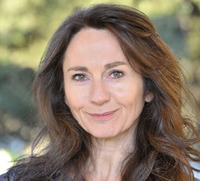
RachelJoyceAbout Rachel Joyce

Rachel Joyce has written over 20 original afternoon plays for BBC Radio 4, and major adaptations for both the Classic Series, Woman’s Hour and also a TV drama adaptation for BBC 2. In 2007 she won the Tinniswood Award for best radio play. She moved to writing after a twenty-year career in theatre and television, performing leading roles for the RSC, the Royal National Theatre, The Royal Court, and Cheek by Jowl, winning a Time Out Best Actress award and the Sony Silver.

Her books include The Unlikely Pilgrimage of Harold Fry, Perfect, A Snow Garden and Other Stories, The Love Song of Miss Queenie Hennessy and The Music Shop.

Website ǀ Facebook ǀ Goodreads

HenleyLiteraryFestivalAbout Henley Literary Festival

The Henley Literary Festival was founded in 2007 and has established itself as one of the UK’s most popular literary festivals, bringing people from far and wide in an annual meeting-of-minds set across its stunning riverside hometown. The 2017 Festival takes place from 2nd to 8th October at venues across Henley-on-Thames with over 150 talks, Q&As, workshops and performances for adults and children.

Website ǀ Facebook ǀ Twitter


Event Review: Anne O’Brien & Rory Clements at Henley Literary Festival

Despite being in its 11th year and the fact I don’t live far away, yesterday was my first visit to Henley Literary Festival. Having enjoyed browsing in some of the town’s excellent bookshops, for my first event of the day, I joined a keen crowd taking their seats in the wood-paneled chamber of Henley Town Hall. We were there to hear best-selling historical fiction writers, Anne O’Brien and Rory Clements, in conversation with writer and presenter, Hephzibah Anderson.

The discussion started with both writers talking about what first drew them to historical fiction.

In Anne’s case, she explained it was her compulsion to write about aristocratic medieval women. Here were well-educated women, involved in important political events of the day through their husbands or family but about which history was largely silent. She felt these women had a lot to say and wanted to give them a voice. Asked if her research into these women’s lives had changed her view of the medieval period, Anne said it had brought home to her that these women lived very different lives to ours today. They were subject to much stricter rules of behavior and, if they had ambition, this had to be pursued in what was a man’s world. Being seen to live a good life was essential because it was easy for women, regarded as ‘Daughters of Eve’, to get the blame for every misfortune.

For Rory, historical fiction is part of our cultural heritage. After all, as he pointed out, Shakespeare made up the words of English Kings and Roman Emperors and writers have always imagined themselves into events in history that weren’t recorded.   Reading about the life of Robert Southwell and coming across the character of Richard Topcliffe – in Rory’s words, ‘a seriously horrible man’ – sparked his interest in the 16th century and was the inspiration behind setting series of thrillers in that period.  Rory was asked if he was sad to be leaving this period behind for his new three-part series set in the 1930s (the first of which is Corpus). Rory said it was fun to research a new period and since his protagonist, Tom Wilde, is an expert on the Elizabethan secret service, he hadn’t completely left it behind.   Rory reassured fans of John Shakespeare (of which I count myself one) that he will return in future books.

Both writers than spoke about what draws them to a period of history – is it a particular character or the time itself? For Anne, it’s definitely the characters. As she put it, ‘people pop up’ as she undertakes her research. Sometimes they may start on the periphery but subsequently move centre stage. For instance, Joan of Kent, the subject of Anne’s latest book The Shadow Queen, has made cameo appearances in several of her previous novels.   At times, Anne said, it’s as if the characters are sitting on her shoulder whispering ‘write about me’ until she eventually gives in! Anne made the very interesting point that, unlike other genres, with historical fiction we know the end, we know how events will turn out. The challenge for her and other writers of historical fiction is to keep the reader reading in spite of this by trying to communicate the motivation of the characters and fill in the gaps between recorded events.

For Rory it’s more likely to be a particular period that attracts him or, as an ex-journalist, his instinct for a story and questioning the facts behind reported events. He gave the example of reading that Phillip II of Spain had taken out a contract against Sir Francis Drake before the Armada – this became the starting point for the plot of his first John Shakespeare novel, Martyr.

The discussion moved on to what both authors find the hardest part of bringing history to life.

Anne said, in a way, it was her own deliberate decision to write in the first person, her desire to provide a woman’s view of the period and explore the motivation of her characters. Clearly, because of their role in society, women would not have witnessed certain events first hand, so her challenge was always to think up creative ways to introduce information about external events.   Rory mentioned slow communication and transport as one of the challenges for a writer constructing a story based in the 16th century. However, he had actually found the 1930s harder. Not only are the events better documented but they are still in the living memory of some people. His greatest, however, was not succumbing to the benefit of hindsight but representing the views of people as they were held at the time.   Reading diaries was the best way to get in tune these because of their immediacy.

Finally, Anne and Rory were asked how they decide when it’s time to stop research and start writing, or if these happen in parallel. Anne said that, for her, it’s when the characters start to ‘speak’ to her, as it were – it can be like flicking a switch. Rory enjoys the process of research and goes to great lengths to get historical detail right. But, in the end, he’s writing a novel not straight history and it’s the story that’s important.


As you can tell from above, this was an absolutely fascinating discussion by two authors at the top of their game when it comes to historical fiction. After the talk, there was an opportunity to purchase Anne’s and Rory’s books and get them signed by the authors. I was thrilled to get Rory to sign my copy of Corpus.   I haven’t read any of Anne O’Brien’s books but I thoroughly enjoyed listening to her talk about her craft. Her passion for history is infectious. I wish she had been my history teacher! Her latest book, The Shadow Queen, is going on my Christmas list.

I shall be writing separately about the second event I attended yesterday, featuring author, Rachel Joyce.

Please note, this review is based on notes I took during the event and my own recollection.  Any errors in recording views expressed during the discussion are my own.


AnneO'BrienAbout Anne O’Brien

Anne was born in the West Riding of Yorkshire. After gaining a B.A. Honours degree in History at Manchester University, a PGCE at Leeds University and a Masters degree in Education at Hull University, she worked as a teacher of history. Always a prolific reader, she enjoyed historical fiction and was encouraged to try her hand at writing. Success in short story competitions spurred her on.  She has written many books including The Queen’s Choice about Joanna of Navarre, The Forbidden Queen about Katherine de Valois and her latest The Shadow Queen about Joan of Kent, mother of Richard II.

Website ǀ Facebook ǀ Twitter ǀ Goodreads


RoryClementsAbout Rory Clements

Rory Clements has had a long and successful newspaper career, including being features editor and associate editor of Today, editor of the Daily Mail’s Good Health Pages, and editor of the health section at the Evening Standard. He now writes full-time in an idyllic corner of Norfolk, England. He is the best-selling author of the John Shakespeare series of historical mysteries. His latest book, Corpus, the first in a new series, is set in 1936.

Website ǀ Goodreads


About Henley Literary Festival

The Henley Literary Festival was founded in 2007 and has established itself as one of the UK’s most popular literary festivals, bringing people from far and wide in an annual meeting-of-minds set across its stunning riverside hometown. The 2017 Festival takes place from October 2-8 at venues across Henley-on-Thames with over 150 talks, Q&As, workshops and performances for adults and children.

Website ǀ Facebook ǀ Twitter