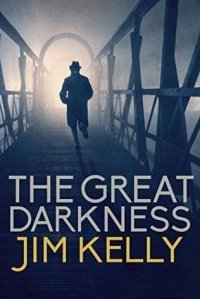
Guest Post: ‘Researching The Great Darkness’ by Jim Kelly

I read The Great Darkness by Jim Kelly a few weeks ago and absolutely loved it.  Set in Cambridge in 1939, The Great Darkness is the first in a new historical crime series.  You can read my full review here but, if you need a little enticement, I commented that the book would be perfect for fans of TV’s Foyles War.  Since I loved the book so much, I’m thrilled to welcome Jim Kelly to What Cathy Read Next today.  Below you can read a fabulous guest post from Jim all about his research for the book.

Follow my blog with Bloglovin


The Great Darkness CoverAbout the Book

1939, Cambridge: The opening weeks of the Second World War, and the first blackout – The Great Darkness – covers southern England, enveloping the city. Detective Inspector Eden Brooke, a wounded hero of the Great War, takes his nightly dip in the cool waters of the Cam.   The night is full of alarms but, in this Phoney War, the enemy never comes.

Daylight reveals a corpse on the riverside, the body torn apart by some unspeakable force. Brooke investigates, calling on the expertise and inspiration of a faithful group of fellow ‘nighthawks’ across the city, all condemned, like him, to a life lived away from the light. Within hours The Great Darkness has claimed a second victim.

War, it seems, has many victims, but what links these crimes of the night?

Format: ebook, hardcover (352 pp.)  Publisher: Allison & Busby
Published: 19th April 2018                   Genre: Historical Fiction, Historical Mystery, Crime

Purchase Links*
Publisher | Amazon.co.uk ǀ  Amazon.com  ǀ Hive.co.uk (supporting UK bookshops)
*links provided for convenience, not as part of any affiliate programme

Find The Great Darkness on Goodreads


Guest Post: ‘Researching The Great Darkness’ by Jim Kelly

Writing a novel set in a historical period is daunting. I always swore I would never do it. Ever. And in a strange way I’ve kept my promise, because The Great Darkness, set in the opening months of the Second World War in Cambridge, isn’t a historical novel in my mind. Let me explain.

Someone wise once said that history is what happened before your parents were born. If that definition stands the so-called test of time – which I think it does – then The Great Darkness is just a crime novel.

My father was a commando in the Second World War, my mum worked in the City of London during the blitz, my brother was born in the war. I came along twelve years after it ended in victory. So it’s just the world I was born into to, the big event I just missed, and heard talked about, for most of my early life. So when people ask how I prepared to write the book my first reaction is simple: “I didn’t prepare. It’s in my head already.”

But that’s not the whole truth. Writing about the past is like writing about anything else, you need detail, an insight into the ways things looked, smelt, tasted, and felt. It’s no good reading history books for this sort of detail.  Such books – and I have read many on the period because I love history – will give me the big facts; for example, that meat rationing began with bacon, butter and sugar on January 8, 1940. But what did sausages taste like?  Did butchers give more to their friends? Which shops had queues outside? How could you spot the Black Market? This kind of detail is much more difficult to find.

One good source is newspapers, especially local ones. I was very lucky because a historian in Cambridge has produced an online resource in which he summarised all the interesting stories in the Cambridge News for the whole war. These priceless abstracts give you the real minutiae of daily life. Another good way to ‘dig down’ into the past is diaries. Again, I was fortunate; I found an excellent war time diary by a conscientious objector called Jack Overton. He told me what it felt like to be in Cambridge when the air raid siren sounded, what the bombs falling sounded like when they struck.  This kind of background gives you a depth of information which feels like knowledge to the reader, not research. Any reader can tell the difference.

Lastly, my third major source was old photographs. These show you all the detail you’d never get in the printed word. A huge wall of sandbags outside the local police station, white lines on the curbs to help in the black out, the stained glass windows of a church removed to safety and replaced by boards. The central library in Cambridge has a first-class collection of such material, The Cambridgeshire Collection, and they produced boxes of pictures for me to see – and – another excellent resource – a map of the city in 1940.

There was a final twist in my preparation for writing the book. Someone – Napoleon I think – said that to understand a man (or a woman, I think we could add) you have to understand the world when he was twenty years of age. This is a good approach to building a character. What were the events which formed him – or her? My hero – Detective Inspector Eden Brooke – is about forty years old when the book starts. So he’d have been twenty in 1920 – so old enough to serve in the First World War.

Again, I knew a little, from books and films. But the great thing is to avoid cliché. So not the trenches, not the Western Front, but something unusual which I could research in a more traditional way. I think it is a good rule to narrow research down, and don’t try to understand too much. So I chose the desert war, which led me to Lawrence of Arabia, and the march from Cairo to Jerusalem.  A forgotten war then, but not now, because it was this campaign which led to the formation of the Middle East as we know it today. I read as much as I could, looked at photographs, and focused on a single event: the Second Battle of Gaza. It was here Eden Brooke’s story really began, because he was captured, and tortured, and this is the man we meet twenty years later.

The book’s out now and people have been very kind. I don’t mind readers spotting errors. I keep a list so that we can put them right when we get to later editions. So far there’s only two, which I am very proud are minor.  I have a Lancaster bomber flying overhead – but they didn’t fly until 1941. And I have a character saying, “Same old, same old” – apparently a phrase which came out of the Korean War.

If that’s the final tally, I’ll be very happy.                            © Jim Kelly


Jim KellyAbout the Author

Jim Kelly was born in 1957 and is the son of a Scotland Yard detective.  He went to university in Sheffield, later training as a journalist and worked on the Bedfordshire Times, Yorkshire Evening Press and was education correspondent for the Financial Times.   His first book, The Water Clock, was shortlisted for the John Creasey Award and he has since won a CWA Dagger in the Library and the New Angle Prize for Literature.  He lives in Ely, Cambridgeshire.

Connect with Jim

Website  ǀ  Twitter  ǀ  Goodreads


Guest Post: The Magpie Tree by Katherine Stansfield

I’m delighted to welcome author Katherine Stansfield to What Cathy Read Next Today.   I recently read and enjoyed Katherine’s latest book, The Magpie Tree, the second in her Cornish Mysteries series.  Therefore, the subject of Katherine’s guest post, ‘Sequels: looking back or looking forward?’ is particularly relevant for me as a reader coming in at book two in the series.  You’ll be able to find out what I thought of The Magpie Tree when I publish my review in the next few days.  What I will say is that it made me immediately add the first book in the series, Falling Creatures, to my wish list!

Follow my blog with Bloglovin

Praise for Falling Creatures:

‘Beautifully realised…Stansfield manages to create a dark and macabre atmosphere that feels fresh and original’ (The Times, Historical Fiction Book of the Month)

‘An enticing adventure of a novel, rich in beautifully realised period detail’ (Kate Hamer, author of The Girl in the Red Coat)

‘Full of dark wisdom and mystery.  A thoroughly good read’ (Paula Brackston, author of The Witch’s Daughter)


The Magpie Tree CoverAbout the Book

Jamaica Inn, 1844: the talk is of witches. A boy has vanished in the woods of Trethevy on the North Cornish coast, and a reward is offered for his return.

Shilly has had enough of such dark doings, but her new companion, the woman who calls herself Anna Drake, insists they investigate. Anna wants to open a detective agency, and the reward would fund it. They soon learn of a mysterious pair of strangers who have likely taken the boy, and of Saint Nectan who, legend has it, kept safe the people of the woods. As Shilly and Anna seek the missing child, the case takes another turn – murder.

Something is stirring in the woods and old sins have come home to roost.

Format: Hardcover, ebook (320 pp.)    Publisher: Allison & Busby
Published: 22nd March 2018                  Genre: Historical Fiction, Historical Mystery

Purchase Links*
Publisher | Amazon.co.uk  ǀ  Amazon.com  ǀ Hive.co.uk (supporting UK bookshops)
*links provided for convenience, not as part of any affiliate programme

Find The Magpie Tree on Goodreads


Guest Post: ‘Sequels: looking back or looking forward?’ by Katherine Stansfield, author of The Magpie Tree

When my publisher, Allison & Busby, signed me with a two book deal I was over the moon. I’d been working on my 1840s crime novel Falling Creatures for nearly five years by that time and had got to know my detective duo, Shilly and Anna Drake, very well. They’re an unlikely pairing, as all good detective partnerships are. Shilly is an illiterate farm servant who hails from rural Bodmin Moor in Cornwall. Her world view might be narrow but her imagination is a wide expanse, open to the supernatural elements that stalk the moors. Anna is the rational to Shilly’s mysticism – a native of London, she is drawn to Cornwall to investigate the infamous murder of Charlotte Dymond, Shilly’s lover. By the time the novel ends (and after I’d worked through umpteen major re-writes), Anna and Shilly have got the measure of each other. Being able to give them another outing in a sequel was a gift. They were ready to go: notebooks primed, satchel packed. But the task was much harder than I’d anticipated when I signed on the dotted line for Book Two.

I’d never written a sequel before and a question that presented itself very early on in writing The Magpie Tree, second in the Cornish Mysteries series, was, ‘How often should the characters look back?’ As I tried to establish the opening of the sequel I found that the ground it was built on was unstable: my protagonist Shilly kept referring to things that had happened in the previous instalment. As she entered a new room she thought of one she’d left behind. When she ate something different for breakfast she compared it to the food she’d been used to in her previous life. These glances back made it hard to get the action moving. My character was stuck in thought mode: passive in her new surroundings when she needed to be active. A big problem was, I was happy to let her look back, worried that readers who had experienced a break between the two books might want a reminder as to how the characters had ended up together in Jamaica Inn, where The Magpie Tree begins. And for those new to the series, nothing happens in a vacuum so some context was definitely needed, but how much? Surely the needs of these two groups of readers – those familiar with the first book and those starting the series with the second – have different needs? Could there be a compromise between them?

I agonised over this for some time, and the new scenes kept circling, and then I realised: it wasn’t my protagonist who needed to look back.

It was me.

I’d worked on Falling Creatures for so long, got to know the scenes and their settings so well, breathed the moor’s peaty air, heard the cows lowing to be milked on Shilly’s farm, that the first book was functioning like a security blanket. I needed to let go of the first book to let the new book stand on its own feet. Yes, the sequel started at the point the first book ended, and yes, the same detectives tackled the new case, but The Magpie Tree couldn’t rely on its predecessor. It wasn’t just a sequel to a story. It was a story itself.

But letting go of a security blanket is hard. Drastic action was needed. Shilly’s partner Anna had to take charge.

I realised that Shilly’s looking back centred on the woman she’d lost: her murdered lover, Charlotte. When Shilly left the moor to go and work with Anna at the end of Falling Creatures, she was wearing one of Charlotte’s old dresses. In one of the early scenes of The Magpie Tree I gave Anna the agency to put an end to Shilly’s longing with a symbolic gesture: Anna cuts up Charlotte’s dress and burns the scraps. Shilly cries but she knows that Anna is right, just as I did.

We all had to move on. There was a new case waiting to be solved.

© Katherine Stansfield, 2018

The Magpie Tree


Katherine StansfieldAbout the Author

Katherine Stansfield is a novelist and poet whose debut novel, The Visitor, won the Holyer an Gof Fiction Award.  She grew up in the wilds of Bodmin Moor in Cornwall and lived on the west coast of Wales for many years.

Connect with Katherine

Website  ǀ  Twitter  ǀ  Goodreads