
I’m delighted to welcome author Katherine Stansfield to What Cathy Read Next Today. I recently read and enjoyed Katherine’s latest book, The Magpie Tree, the second in her Cornish Mysteries series. Therefore, the subject of Katherine’s guest post, ‘Sequels: looking back or looking forward?’ is particularly relevant for me as a reader coming in at book two in the series. You’ll be able to find out what I thought of The Magpie Tree when I publish my review in the next few days. What I will say is that it made me immediately add the first book in the series, Falling Creatures, to my wish list!
Praise for Falling Creatures:
‘Beautifully realised…Stansfield manages to create a dark and macabre atmosphere that feels fresh and original’ (The Times, Historical Fiction Book of the Month)
‘An enticing adventure of a novel, rich in beautifully realised period detail’ (Kate Hamer, author of The Girl in the Red Coat)
‘Full of dark wisdom and mystery. A thoroughly good read’ (Paula Brackston, author of The Witch’s Daughter)
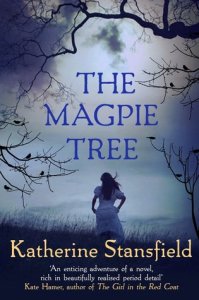 About the Book
Jamaica Inn, 1844: the talk is of witches. A boy has vanished in the woods of Trethevy on the North Cornish coast, and a reward is offered for his return.
Shilly has had enough of such dark doings, but her new companion, the woman who calls herself Anna Drake, insists they investigate. Anna wants to open a detective agency, and the reward would fund it. They soon learn of a mysterious pair of strangers who have likely taken the boy, and of Saint Nectan who, legend has it, kept safe the people of the woods. As Shilly and Anna seek the missing child, the case takes another turn – murder.
Something is stirring in the woods and old sins have come home to roost.
Format: Hardcover, ebook (320 pp.) Publisher: Allison & Busby
Published: 22nd March 2018 Genre: Historical Fiction, Historical Mystery
Purchase Links*
Publisher | Amazon.co.uk ǀ Amazon.com ǀ Hive.co.uk (supporting UK bookshops)
*links provided for convenience, not as part of any affiliate programme
Find The Magpie Tree on Goodreads
Guest Post: ‘Sequels: looking back or looking forward?’ by Katherine Stansfield, author of The Magpie Tree
When my publisher, Allison & Busby, signed me with a two book deal I was over the moon. I’d been working on my 1840s crime novel Falling Creatures for nearly five years by that time and had got to know my detective duo, Shilly and Anna Drake, very well. They’re an unlikely pairing, as all good detective partnerships are. Shilly is an illiterate farm servant who hails from rural Bodmin Moor in Cornwall. Her world view might be narrow but her imagination is a wide expanse, open to the supernatural elements that stalk the moors. Anna is the rational to Shilly’s mysticism – a native of London, she is drawn to Cornwall to investigate the infamous murder of Charlotte Dymond, Shilly’s lover. By the time the novel ends (and after I’d worked through umpteen major re-writes), Anna and Shilly have got the measure of each other. Being able to give them another outing in a sequel was a gift. They were ready to go: notebooks primed, satchel packed. But the task was much harder than I’d anticipated when I signed on the dotted line for Book Two.
I’d never written a sequel before and a question that presented itself very early on in writing The Magpie Tree, second in the Cornish Mysteries series, was, ‘How often should the characters look back?’ As I tried to establish the opening of the sequel I found that the ground it was built on was unstable: my protagonist Shilly kept referring to things that had happened in the previous instalment. As she entered a new room she thought of one she’d left behind. When she ate something different for breakfast she compared it to the food she’d been used to in her previous life. These glances back made it hard to get the action moving. My character was stuck in thought mode: passive in her new surroundings when she needed to be active. A big problem was, I was happy to let her look back, worried that readers who had experienced a break between the two books might want a reminder as to how the characters had ended up together in Jamaica Inn, where The Magpie Tree begins. And for those new to the series, nothing happens in a vacuum so some context was definitely needed, but how much? Surely the needs of these two groups of readers – those familiar with the first book and those starting the series with the second – have different needs? Could there be a compromise between them?
I agonised over this for some time, and the new scenes kept circling, and then I realised: it wasn’t my protagonist who needed to look back.
It was me.
I’d worked on Falling Creatures for so long, got to know the scenes and their settings so well, breathed the moor’s peaty air, heard the cows lowing to be milked on Shilly’s farm, that the first book was functioning like a security blanket. I needed to let go of the first book to let the new book stand on its own feet. Yes, the sequel started at the point the first book ended, and yes, the same detectives tackled the new case, but The Magpie Tree couldn’t rely on its predecessor. It wasn’t just a sequel to a story. It was a story itself.
But letting go of a security blanket is hard. Drastic action was needed. Shilly’s partner Anna had to take charge.
I realised that Shilly’s looking back centred on the woman she’d lost: her murdered lover, Charlotte. When Shilly left the moor to go and work with Anna at the end of Falling Creatures, she was wearing one of Charlotte’s old dresses. In one of the early scenes of The Magpie Tree I gave Anna the agency to put an end to Shilly’s longing with a symbolic gesture: Anna cuts up Charlotte’s dress and burns the scraps. Shilly cries but she knows that Anna is right, just as I did.
We all had to move on. There was a new case waiting to be solved.
© Katherine Stansfield, 2018
 About the Author
Katherine Stansfield is a novelist and poet whose debut novel, The Visitor, won the Holyer an Gof Fiction Award. She grew up in the wilds of Bodmin Moor in Cornwall and lived on the west coast of Wales for many years.
Connect with Katherine

 About the Book
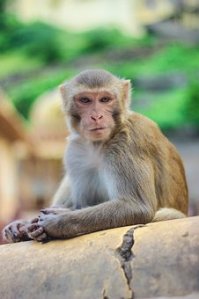 Monkeys feature several times in The Concubine’s Child, inspired in part by my encounters with macaques. The macaques near my in-law’s house live in a narrow strip of remnant jungle and roam backyards and local parks searching for food. They live in family groups, usually with at least one large male and several babies. Years ago, I was bailed up by a very large monkey while hanging out washing. He was hissing and snarling at me and his teeth didn’t look at all pleasant. My elderly father-in-law saved me by running out shouting and throwing slippers at it. On another occasion, I came downstairs to find a young macaque sitting on the family altar, snacking on the offerings to the gods. It had snuck in between the window bars.
 About the Author

 What Cathy Read Next...