

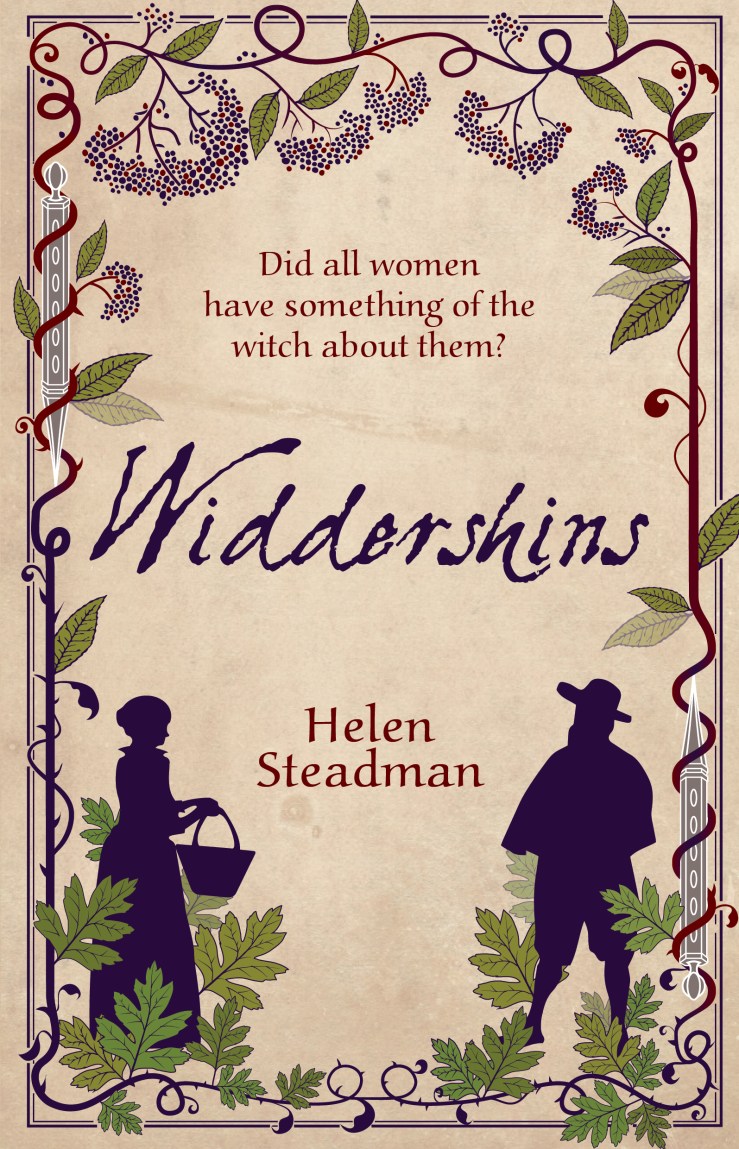
I’m thrilled to be kicking off the blog tour for Widdershins by Helen Steadman. Click here to read my review of this atmospheric, chilling and compelling story inspired by the 17th century witchcraft trials in Newcastle. Below you can read Helen’s fascinating article about the attempts of the real life witch-finders to justify their actions. It seems ‘spin’ was alive and well even as long ago as the 17th century!
 About the Book
Did all women have something of the witch about them? Jane Chandler is an apprentice healer. From childhood, she and her mother have used herbs to cure the sick. But Jane will soon learn that her sheltered life in a small village is not safe from the troubles of the wider world. From his father’s beatings to his uncle’s raging sermons, John Sharpe is beset by bad fortune. Fighting through personal tragedy, he finds his purpose: to become a witch-finder and save innocents from the scourge of witchcraft.
Book Facts
Format: Paperback Publisher: Impress Books No. of pages: 250
Publication: 1st July 2017 Genre: Historical Fiction
To pre-order/purchase Widdershins from Amazon.co.uk, click here (link provided for convenience, not as part of any affiliate programme)
Find Widdershins on Goodreads
‘Witch-finders go on the record to defend their diabolical practices’, guest post by Helen Steadman
As part of the research for my novel, Widdershins, I read the diaries of two of the better known witch-finders in England.
In perhaps an early attempt at PR, or damage-limitation at the very least, the very famous witch-finder, Matthew Hopkins (more commonly known as the Witch-finder General) and a witch pricker, John Stearne, published their diaries. The decision to publish may have been in response to one vicar who had had enough. John Gaule, vicar of Great Staughton published his own book, Select Cases of Conscience Touching Witches and Witchcrafts, in which Gaule criticised the work of the witch-finders and led to them being questioned by the judiciary.
These are filled with fascinating (if troubling) insights into what might go through the mind of someone determining whether someone should live or die. In this short book, Hopkins sets out fourteen questions and replies to them. These questions range from whether he is a witch himself, through to whether witch-finders are simply fleecing people. In fairness to Hopkins, he appears to be rather better value than the Newcastle witch-finder. Hopkins states he charged only twenty shillings per town. This appears to be excellent value compared with the Newcastle witch-finder’s fee of twenty shillings per witch, and John Kincaid’s fee of six pounds for one witch in Scotland.
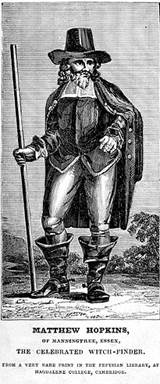 Some of his justifications for finding people guilty of witchcraft are a little on the thin side. For example, he provides the names of some of the familiars of an accused witch. On her fourth night of being kept awake, the accused woman confessed to having several familiars and imps. Hopkins lists the imps’ names given by the woman as ‘Elemanzer, Pyewacket, Peckin the Crown, Grizzel, Greedigut &c. which no mortall could invent…’ So, this woman’s fate has been sealed by her having a vivid imagination and a knack for making up names.
While Hopkins’ book is short, to the point and easy to read, Stearne’s book overflows with so many biblical quotations, it is quite hard to get to the point of his defence. But he also refers to waking and mentions Elizabeth Manningtree from Essex, who was kept awake for three days and three nights and who then confessed ‘many things’.
Sleep deprivation has been used as a form of torture by many regimes. Menachem Begin, the Israeli prime minister from 1977-83, talks about being tortured by the KGB by being kept awake for three days and three nights. He says that ‘In the head of the interrogated prisoner, a haze begins to form. His spirit is wearied to death, his legs are unsteady, and he has one sole desire: to sleep…’
Despite using a range of terrible torture techniques to send dozens of (mainly) women to untimely and dreadful deaths, Stearne uses the bible as his defence and ends his book by reminding readers that he was doing God’s work: ‘And so I leave myself to the censure of the world, yet desire it might be left to the Almighty, who knoweth the secrets of all hearts: For, blessed are they that do his commandments, Revel. 22.14.’
Sources
Menachem Begin (1978) White Nights: The Story of a Prisoner in Russia. London: Futura Publications
John Gaule [1646] Select Cases of Conscience Touching Witches and Witchcrafts. London: Richard Clutterbuck. Accessed at: https://archive.org/stream/JohnGauleSermonOnWitches/John%20Gaule-Sermon-on-Witches#page/n5/mode/2up.
Matthew Hopkins ( 2010) [1647] The Discovery of Witches in Answer to Severall Queries, Lately: Delivered to the Judges of Assize for the County of Norfolk and Now Published by Matthew Hopkins, Witch-finder, for the Benefit of the Whole Kingdome. Qontro Classics
John Stearne (1973) [1648] A Confirmation and Discovery of Witch Craft. The Rota.
 About the Author
Helen Steadman lives in the foothills of the North Pennines, and she particularly enjoys researching and writing about the history of the north east of England. Following her MA in creative writing at Manchester Met, Helen is now completing a PhD in English at the University of Aberdeen. When she’s not studying or writing, Helen critiques, edits and proofreads other writers work, and she is a professional member of the Society for Editors and Proofreaders. Her next novel will be about Grace Darling and she is carrying out research for a novel about the Shotley Bridge sword makers.
Connect with Helen

 Bookstore Manager: So Adam Black, welcome back to Shakespeare and Company, it’s been almost thirty years, hasn’t it?
 Adam Black: It has indeed, but it’s great to be back. I see you still have the famous sign upstairs.

 What Cathy Read Next...