

Throwback Thursday is a weekly meme hosted by Renee at It’s Book Talk. It’s designed as an opportunity to share old favourites as well as books that we’ve finally got around to reading that were published over a year ago. If you decide to take part, please link back to It’s Book Talk.
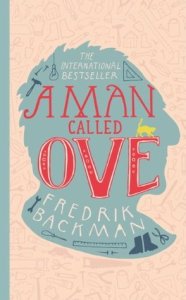
There are some books I feel as if I must be the last person in the world to read. This week’s book – A Man Called Ove by Fredrik Backman – is a case in point. Published in 2012, it was an international best-seller. My impetus for reading it now is that it forms part of my From Page to Screen reading challenge. The Swedish adaptation* of the book was shown recently at my local independent cinema, Reading Film Theatre. I shall be reviewing the film adaptation and comparing the two in a separate post.
*A Hollywood version produced by and starring Tom Hanks has recently been announced
 About the Book
A grumpy yet loveable man finds his solitary world turned on its head when a boisterous young family moves in next door. Meet Ove. He’s a curmudgeon, the kind of man who points at people he dislikes as if they were burglars caught outside his bedroom window. He has staunch principles, strict routines, and a short fuse. People call him the bitter neighbour from hell, but must Ove be bitter just because he doesn’t walk around with a smile plastered to his face all the time? Behind the cranky exterior there is a story and sadness. So when one November morning a chatty young couple with two chatty young daughters move in next door and accidentally flatten Ove’s mailbox, it is the lead-in to a comical and heart-warming tale of unkempt cats, unexpected friendship, and the ancient art of backing up a U-Haul. All of which will change one cranky old man and a local residents’ association to their very foundations.
Format: ebook (304 pp.) Publisher: Sceptre
Published: 3rd July 2014 Genre: Fiction
Purchase Links*
Amazon.co.uk ǀ Amazon.com ǀ Barnes & Noble
*links provided for convenience, not as part of any affiliate programme
Find A Man Called Ove on Goodreads
My Review
I’m always a little anxious when I start reading a much-lauded, and more importantly, a much loved book. In fact, I’m aware many people cite A Man Called Ove as one of their favourite books ever. While I liked a lot about A Man Called Ove – I found parts of it moving, funny and quirky – I can’t say I loved it wholeheartedly. I’m going to start by talking about the elements I did really like and then move on to explain my reservations.
I loved the strange and beautiful love story of Ove and Sonja – ‘He was a man of black and white. And she was colour. All the colour he had.’ I thought the picture we get of Ove through Sonja’s love for him and his devotion to her, is the most moving part of the book. Sonja could see beneath the exterior of the shy rather awkward young man she met on a train to the truthful, loyal, heroic and resilient person beneath. If other words, she could see the colour in Ove that others couldn’t. Despite the contrasts between them, they fitted together like two pieces of a jigsaw puzzle to produce a complete picture.
There are beautiful lines, such as:
‘But if anyone had asked, he would have told them that he had never lived before he met her.’
‘He knew better to speak ill of what she loved; after all, he understood very keenly how it was to receive her love when no one else could understand why he was worthy of it.’
Really, I simply loved Sonja and who wouldn’t? She loves books, she loves to laugh, she’s a teacher, she fights for her pupils and inspires them to achieve more than they think they can. In a way, Ove is her most ambitious project and the saddest aspect of the book is that we never get to see what she could have achieved.
So what were the aspects I was less enthusiastic about? Well, I got a little bored with all the Saab references and jokes. Perhaps you have to be Swedish or a car owner (and I’m neither) to appreciate them. And although the book was really funny in parts, at times I found the humour rather predictable and the visual and verbal punch lines easy to see coming.
However, my main reservation was about the development of the character of Ove himself. The author didn’t completely convince me how the socially awkward but essentially decent and likeable young man that Sonja fell in love with became the anti-social, sexist curmudgeon that we meet at the beginning of the book. I appreciate we learn about tragic events in Ove’s life but they didn’t seem to me to sufficiently explain such a change in his character.
Having said this, the author is a skilful writer and although one may not like Ove – and you definitely wouldn’t want to have him as a neighbour – the author makes you care about him. And, in the end, any imperfections in the portrayal of Ove’s character were redeemed for me by the portrait painted of Sonja and their emotional story. That love story, for me, is the beautiful heart of the book.
In three words: Charming, moving, amusing
Try something similar…600 Hours of Edward by Craig Lancaster
 About the Author
Fredrik Backman is a well-known Swedish blogger and columnist. His debut novel’s protagonist was born on his blog, where over 1,000 readers voted for Backman to write a novel about Ove. In 2011, he became an overnight success when one of his blog entries, ‘Personal message to stressed blond woman in Volkswagen’, about reckless driving and parental love, became the most linked entry on Facebook ever, with 60,000 shares.
Connect with Fredrik


 About the Book
 About the Author
 What Cathy Read Next...