
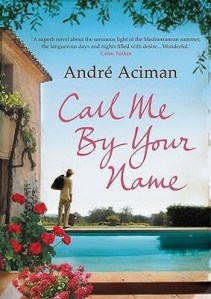
Book Review: Call Me By Your Name by André Aciman

Call Me By Your NameAbout the Book

The story of a sudden and powerful romance that blooms between seventeen-year-old Elio and his father’s house guest Oliver during a restless summer on the Italian Riviera.

It tells how unrelenting currents of obsession and fear, fascination and desire threaten to overwhelm the lovers who at first feign indifference to the charge between them.

Format: eBook, paperback (248 pp.) Publisher: Atlantic Books
Published:  1st April 2009                    Genre: Fiction

Purchase Links*
Amazon.co.uk  ǀ  Amazon.com
*links provided for convenience, not as part of any affiliate programme

Find Call Me By Your Name on Goodreads


My Review

Call Me By Your Name forms part of my From Page to Screen reading project. I shall be publishing my comparison of the book and the film in due course.  In the meantime, you can read Andre Aciman’s own thoughts about the process of adaptation here.

The book is a study of sexual exploration and of the doubts and uncertainties that characterize the early stages of a relationship. Not knowing what to say, saying the wrong thing, saying nothing… Trying to interpret another’s feelings from gestures, glances or small actions… Moving from despair to elation in response to any small sign of returned affection… Struggling with the complexity of your own feelings just as much as those of the other party. All these sensations the author describes in intricate detail as the reader wonders and agonizes along with Elio.

Elio and his family seem to live a privileged and rarified existence, rather remote from the local community. Days are spent swimming, playing tennis or sunbathing.  Mealtime conversations encompass history, philosophy, music, books. Although set on the Italian Riviera, I only really got a sense of the atmosphere of Italy when the action moves to Rome later in the book. That section was lively and playful and I really felt Elio’s and Oliver’s joy in each other’s company and in that vibrant city.

Call Me By Your Name is beautifully written and conjures up all the emotional turmoil of young love and awakening sexuality. For me, in the end though, there was just a little too much introspection and adolescent angst. However, I’m very much looking forward to seeing the award-winning film adaptation which I think may address some of the shortcomings I found in the book.

Follow my blog with Bloglovin

In three words: Emotional, intimate, introspective

Try something similar…Mussolini’s Island by Sarah Day (click here to read my review)


Andre AcimanAbout the Author

André Aciman was born in Alexandria, Egypt and is an American memoirist, essayist, novelist, and scholar of seventeenth-century literature. He has also written many essays and reviews on Marcel Proust. His work has appeared in The New Yorker, The New York Review of Books, The New York Times, The Paris Review, The New Republic, Condé Nast Traveler as well as in many volumes of The Best American Essays. Aciman received his Ph.D. in Comparative Literature from Harvard University, has taught at Princeton and Bard and is Distinguished Professor of Comparative Literature at The CUNY Graduate Center. He is currently chair of the Ph. D. Program in Comparative Literature and founder and director of The Writers’ Institute at the Graduate Center.

Connect with André

Facebook  ǀ  Twitter ǀ  Goodreads


From Page to Screen: Carol by Patricia Highsmith

Carol BloomsburyFrom Page to ScreenCarol Film Poster

About the Book: Carol (The Price of  Salt)  by Patricia Highsmith

Therese is just an ordinary sales assistant working in a New York department store when a beautiful, alluring woman in her thirties walks up to her counter.  Standing there, Therese is wholly unprepared for the first shock of love.  Therese is an awkward nineteen-year-old with a job she hates and a boyfriend she doesn’t love; Carol is a sophisticated, bored suburban housewife in the throes of a divorce and a custody battle for her only daughter.  As Therese becomes irresistibly drawn into Carol’s world, she soon realises how much they both stand to lose…

Read my review of the book here.

About the Film: Carol (2015)

Carol is directed by Todd Haynes from a screenplay by Phyllis Nagy based on Patricia Highsmith’s novel.  It stars Cate Blanchett as Carol Aird and Rooney Mara as Therese Belivet.

More information about the film can be found here.

Book v Film (Spoiler free)

In the book, the reader sees everything through the eyes of Therese so, as I remarked in my review, Carol remains ‘something of an enigma, slightly distant and often unreadable’.  At times, Therese is unsure exactly what Carol’s feelings for her are.  The film gives us much more insight into Carol’s character and her domestic situation.  For instance, there are scenes between Carol and her daughter, Rindy, that demonstrate the strength of Carol’s love for her daughter.  We also get to understand more about the strains in the relationship between Carol and her husband, Harge.   I’d have to say that possibly the film gives a more rounded picture of Harge or at least we start to understand a little why he feels as he does.

Conversely, the film gives us less of Therese’s back-story and her struggles to make her way in her chosen career (which for some reason has been changed from stage design to photography). It struck me watching the film that both Therese’s boyfriend, Richard, and Carol’s husband, Harge, want to control them, make them part of their own respective families,  make them conform to some conventional picture of womanhood/motherhood.

From a structural point of view, I liked the way the film opens with a scene near the end of the book and then proceeds in flashback until it returns us to that same scene at the end of the film.    The story line follows the book pretty closely although Highsmith, as you might expect, inserts a more suspenseful element into some scenes.  The film includes additional scenes that show just what Carol is expected to go through to win access to her daughter in the custody battle with Harge.  Similarly, the viewer witnesses the decision she finally makes about how she intends to live her life and whether Therese will have a place in it.

As you might expect from an experienced director like Todd Haynes, the film is beautifully shot with a wonderful period atmosphere, whether that‘s the crowded streets of New York or the slightly rundown look of Therese’s apartment.  The costumes are simply gorgeous.   When it comes to the leads, Cate Blanchett is Carol for me and Rooney Mara, with her gamine look reminiscent of a young Audrey Hepburn, is perfect as Therese.   They are really mesmerising in those key scenes where Carol and Therese lock eyes with each other across a room.

The Verdict

The film respects the main story line of the novel and is a beautifully crafted piece of work with superb acting. It is also great to see a film that provides not one but two strong lead roles for female actors.  I really loved it.  The film does however shift the emphasis from Therese to Carol, making Carol a less enigmatic character than in the book.  I think the book gives a more complex picture of the relationship between the two women.  The film is wonderful entertainment but I think the book wins out for its more nuanced examination of the relationship between two people at a time when such a relationship was considered immoral by many.

What do you think?  Have you read the book or seen the film?