
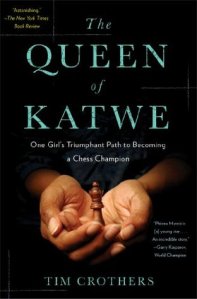
A story of life, chess and one girl’s dream of becoming a Grandmaster
About the Book
Description (courtesy of Goodreads): One day in 2005, while searching for food, nine-year-old Phiona Mutesi followed her brother to a dusty veranda where she met Robert Katende, who had also grown up in the Kampala slums. Katende, a war refugee turned missionary, had an improbable dream: to empower kids through chess – a game so foreign there is no word for it in their native language. Laying a chessboard in the dirt of the Katwe slum, Robert painstakingly taught the game each day. When he left at night, slum kids played on with bottle caps on scraps of cardboard. At first they came for a free bowl of porridge, but many grew to love chess, a game that – like their daily lives – means persevering against great obstacles. By the age of eleven Phiona was her country’s junior champion and at fifteen, the national champion. Phiona’s dream is to one day become a Grandmaster, the most elite title in chess. But to reach that goal, she must grapple with everyday life in one of the world’s most unstable countries, a place where girls are taught to be mothers, not dreamers, and the threats of AIDS, kidnapping, and starvation loom over the people.
Book Facts
Format: ebook – to buy from Amazon, click here
Pages: 242
Publication date: October 2012
Genre: Non-Fiction, Biography
My Review (3½ out of 5)
Subtitled “A Story of Life, Chess, and One Extraordinary Girl’s Dream of Becoming a Grandmaster”, the book tells the true story of Phiona Mutesi, a girl from the Katwe slum area of Kampala, Uganda. Phiona’s aptitude for chess is spotted by an inspirational mentor, Robert Katende, and soon it offers her the tantalising possibility of finding a route out of poverty and hardship. She joins his group of “Pioneers” and it soon becomes obvious that she has a special talent.
I really enjoyed learning about the family background and upbringing of Phiona and her mentor, Robert Katende, who had an equally challenging start in life. The book really brought to life how awful and precarious life is in the Katwe slums, its inhabitants constantly at the mercy of the elements and prey to disease, crime and addiction.
‘Katwe has no street signs. No addresses. It is a maze of rutted alleys and dilapidated shacks…Survival in Katwe depends on courage and determination as well as guile and luck.’
Expectations are low for the inhabitants of Katwe, particularly its women. As the author notes: ‘If you live in Katwe, the rest of the Ugandan population would prefer that you stay there.’ He makes an interesting connection between the mental aptitude needed to master chess and the mental toughness needed to overcome the daily challenges of life in Katwe. As one of Phiona’s fellow ‘Pioneers’ says:
‘The big deal with chess is planning. What’s the next move? How can you get out of the attack they have made against you? We make decisions like that every day in the slum.’
When Phiona achieves her first tournament success, it opens up thoughts of new possibilities: ‘I remember by the time I got home I felt I was not the Phiona of always. I was a different Phiona.’ However, the book puts into context Phiona’s achievements in the chess world, which although tremendous for a girl of her background, are a long way from becoming a Grandmaster. Similarly, the author is brutally realistic about the challenge Phiona faces in achieving this goal because of the need for financial support that is probably beyond the means of a country like Uganda, unlike say China or Russia. In fact, it is this book (and subsequently the film adaptation of it) that has brought most financial benefit for Phiona and her family so far.
In separate sections of the book, the author contrasts Phiona’s story with the story of other Ugandan athletes and the struggles they faced to compete on equal terms in the world. He also provides a lot of information about the founding of Sports Outreach, the project that enabled Robert Katende to set up his chess group.
Although I found the book fascinating in parts, the style was rather journalistic with lengthy interview-like quotes and therefore it was not as easy to read as I would have liked. This is probably explained by the fact that the book grew out of an ESPN Magazine article. Also, I would have preferred the book to focus mainly on Phiona, the other “Pioneers” and Robert Katende. However, it is an inspiring story very proficiently told.
This book forms part of my From Page to Screen reading challenge. I will be posting a comparison of the book and film separately.
In three words: Factual, informative, interesting
Try something similar…A Long Way Home by Saroo Brierley
 About the Author
Tim Crothers is a former senior writer at Sports Illustrated who is currently a journalism professor and a freelance sportswriter. He is the author of The Man Watching, a biography of Anson Dorrance, the legendary coach of the University of North Carolina women’s soccer team, co-author of Hard Work, the autobiography of UNC basketball coach Roy Williams, and author of The Queen of Katwe, the story of a 16-year-old female chess champion from the slums of Kampala, Uganda. Crothers lives with his wife and two children in Chapel Hill, North Carolina. Author Website


 What Cathy Read Next...