

Welcome to today’s stop on the blog tour for Together by Luke Adam Hawker, with words by Marianne Laidlaw. My thanks to Anne at Random Things Tours for inviting me to take part in the tour and to Kyle Books for my review copy.
 About the Book
Used to drawing out on location, the lockdown of 2020 suddenly limited artist Luke Hawker’s day to day work. Like many of us he spent months at home, and, unable to go out and about found himself inspired to depict the day to day effects of the extraordinary challenges unfolding across the world.
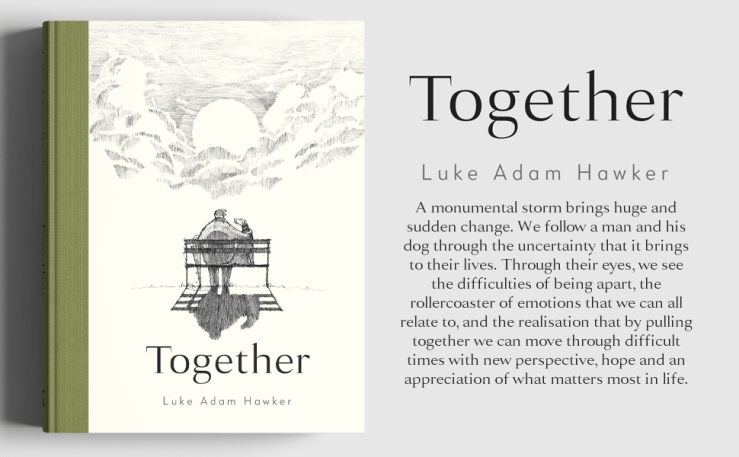
Together takes a gentle and philosophical look at the events of 2020. Using the metaphor of a monumental storm, we follow a man and his dog through the uncertainty and change that it brings to their lives. Through their eyes we see the difficulties of being apart, the rollercoaster of emotions that we have all shared, and the realisation that by pulling together we can move forward with new perspective, hope, and an appreciation of what matters most in life.
Format: Hardcover (64 pages) Publisher: Kyle Books
Publication date: 18th March 2021 Genre: Art, Fiction
Find Together on Goodreads
Purchase links
Bookshop.org
Disclosure: If you buy a book via the above link, I may earn a commission from Bookshop.org, whose fees support independent bookshops
Hive | Amazon UK
Links provided for convenience only, not as part of an affiliate programme
My Review
This is my first experience of reviewing a book of illustrations and I have to admit to being a little daunted at the prospect. It was reading the following details about how the book was produced that gave me a clue to a possible approach.
‘Together is very much a product of the new ways in which many of us have learned to work during lockdown. Having seen a beautiful depiction of the 8pm applause for the NHS, Editor Marianne Laidlaw approached Luke, asking him to illustrate the emotional rollercoaster we were all on. They started collaborating on the book, Luke mapping out images and Marianne writing words, while not having met – everything took place over Zoom for many months. The book’s creation mirrors its message that we are better joining forces and working together through adversity. Even in difficult times, there are silver linings, and beauty can be found.’
Inspired by the collaborative process described above, I concentrated first on the illustrations alone, reflecting on the feelings and thoughts they evoked. Then I returned to the beginning of the book, this time reading the words and looking at the accompanying illustrations together. By the way, I highly recommend checking out Luke’s Instagram feed where he shares insights into his work and the inspiration behind some of the images in the book. For example, I learned that one of the drawings, of people gathered outside a brightly lit store window, is a homage to Edward Hopper’s painting Nighthawks (held by the Art Institute of Chicago).
The publishers summarise the themes of the book as empathy, kindness, an appreciation of nature and of the people around us. Unfortunately, it doesn’t start out that way, as a striking drawing near the beginning of the book shows which depicts people wheeling loaded trolleys as supermarket shelves are emptied.
Scale is a frequent theme of the illustrations with tiny figures shown against a background of towering building or tall trees. I also liked the use of contrasts – between light and dark, empty and full. A good example of the latter is a drawing of people crowded together on the platform of an underground station and then in a tube carriage (I think it will be a while until we experience that again!) followed by the image of a deserted tunnel. This is reflected in Marianne Laidlaw’s words which accompany the illustrations. ‘Quiet, where once there was an orchestra of noise. The busiest of places stood empty and still. Normal things began to feel strange. Strange things began to feel normal.’
My favourite drawings were the double page spreads because they were so rich in detail. I enjoyed spending time observing the individual figures and spotting the little touches included by the artist. A good example is a drawing showing people at their windows, as happened during the weekly ‘Clap for Carers’. Luke Hawker’s background in architectural design is clear in the details of the windows: their different shapes – square, round, arched; or their decorative features – shutters, balconies, porticoes. Another drawing I particularly liked was a full page one humorously depicting some of the activities people have taken up to occupy them during lockdown. Pillow fight anyone?
Throughout the book, the figures of the old man (inspired by the artist’s grandfather) and his dog (inspired by the author’s own dog, Robin) evoke a sense of companionship and generosity. Occasionally, they appear as a solitary pair of onlookers or observers, such as a drawing in which they are seated on a bench high above a city.
The joyful final illustration encapsulates the book’s title and the anticipation of long-awaited reunions.
Together is a short book but one well worth lingering over. It is beautifully produced and would make a wonderful gift. It’s certainly going to be a treasured addition to my own book collection.
In three words: Tender, heartfelt, profound
Try something similar: A Drawing A Day by Edward Carey
Follow this blog via Bloglovin


 About the Author
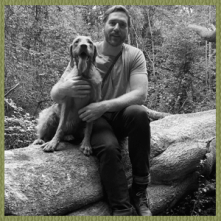
This is the debut from Luke Adam Hawker, who worked as an architectural designer before becoming a full-time artist in 2015. He lives just outside of London with his partner Lizzie and dog Robin. Luke ships his prints and originals to buyers all over the
world and has been commissioned by brands such as Soho House Hotel Group, Annabel’s Club, and Eventbrite.
Connect with Luke
Website | Instagram | Twitter

 About the Book
 About the Author


 What Cathy Read Next...