#BookReview The Binding by Bridget Collins

About the Book

Imagine you could erase your grief. Imagine you could forget your pain. Imagine you could hide a secret. Forever.

Emmett Farmer is working in the fields when a letter arrives summoning him to begin an apprenticeship. He will work for a bookbinder, a vocation that arouses fear, superstition and prejudice – but one neither he nor his parents can afford to refuse.

He will learn to hand-craft beautiful volumes, and within each he will capture something unique and extraordinary: a memory. If there’s something you want to forget, he can help. If there’s something you need to erase, he can assist. Your past will be stored safely in a book and you will never remember your secret, however terrible.

In a vault under his mentor’s workshop, row upon row of books – and memories – are meticulously stored and recorded. Then one day Emmett makes an astonishing discovery: one of them has his name on it.

Format: Hardback (448 pages) Publisher: The Borough Press
Publication date: 10th January 2019 Genre: Historical Fiction, Fantasy

Find The Binding on Goodreads

Purchase links 
Bookshop.org 
Disclosure: If you buy a book via the above link, I may earn a commission from Bookshop.org, whose fees support independent bookshops

Hive | Amazon UK 
Links provided for convenience only, not as part of an affiliate programme


My Review

Although I’m not often drawn to books with a fantasy element, the inventive premise that unpleasant memories can be erased by being bound within the pages of a book kept me captivated for the first section of the story. The book is set in an undisclosed period that at times, with its talk of persecution of bookbinders, conjures up the feel of 17th century England and at other times seems set much later, perhaps in the 19th century. It didn’t really matter because both had a great sense of atmosphere.

I liked the way, in this imagined world, books are a not just a repository of memories but also become manifestations of power – as a means to erase evidence of abuse or crime, for example – or as a way to exercise control. They are also items of value, collected or traded by wealthy individuals. Playfully, in this world novels are regarded as ‘fake’. As one character observes, ‘They’re not real books. They’re written, like magazines. They’re not actual people, or actual memories. They’re invented.‘ Another character wonders who would write a novel: ‘People who enjoy imagining misery, I suppose. People who have no scruples about dishonesty. People who can spend days writing a long sad lie without going insane.’ Ironically, for some people bound books have become a source of titillation with readers meeting in secret to consume the dreadful experiences of others. Some are even copied and openly traded.

All this was brilliant but I confess as the plot became more of a romance – and a young adult romance at that – with a bit of mystery thrown in, I began to lose interest especially as this is a long book and events move quite slowly.

The Binding is a dark story in places with scenes that may be upsetting for some readers. I liked that it ended on a hopeful note even if I wasn’t completely engaged by the romantic storyline. However, the author is clearly a great storyteller and there are some brilliantly eccentric secondary characters who introduce elements of menace, magic or humour to the storyline.

I received a digital review copy courtesy of The Borough Press via NetGalley.

In three words: Imaginative, atmospheric, romantic


About the Author

Bridget Collins trained as an actor at the London Academy of Music and Dramatic Art after reading English at King’s College, Cambridge. She is the author of seven acclaimed books for young adults and has had two plays produced, one at the Edinburgh Festival Fringe. The Binding is her first adult novel. (Photo: Goodreads author page)

Connect with Bridget
Website | Twitter

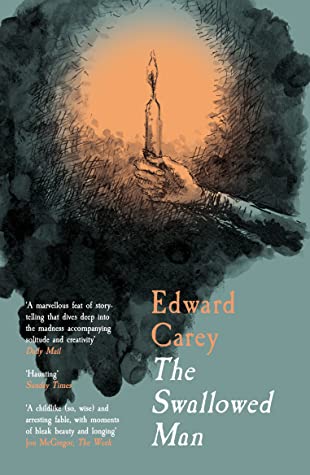
#BookReview The Swallowed Man by Edward Carey @BelgraviaB

The Swallowed ManAbout the Book

‘I am writing this account, in another man’s book, by candlelight, inside the belly of a fish. I have been eaten. I have been eaten, yet I am living still.’

Trapped inside a giant sea beast with only the contents of the swallowed schooner Maria to sustain him, Geppetto yearns for the wooden boy he created out of greed but came to cherish as a son. The ship provides materials for the carpenter to make art in memory of Pinocchio and the other loves of his life. But the candles are running out, and the mind can only survive for so long without company.

Drawing upon the classic Pinocchio story while creating something entirely his own, Carey tells an unforgettable tale of fatherly love and loss, of pride and regret, and of the sustaining power of art and imagination.

Format: Paperback (176 pages)   Publisher: Gallic Books
Publication date: 4th April 2022 Genre: Fantasy

Find The Swallowed Man on Goodreads

Purchase links
Bookshop.org
Disclosure: If you buy a book via the above link, I may earn a commission from Bookshop.org, whose fees support independent bookshops

Hive | Amazon UK
Links provided for convenience only, not as part of an affiliate programme


My Review

I was first introduced to Edward Carey’s quirky and inventive writing when I read his historical novel, Little at the end of last year. It quickly found a place on the list of my favourite books of 2021.

The Swallowed Man is the author’s retelling of the story of Pinocchio, the wooden boy created by the carpenter Geppetto who comes to life. In the author’s version, Pinocchio (a rather recalcitrant child it has to be said) is shunned by the local people because he is different. They call him a heathen, unholy, the Devil’s work. Geppetto is told, ‘He was not one of us, you do see that?’

Geppetto’s imprisonment within the belly of the fish gives him time for reflection. He recalls the many disappointments in his life but more than anything he mourns the loss of Pinocchio, berating himself for having viewed him initially as just proof of his own skill or as a means of making money. ‘And I own it: I was expecting not just a boy, but a fortune. I was wishing not just for family but for fame…’ Now that it is too late to rectify his mistakes, he reflects sadly ‘My past and present are not friends’.  I don’t think it’s necessary to believe, as Geppetto does, that Pinocchio was a living boy in order to feel sympathy for his loss. Any parent mourning a lost child I’m sure would identify with Geppetto’s observation, ‘He cannot grow, my boy… Not like all the others. Wherever he is, he stays as he is’.

I was struck by the idea of Geppetto’s confinement inside the great fish being a metaphor for lockdown. For example, he welcomes the objects he receives in the ‘post’ (random items which have been swallowed by the fish) and passes the time on projects such as painting, carving and, of course, writing in his journal, the former logbook of the captain of the Maria.  As time goes by his solitary existence brings on a kind of madness; he starts to have disturbing visions and even comes to believe someone is writing in his journal.  The epilogue provides yet another pandemic parallel as a community is forced to exclude themselves ‘for a time, from the rest of humanity’ in order to prevent the spread of a contagion.

The book’s short sentences give the impression that we are privy to Geppetto’s random thoughts and to phrases he’s trying out in his head, sometimes playfully. For instance, with no way to rid himself of the awful stink of the fish’s insides, he considers rechristening himself ‘Josephus Odorous. Joey ‘The Kipper’ Lorenzini. Putrefaction ‘Petto’. There are other brilliant touches of humor such as when Geppetto recalls purchasing his first wig and explaining euphemistically – much to the wigmaker’s confusion – that ‘The garden atop me has gone barren’, ‘I wilt in the north’ and ‘I have been abandoned, hairly’.  And as always with one of Edward Carey’s books, there are wonderful illustrations and lovely little touches such as smudge marks on some of the pages suggesting ink blots or drops of candle wax.

The Swallowed Man is a delightfully bizarre gem of a book. I thoroughly enjoyed it. (In fact, I’ve yet to read a book published by Gallic Books that I haven’t enjoyed.)

I received an advance review copy courtesy of Isabelle at Gallic Books.

In three words: Touching, witty, inventive

Follow this blog via Bloglovin


Edward Carey NewAbout the Author

Edward Carey is a novelist, visual artist and playwright. He is the author of three acclaimed novels, Observatory Mansions, Alva and Irva and Little.

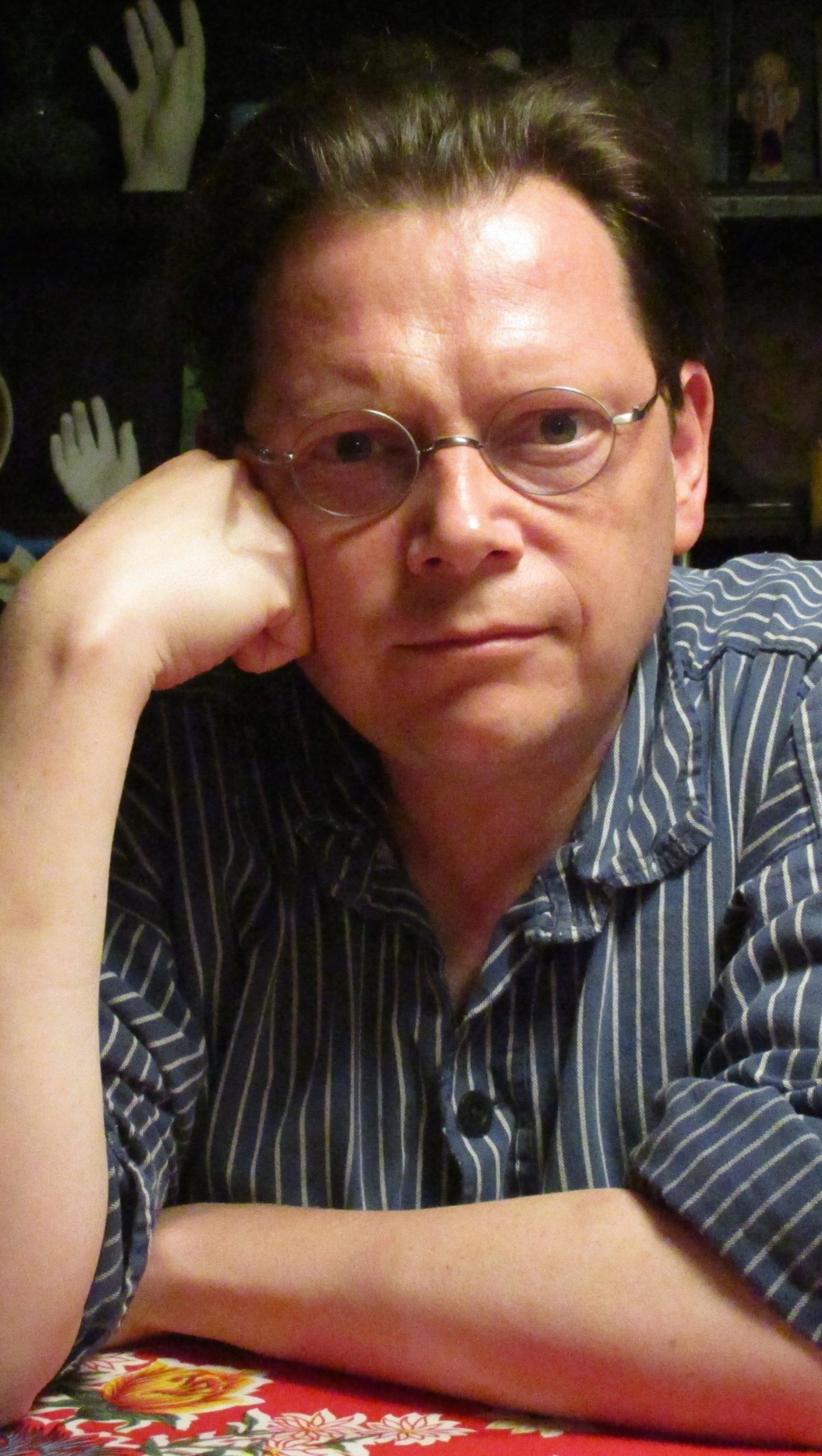
Born in England, he teaches at the University of Texas in Austin. (Photo: Publisher author page)

Connect with Edward
Website | Twitter | Facebook | Instagram