
I really enjoyed Timothy Ashby’s book In Shadowland, the second in his series featuring Special Agent Seth Armitage, when I read it back in 2017. You can read my review of In Shadowland here and also my earlier Q&A with Timothy about the book.
He’s now back with a new book, Ranger, an adventure novel set in the 18th century featuring a mixed-raced hero who overcomes overwhelming obstacles to succeed as a British military officer. The author describes him as ‘a black Sharpe, a la Bernard Cornwell´s famous series’.
I’m delighted to be able to bring you an extract from Ranger but before that let’s find out a bit more about the book.
 West Indies, 1796. Alexander Charteris – the mixed-race son of an aristocratic planter and a slave mother – is raised as a gentleman amidst the country houses and London drawing rooms of Georgian England. Tricked out of his inheritance by his cousin Pemberton – Chart is kidnapped and transported to the island of Grenada where he endures the hell of slavery on a sugar plantation. When Pemberton arrives at the plantation, accompanied by Chart’s former lover, Lady Arabella, he orders Chart’s torture and execution.
A slave revolt ensues, before the order can be carried out. Chart initially joins the revolutionaries but is sentenced to death for refusing to take part in a massacre of British colonists. Aided by the beautiful daughter of the rebel general, Julian Fédon, Chart escapes. He is recruited into a new British unit called the Loyal Black Rangers and promised freedom if he fights against the French.
Chart confronts conflicting loyalties as he leads his men in vicious bush-fighting. He rises through the ranks and plays a pivotal role in the bloody battle that crushes the rebellion. But the soldier must confront one more enemy, that of his treacherous cousin, before he can find peace.
If you like the sound of Ranger as much as I do it’s available to purchase now either as an ebook or in paperback from Amazon UK and Amazon US. Look out for my review of the book just as soon as I can find the time to read it.
Extract from Ranger by Timothy Ashby
Julien Fédon had not slept. His entire being was suffused with bitter disappointment that had long since swept away the vestiges of defiance. He had stood by the battery below the guillotine for most of the night after drafting his final manifesto under the brooding eyes of his officers. Just before midnight his daughter Céleste had begged him in choking sobs to go to the side of her dying mother who was asking for him. But he ignored her and sent her back to the family’s simple hut under guard.
Now he watched hundreds of bivouac fires dotting the dark valley around his former home, seeing how they flickered like fireflies as troops moved past them. Abercromby’s army was massing at the foot of the mountain and he knew the redcoats would attack at dawn. The Brigands could delay the infantrymen as they struggled up the slope but would be unable to repel them. He was especially fearful of the Black Rangers and their German comrades in arms, who he expected to be in the vanguard. But the rebel general had an escape plan; it was risky but needed to bolster his men’s spirits so they would not feel trapped.
A last act of revolutionary bravado was needed. When Abercromby trained his telescope on Camp de la Mort as the sun rose, he would see the quartered pieces of the English milord dangling from the top of the guillotine, and his aristocratic head would be the final missile launched from the mortar.
Fédon turned to the renegade French captain Noguet. “Fetch the English colonel here. Take two men in case he must be carried.”
******
Chart’s fingers scrabbled across the side of the rough-hewn stock until he found the crude dowels securing Hugh’s arms and legs. Both were hammered too tightly into the holes to extract with his fingers.
“Is anyone else here with you?” he rasped.
“I’m the only living one left,” Hugh answered in a barely perceptible voice. “Couple of bodies in the far corner, I think.”
“Are you injured? Can you walk?”
“No and hopefully. Need water.”
“Need to get you out of here,” said Chart, coming to a decision. He took the mallet from his belt, felt for the bottom of the lowest dowel, and began gently tapping to loosen it. As he finished the upper pin a light appeared outside the doorway accompanied by voices speaking in guttural patois.
Chart leaned close to Hugh’s ear. “Keep still!” he hissed, then moved swiftly to the side of the doorway with a cutlass in one hand and sword bayonet in the other.
******
“You hear that?” the man carrying a rushlight torch said in a tremulous voice. “Coming from inside.”
“Lot of jumbies here round this place,” another Brigand said. “They make tapping sound like that!”
“Primitive nonsense!” snarled Noguet, who had failed to hear the noise which had now ended. “Ghosts do not exist!”
As the two ragged soldiers with slung muskets hesitated fearfully at the prison entrance, the French captain thrust forward, seized the torch and opened the door.
“Follow me,” he ordered, sweeping the torch over Hugh’s inert form as the men hesitantly followed.
“You see, no ‘jumbies’ here,” Noguet sneered, “just the milord, although he does look dead.”
Chart sprang from the darkness, whirling like the dervishes he had seen in Bengal. He swung the cutlass, nearly scalping Noguet, who screamed and let the torch fly into a heap of rags and dried thatch. Simultaneously, Chart stabbed the bayonet into the chest of one of the soldiers. Pivoting, he hacked and stabbed with an almost superhuman fury at the other man. Both Brigand soldiers were dead in seconds.
“Behind you, Chart!” Hugh gasped.
Chart spun to see Noguet, face twisted in a rictus of agony, fumbling for a pistol in his belt. Despite his blood-curtained face, in the light of the spreading flames Chart recognised him as the French officer who had ordered the killing of his friend Titus, the murderer of the concubine at La Sagesse and the commander of the firing squad that had massacred the British prisoners. Teeth bared in rage bordering on madness, Chart slashed open the Frenchman’s belly spewing his entrails like purplish serpents down his waist. Chart was on the verge of beheading Noguet as he dropped the pistol and doubled over, but halted the cutlass in mid-swing.
“Non,” he hissed in French, “you die slowly.”
Hooking the bloody cutlass to his cross belt, he dragged Noguet to the fire consuming the bamboo walls of the prison and hurled him into the flames, where the Frenchman convulsed and screamed weakly. Panting, he returned to Hugh, pulled out the loosened dowels and flipped open the heavy wood stocks.
Follow this blog via Bloglovin
 About the Author
Timothy writes: I explore the nuances of history through fiction and non-fiction.
I’ve always had a passion for history… and adventure. My formative years were spent on the Caribbean island of Grenada, where I rarely attended school, spending my days indulging in archaeology, sailing, diving and exploring. I spent my 21st birthday partying at the British Army’s Jungle Warfare Training camp – “Hummingbird Cottage” in Belize – and later I held a Top Secret security clearance while working throughout Latin America and the Caribbean on counter-narcotics and counter-terrorism operations with the US Joint Special Operations Command (JSOC).
To the surprise of family and friends (not to mention myself), I eventually added the alphabet soup of PhD, JD and MBA after my name, became a senior official in the US government, and spent the following years as an international lawyer and entrepreneur, during which time I rose early and spent weekends to indulge another passion – writing. During that time, I published four books and over 100 articles including scholarly pieces on Caribbean colonial history – “Fedon’s Rebellion” (Journal of the Society for Army Historical Research 1984) – and Scottish history – “Walsingham and the Witch: England´s Failed Attempt to Pacify King James VI” (History Scotland, August-September 2021). I also wrote for the Harvard International Review, The New York Times, US Naval Institute Proceedings and the RUSI Journal.
I’m now devoting 100 percent of my time to building my literary career. My narrative non-fiction biography, Elizabethan Secret Agent: The Untold Story of William Ashby (1536-1593) will be released in hardback on 30 March 2022 by Scotland Street Press, Edinburgh.
Connect with Tim
Website | Twitter | Facebook

 Welcome to today’s stop on the blog tour for Lucifer’s Game by Cristina Loggia. My thanks to Anne at Random Things Tours for inviting me to take part in the tour. You can read an extract from the book below.
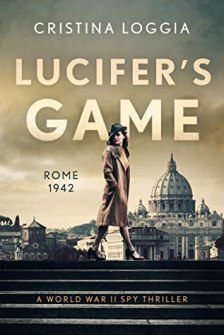 About the Book
 About the Author

 What Cathy Read Next...