Blog Tour/Extract: Dead Girls Can’t Lie by Carys Jones

Dead Girls Can't Lie - blog tour banner

I’m delighted to be one of the hosts for today’s stop on the blog tour for Dead Girls Can’t Lie by Carys Jones, bestselling author of Wrong Number and Last Witness.  I’m thrilled to be able to give you a sneak peak of the book.  Do check out the post of my co-host, the lovely Kaisha at The Writing Garnet.

Follow my blog with Bloglovin


DeadGirlsCan'tLieAbout the Book

Best friends tell each other the truth – don’t they?

When North Stone’s best friend Kelly Orton is found hanging lifeless in a tree, North knows for certain it wasn’t suicide. Kelly had everything to live for – a loving boyfriend, a happy life, and most importantly of all, Kelly would never leave North all by herself. The girls have been friends since childhood, devoted to each other, soul sisters, or at least that’s what North has always believed. But did Kelly feel the same way, or was she keeping secrets from her ‘best friend’ – deadly secrets…

When the police refuse to take North’s suspicions seriously, she sets out to investigate for herself. But her search soon takes her to a glamorous world with a seedy underbelly, and before long North is out of her depth and getting ever closer to danger. Determined to find the truth, she soon wishes that dead girls could lie, because the truth is too painful to believe…

Format: ebook Publisher: Aria Pages: 330
Publication: 15th Aug 2017 Genre: Thriller    

Purchase links*
Amazon.co.uk ǀ Amazon.com ǀ Kobo ǀ Google Play ǀ iTunes
*links provided for convenience, not as part of any affiliate programme

To purchase Carys’ previous novels, Wrong Number and Last Witness, from Amazon click here

Find Dead Girls Can’t Lie on Goodreads


Excerpt: Dead Girls Can’t Lie by Carys Jones

Kelly didn’t kill herself.

The message arrived shortly after midnight when North was caught somewhere between sleep and surrender. Blurry-eyed she stared at her phone, at the cryptic message from an unknown sender. ‘I know,’ she whispered to the device as she lay on her sofa, bathed in the glow from her television which was on its second run through of Dark Crystal. ‘I know she’d never leave me.’

By dawn North was completely awake and the message was gone, wiped from her phone as though it were the fragment of a dream. But North didn’t care. It had given her the impetus she needed to get out of her flat and prove the point which had been gnawing at her since her best friend’s demise. She wasn’t alone in her conviction. That was all that mattered.

***

‘North Stone. That your name?’

‘Yes,’ North tightened her fingers which were clenched around her hands. It was cold in the interview room. Colder than she’d expected.

‘North. That’s an… interesting name.’

With a sigh she braced herself for the inevitable volley of questions which would now be flung back and forth across the table.

Why North?  Why did your parents call you that?  Where are your parents?

The conclusion to such questions was always the same; North was strange. Everyone in their small South Downs town knew it. Everyone except Kelly. And she was the reason that North was even here. They were supposed to be talking about her.

 ‘My parents were mega into stargazing. I know, I know, I work in the local observatory the irony of which isn’t lost on me. Yes they were lost at sea during a romantic adventure on board a yacht. No I don’t expect them to ever return. It’s been eighteen years, I’m pretty sure they’re gone.’

The police officer’s silver eyebrows dropped into a flat, sympathetic line. He was obviously old enough to know the notorious story of what happened to the Stones. He was asking about her name to be polite. Kind even. And North did not have time for either placation. She was here on urgent business.

‘Look,’ North unclasped her hands and lay them flat on the table as though she were showing her cards in a high stakes poker game. ‘You’re wrong about Kelly Orton. She would never kill herself.’

‘Miss Stone—’

The officer hung a little too heavily on the Miss for North’s liking.

‘And on a jogging trail? Absolutely not! No way! For starters, Kelly never went jogging. Like, ever. We’re both allergic to anything that makes you sweat. Seriously, Officer…’ she lifted her ashen eyes to meet his.

‘Childs,’ he stiffly informed her.

‘Officer Childs. You’re wrong about Kelly. You guys shouldn’t be ruling this as a suicide you should be launching a murder investigation.’

With a sigh, Officer Childs stood up, letting his chair grate noisily against the tiled floors. He walked over to the door to the interview room and opened it with one fluid motion, extending his body out into the hallway. ‘Angie, can you get in here?’

A moment later he was joined by another officer, a woman with bright red hair which stopped suddenly at her shoulders. Her mouth lifted into a pitying smile the second she saw North hunched on the other side of the table.

The air in the little room managed to hold the years’ old stench of stale cigarettes and coffee. A single strip light across the ceiling bathed everyone who sat in there in an unflattering light. Kelly would have hated it. She’d have tossed her golden hair over her shoulders and refused to sit in such a room. North twisted uncomfortably on her plastic chair.

‘I’ll handle this,’ Angie whispered to Officer Childs who eagerly left as she slid into his vacated seat. ‘So, Miss Stone.’ Her tone was clipped and formal. She reminded North of some of her more competent teachers during her time at Millwater Secondary. But thinking about school made her think of the Kelly from the past and she couldn’t do that. Not yet. Not when there were so many questions about the present left unanswered.

‘As I was telling your colleague,’ North adjusted herself to match the female officer in stature. Though she was much shorter than Angie, she could still push her shoulders back and lift her chin. She wanted to look confident.


Jones_CarysAbout the Author

Carys Jones loves nothing more than to write and create stories which ignite the reader’s imagination. Based in Shropshire, England, Carys lives with her husband, two guinea pigs and her adored canine companion Rollo.

Connect with Carys

Website ǀ Facebook ǀ Twitter ǀ Goodreads ǀ Instagram


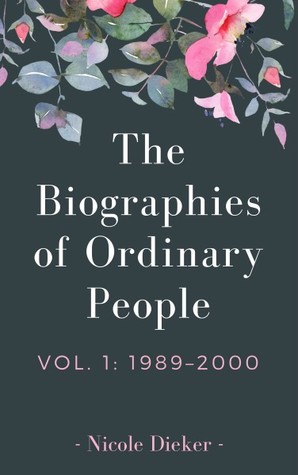
The Biographies of Ordinary People by Nicole Dieker

My second guest today is Nicole Dieker, author of The Biographies of Ordinary People, a two-volume series telling the story of one family over three decades. You can find an extract from Volume 1 below along with a fascinating guest post from Nicole about her inspiration for the book.

Follow my blog with Bloglovin


TheBiographiesofOrdinaryPeopleAbout the Book

The Biographies of Ordinary People is the story of the Gruber family: Rosemary and Jack, and their daughters Meredith, Natalie, and Jackie. The two-volume series begins in July 1989, on Rosemary’s thirty-fifth birthday; it ends in November 2016, on Meredith’s thirty-fifth birthday. When the Grubers move to a small Midwestern town so Jack can teach music at a local college, each family member has an idea of who they might become. Jack wants to foster intellectual curiosity in his students. Rosemary wants to be “the most important person in her own life for the length of an afternoon.” Meredith wants to model herself after the girls she’s read about in books: Betsy Ray, Pauline Fossil, Jo March. Natalie wants to figure out how she’s different from her sisters—and Jackie, the youngest, wants to sing. Set against the past thirty years of social and cultural changes, this story of family, friendship, and artistic ambition takes us into intimately familiar experiences: putting on a play, falling out with a best friend, getting dial-up internet for the first time. Drinking sparkling wine out of a paper cup on December 31, 1999 and wondering what will happen next.

Format: ebook Publisher: Pronoun Pages: 378
Publication: 23rd May 2017 Genre: Fiction

Purchase Links*
Amazon.co.uk ǀ Amazon.com ǀ Barnes & Noble
*links provided for convenience, not as part of any affiliate programme

Find The Biographies of Ordinary People on Goodreads


Guest Post: ‘Why I Wrote The Biographies of Ordinary People’ by Nicole Dieker

I don’t know about you, but I grew up reading novels that followed girls’ lives from childhood to adulthood: Little House on the Prairie, Anne of Green Gables, Ballet Shoes, Betsy-Tacy, Little Women. Although I read voraciously, in all genres, I kept coming back to these stories of girls growing up – even after I had grown up myself.

I used these novels as guides: I studied Pauline Fossil’s audition experiences before trying out for plays and read about Betsy Ray’s first dance before attending mine. When I got my first full-time job, I went back to Little Town on the Prairie and comforted myself with the knowledge that Laura Ingalls had also felt as shocked as I was; the repetition, the querulous bosses, the outside world that was now only glimpsed in sunrise and twilight.

So I knew, for years, that I wanted to write a book like that—but I wanted to set it in a contemporary time period.

The Biographies of Ordinary People tells the story of three sisters—Meredith, Natalie, and Jackie Gruber—growing up at the turn of the millennium. The book is not autobiography, but it draws from many of my own experiences. I grew up in a small Midwestern town, my parents were both musicians, and my life was as ordinary as Meredith’s: I went to the library, I acted out imagined narratives with my sister and my friends, I wrote stories.

Like Meredith—and like Pauline, Betsy, Anne, and Jo—I was also ambitious. The first volume of The Biographies of Ordinary People is about childhood, family, and learning who you might want to become. The second volume is about working towards those ambitions. I include the first chapter of Volume Two at the end of Volume One because it sets the tone for what is coming next: Meredith, about to graduate from college, asking a professor why they’ve only studied the lives of famous artists.

“Everything we’ve studied—in theater, and in my English classes, and in art history and music history and everything else—has been about famous people.”

“Okay,” Gina said, smiling. Sometimes Meredith looked at her and saw the person she hoped she might become, smart and calm and patient in an office surrounded by bookshelves that reached up to the ceiling. Meredith expected she would have students someday—it was one of the better ways for artists and writers to make money—and she thought about what she would put in her own office. The students who came to visit her might see all the books, memorize the titles, and look them up later, just like she had done.

“And then when we go to the library it’s the same thing. There are all these biographies of famous people and how they lived their lives, but most of us aren’t going to be famous. It’s like we’ve gotten these models for life that aren’t applicable.” Meredith didn’t need to think about how to phrase her thoughts, because she had planned them out before she climbed the stairs. “We’ve learned about all of these well-known artists and how they did their work, but we don’t ever study how the rest of us do it. Where are the biographies of ordinary people?”

Gina didn’t answer right away, and when she did she said “I don’t know,” and Meredith could tell that it wasn’t a question she had ever really thought about before. “There’s Studs Terkel—”

“Well, sure—”

“But that’s not what you mean. I’m not sure they exist. Maybe it’s something everyone has to figure out on their own.”

My series doesn’t offer all the answers. But I could see someone reading it the same way I read Betsy In Spite of Herself or Anne of Windy Poplars: to learn how another young woman figures it out, and to know that another person feels the same way they do.


Extract from The Biographies of Ordinary People, Vol 1 – Chapter 1

The last night before they left was Rosemary Gruber’s thirty-fifth birthday.

It had, of course, been her birthday since the morning, and the girls had duly remembered to call out “Happy birthday, mommy!” when they came out of the bedroom. Meredith did the bulk of the remembering, and had written it on her chart by the door, but after they were finished the chart came down and was thrown away, and Rosemary dug her nails gently at the bits of Scotch tape stuck to the hollow door’s wooden veneer, because they did not want to lose their security deposit. Jack had assumed they would lose it, with the three girls, but Rosemary knew better. Teach a child that food is only served at the table, and they’ll never try to eat it over the carpet. It hadn’t been like that in her house when she was a child, but she had made this home with her own words and will. (And now she was unmaking it and stacking it in boxes, and that chart was finally coming down.)

“Were you born on a Friday?” Meredith asked, as Rosemary brushed her hair.

“No,” Rosemary said. “I was born on a Saturday.” She was pretty sure of this. It sounded like it could be true. She was thinking about everything that still had to be finished before they left, and only partially thinking about Meredith’s hair, and it was a good thing the mirror had been packed away or her daughter would have noticed.

“Saturday’s child works hard for a living,” Meredith recited. That’s true enough, Rosemary thought, with the part of her mind that wasn’t worrying about packing and cleaning and whether it was worth it to bathe all three girls one more time before they left. “What day was I born on?” her daughter continued.

“Tuesday,” Rosemary said, and this she did remember, because she had been watching Laverne and Shirley in the hospital while she waited for her contractions to continue.

“Tuesday’s child is full of grace,” Meredith said, and smiled at herself, and at the idea of being graceful. It was a real smile, because Meredith was happy, not one of the posed ones she put on for pictures. Rosemary’s oldest daughter was not yet eight years old and she would tilt her head and widen her eyes whenever anyone pulled out a camera, imitating the child models she saw in Rosemary’s issues of Ladies’ Home Journal. Rosemary had thought about tossing the magazines out before Meredith could get to them, but her weirdo kid read everything that came into the house, often before Rosemary herself could read it. She’d be making dinner and the kids would have PBS on and Meredith wouldn’t be watching; she’d be squatting on the carpet in front of the sofa with one knee tucked under her chin, studying “Can This Marriage Be Saved?”

“What day was Natalie born on?” Meredith asked, and Rosemary said “Sunday,” because she remembered that day too—and then she suddenly remembered she was wrong about Meredith, that she had gone into the hospital on Tuesday but Meredith had been born at night, when it was Wednesday.

“Nat, hair,” Meredith called out, and Rosemary’s second daughter took her place in front of what would have been the mirror but was now just a blank wall, with a mom and her little girl cross-legged on the carpet and facing the empty space. Rosemary did not need to look in the mirror on her thirty-fifth birthday; she had not showered that day and probably wouldn’t until the evening, and she had stopped wearing makeup years ago, but she was still thin, and Jack smiled when he looked at her, and nobody else really looked at her besides her daughters.

“Sunday’s child—no, wait, the child that’s born on the Sabbath Day is blithe and bonny and good and gay,” Meredith sang, and Natalie echoed “blithe and bonny” the way she always imitated her sister, and Rosemary looked at her happy baby, the one who came home from preschool with stories about new friends and games, and thought again: true enough. Her middle daughter had Rosemary’s own golden-brown wavy hair, though the girls only knew that from photos because Rosemary had cut it all short right before Meredith was born. All three of her children had been born with hair that clustered in tiny dark sweatlocks, but Natalie’s hair was the only one to thicken and curl.

“Blithe and bonny,” Natalie continued to sing, turning the words into nonsense, and Rosemary could see Meredith stiffen slightly with frustration. The two of them were close, but Meredith very much wanted to be her own person. The nursery rhyme was something she had memorized.

“When was Jackie born?” Meredith asked, over Natalie’s song.

“I don’t remember,” Rosemary said, even though it would have been easy enough to count backwards; Jackie had just turned three a few weeks ago. On a Tuesday.

“We don’t know who you are yet,” Meredith said to Jackie, and Rosemary thought this was also true; she was pretty sure she knew who her two older daughters were, but Jackie was still toddling between babyhood and personality. Watching the two girls who had already gone ahead of her and figuring out how she was going to be similar to—and different from—them.


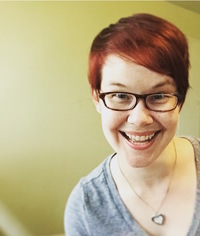
NicoleDiekerAbout the Author

Nicole Dieker is a freelance writer, a senior editor at The Billfold, and a columnist at The Write Life. Her work has appeared in Boing Boing, Popular Science, Scratch, SparkLife, The Freelancer, The Toast, and numerous other publications. The Biographies of Ordinary People is her debut novel, if you don’t count the speculative fiction epic she wrote when she was in high school.

Connect with Nicole

Website ǀ   Twitter ǀ Goodreads